Q59X94
Gene name |
CCP2 (CAALFM_C500810CA, CaO19.584, CaO19.8216) |
Protein name |
Putative heme-binding peroxidase |
Names |
|
Species |
Candida albicans (strain SC5314 / ATCC MYA-2876) (Yeast) |
KEGG Pathway |
cal:CAALFM_C500810CA |
EC number |
|
Protein Class |
|
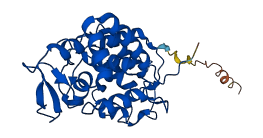
Descriptions
The autoinhibited protein was predicted that may have potential autoinhibitory elements via cis-regPred.
Autoinhibitory domains (AIDs)
Target domain |
|
Relief mechanism |
|
Assay |
cis-regPred |
Accessory elements
No accessory elements
Autoinhibited structure

Activated structure
1 structures for Q59X94
| Entry ID | Method | Resolution | Chain | Position | Source |
|---|---|---|---|---|---|
| AF-Q59X94-F1 | Predicted | AlphaFoldDB |
No variants for Q59X94
| Variant ID(s) | Position | Change | Description | Diseaes Association | Provenance |
|---|---|---|---|---|---|
| No variants for Q59X94 | |||||
No associated diseases with Q59X94
No GO annotations of cellular component
| Name | Definition |
|---|---|
| No GO annotations for cellular component |
3 GO annotations of molecular function
| Name | Definition |
|---|---|
| heme binding | Binding to a heme, a compound composed of iron complexed in a porphyrin (tetrapyrrole) ring. |
| metal ion binding | Binding to a metal ion. |
| peroxidase activity | Catalysis of the reaction: a donor + a peroxide = an oxidized donor + 2 H2O. |
3 GO annotations of biological process
| Name | Definition |
|---|---|
| cellular response to oxidative stress | Any process that results in a change in state or activity of a cell (in terms of movement, secretion, enzyme production, gene expression, etc.) as a result of oxidative stress, a state often resulting from exposure to high levels of reactive oxygen species, e.g. superoxide anions, hydrogen peroxide (H2O2), and hydroxyl radicals. |
| hydrogen peroxide catabolic process | The chemical reactions and pathways resulting in the breakdown of hydrogen peroxide (H2O2). |
| response to reactive oxygen species | Any process that results in a change in state or activity of a cell or an organism (in terms of movement, secretion, enzyme production, gene expression, etc.) as a result of a reactive oxygen species stimulus. Reactive oxygen species include singlet oxygen, superoxide, and oxygen free radicals. |
No homologous proteins in AiPD
| UniProt AC | Gene Name | Protein Name | Species | Evidence Code |
|---|---|---|---|---|
| No homologous proteins | ||||
| 10 | 20 | 30 | 40 | 50 | 60 |
| MIRSYIRNII | LAILSPLLTT | PPPLILPPPY | EKIIQEITTV | LSINNYDDGS | LAPIILRLAW |
| 70 | 80 | 90 | 100 | 110 | 120 |
| HCCATYDMTT | NTGGSNGATM | RFVPEITDEG | NYGLDIARAA | LEPIKQRYPA | ISYADLWTLA |
| 130 | 140 | 150 | 160 | 170 | 180 |
| GKVAIEYMGG | PTIIWKSGRV | DYTNDRCTPS | NGLLPFADKD | ANHIRKTFTR | LGYNDQQTVA |
| 190 | 200 | 210 | 220 | 230 | 240 |
| LIGAHGVGRC | HKRFSGWEGK | WTRTPKTFSN | QFYVVLLNET | WSQGEVPETG | KTQYFNADKS |
| 250 | 260 | 270 | 280 | 290 | |
| LIMLNTDMEL | IRDKSYLHWV | EIYAKDEPKF | FHDFSSAFAK | LLELGIKRET | L |