Q59WF4
Gene name |
MNN2 (MNN25, MNN5, CAALFM_C110720CA, CaO19.2347, CaO19.9883) |
Protein name |
Alpha-1,2-mannosyltransferase MNN2 |
Names |
|
Species |
Candida albicans (strain SC5314 / ATCC MYA-2876) (Yeast) |
KEGG Pathway |
cal:CAALFM_C110720CA |
EC number |
|
Protein Class |
|
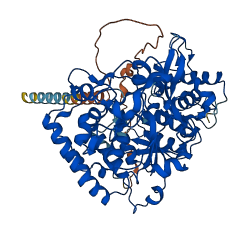
Descriptions
The autoinhibited protein was predicted that may have potential autoinhibitory elements via cis-regPred.
Autoinhibitory domains (AIDs)
Target domain |
|
Relief mechanism |
|
Assay |
cis-regPred |
Accessory elements
No accessory elements
Autoinhibited structure

Activated structure
1 structures for Q59WF4
| Entry ID | Method | Resolution | Chain | Position | Source |
|---|---|---|---|---|---|
| AF-Q59WF4-F1 | Predicted | AlphaFoldDB |
No variants for Q59WF4
| Variant ID(s) | Position | Change | Description | Diseaes Association | Provenance |
|---|---|---|---|---|---|
| No variants for Q59WF4 | |||||
No associated diseases with Q59WF4
No regional properties for Q59WF4
| Type | Name | Position | InterPro Accession |
|---|---|---|---|
| No domain, repeats, and functional sites for Q59WF4 | |||
3 GO annotations of cellular component
| Name | Definition |
|---|---|
| Golgi apparatus | A membrane-bound cytoplasmic organelle of the endomembrane system that further processes the core oligosaccharides (e.g. N-glycans) added to proteins in the endoplasmic reticulum and packages them into membrane-bound vesicles. The Golgi apparatus operates at the intersection of the secretory, lysosomal, and endocytic pathways. |
| Golgi membrane | The lipid bilayer surrounding any of the compartments of the Golgi apparatus. |
| integral component of membrane | The component of a membrane consisting of the gene products and protein complexes having at least some part of their peptide sequence embedded in the hydrophobic region of the membrane. |
1 GO annotations of molecular function
| Name | Definition |
|---|---|
| alpha-1,2-mannosyltransferase activity | Catalysis of the transfer of a mannose residue to an oligosaccharide, forming an alpha-(1->2) linkage. |
10 GO annotations of biological process
| Name | Definition |
|---|---|
| cellular response to starvation | Any process that results in a change in state or activity of a cell (in terms of movement, secretion, enzyme production, gene expression, etc.) as a result of deprivation of nourishment. |
| filamentous growth | The process in which a multicellular organism, a unicellular organism or a group of unicellular organisms grow in a threadlike, filamentous shape. |
| filamentous growth of a population of unicellular organisms | The process in which a group of unicellular organisms grow in a threadlike, filamentous shape. |
| filamentous growth of a population of unicellular organisms in response to biotic stimulus | The process in which a group of unicellular organisms grow in a threadlike, filamentous shape in response to a biotic (living) stimulus. |
| filamentous growth of a population of unicellular organisms in response to neutral pH | The process in which a group of unicellular organisms grow in a threadlike, filamentous shape in response to a neutral pH (pH close to 7) stimulus. |
| filamentous growth of a population of unicellular organisms in response to starvation | The process in which a group of unicellular organisms grow in a threadlike, filamentous shape in response to deprivation of nourishment. |
| iron ion transmembrane transport | A process in which an iron ion is transported from one side of a membrane to the other by means of some agent such as a transporter or pore. |
| mannan biosynthetic process | The chemical reactions and pathways resulting in the formation of mannan, the main hemicellulose of soft (coniferous) wood, made up of D-mannose, D-glucose and D-galactose. |
| protein glycosylation | A protein modification process that results in the addition of a carbohydrate or carbohydrate derivative unit to a protein amino acid, e.g. the addition of glycan chains to proteins. |
| protein mannosylation | The addition of a mannose residue to a protein acceptor molecule. |
No homologous proteins in AiPD
| UniProt AC | Gene Name | Protein Name | Species | Evidence Code |
|---|---|---|---|---|
| No homologous proteins | ||||
| 10 | 20 | 30 | 40 | 50 | 60 |
| MIAKQKIKIL | IGVIIVIATY | HFIVSSNVRS | KDLSDLVDLG | SSDKSTTENE | RPKNNIVTNN |
| 70 | 80 | 90 | 100 | 110 | 120 |
| RLDNPPNEDI | PHAEPDSPPQ | EPPKSGNKPD | FSIFFEGLEK | FAIKQPGIKD | KYTSEKAKEK |
| 130 | 140 | 150 | 160 | 170 | 180 |
| FSTDDNFLFG | KEYLENVLDI | PQATFKELKD | SHKRYVDEHI | PKMLQRVKTF | GSLAPSDKEW |
| 190 | 200 | 210 | 220 | 230 | 240 |
| ESYKGSSGYI | IVGGGRFTWL | SFLVIKQLRA | TGAKLPVEMF | IATESDYEKE | FCEKVLPKYN |
| 250 | 260 | 270 | 280 | 290 | 300 |
| ARCNVFDYKL | ADDLKKRFDI | GGYQYKMLAL | LSSKFENVLY | LDSDNFPTRN | VDYLFESDLY |
| 310 | 320 | 330 | 340 | 350 | 360 |
| KENNLLLWPD | AWARTTNPKY | YEIAGVPVKE | NKLRYSKYDE | KQAGGKDKLK | PLSEYTFKDS |
| 370 | 380 | 390 | 400 | 410 | 420 |
| WYHDFEGTLP | DPTSETGMFM | VNKSSHLKTL | LLCLYYNVFG | PQYYYPLLTQ | GSAGEGDKET |
| 430 | 440 | 450 | 460 | 470 | 480 |
| FIAAAHVMKE | PWYQCARQFK | WTGYVSKVDN | KFTSKALAHY | DPVQAQDTTR | QDVDIIFMHL |
| 490 | 500 | 510 | 520 | 530 | 540 |
| SYPKFYPNWL | ADNHDLVYAD | TDEHIRMYSS | INKNVGYDFD | LRVMQFFTEG | LCPNYYDSKT |
| 550 | 560 | 570 | 580 | 590 | |
| GKPIENIPHI | DYTNDYMGNH | LMYVKDEEQN | NIDRCNKVFI | PHLKWLKETA | EIPTVVS |