Q59NG5
Gene name |
MUS81 (CAALFM_C600540WA, CaO19.11682, CaO19.4206) |
Protein name |
Crossover junction endonuclease MUS81 |
Names |
|
Species |
Candida albicans (strain SC5314 / ATCC MYA-2876) (Yeast) |
KEGG Pathway |
cal:CAALFM_C600540WA |
EC number |
|
Protein Class |
|
Descriptions
The autoinhibited protein was predicted that may have potential autoinhibitory elements via cis-regPred.
Autoinhibitory domains (AIDs)
Target domain |
|
Relief mechanism |
|
Assay |
cis-regPred |
Accessory elements
No accessory elements
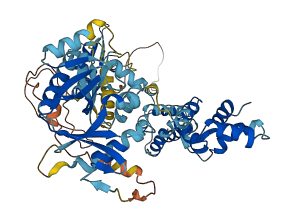
Autoinhibited structure

Activated structure
1 structures for Q59NG5
| Entry ID | Method | Resolution | Chain | Position | Source |
|---|---|---|---|---|---|
| AF-Q59NG5-F1 | Predicted | AlphaFoldDB |
No variants for Q59NG5
| Variant ID(s) | Position | Change | Description | Diseaes Association | Provenance |
|---|---|---|---|---|---|
| No variants for Q59NG5 | |||||
No associated diseases with Q59NG5
3 GO annotations of cellular component
| Name | Definition |
|---|---|
| Holliday junction resolvase complex | An endodeoxyribonuclease complex that resolves the 4-way DNA intermediates of a Holliday junction into two separate duplex DNA molecules. Can be branch-migration associated. |
| nuclear replication fork | The Y-shaped region of a nuclear replicating DNA molecule, resulting from the separation of the DNA strands and in which the synthesis of new strands takes place. Also includes associated protein complexes. |
| nucleus | A membrane-bounded organelle of eukaryotic cells in which chromosomes are housed and replicated. In most cells, the nucleus contains all of the cell's chromosomes except the organellar chromosomes, and is the site of RNA synthesis and processing. In some species, or in specialized cell types, RNA metabolism or DNA replication may be absent. |
5 GO annotations of molecular function
| Name | Definition |
|---|---|
| 3'-flap endonuclease activity | Catalysis of the cleavage of a 3' flap structure in DNA, but not other DNA structures; processes the 3' ends of Okazaki fragments in lagging strand DNA synthesis. |
| crossover junction endodeoxyribonuclease activity | Catalysis of the endonucleolytic cleavage at a junction such as a reciprocal single-stranded crossover between two homologous DNA duplexes (Holliday junction). |
| DNA binding | Any molecular function by which a gene product interacts selectively and non-covalently with DNA (deoxyribonucleic acid). |
| enzyme inhibitor activity | Binds to and stops, prevents or reduces the activity of an enzyme. |
| metal ion binding | Binding to a metal ion. |
7 GO annotations of biological process
| Name | Definition |
|---|---|
| DNA catabolic process, endonucleolytic | The chemical reactions and pathways resulting in the breakdown of DNA, involving the hydrolysis of internal 3',5'-phosphodiester bonds in one or two strands of deoxyribonucleotides. |
| DNA topological change | The process in which a transformation is induced in the topological structure of a double-stranded DNA helix, resulting in a change in linking number. |
| double-strand break repair via break-induced replication | The error-free repair of a double-strand break in DNA in which the centromere-proximal end of a broken chromosome searches for a homologous region in an intact chromosome. DNA synthesis initiates from the 3' end of the invading DNA strand, using the intact chromosome as the template, and progresses to the end of the chromosome. |
| filamentous growth of a population of unicellular organisms | The process in which a group of unicellular organisms grow in a threadlike, filamentous shape. |
| mitotic intra-S DNA damage checkpoint signaling | A mitotic cell cycle checkpoint that slows DNA synthesis in response to DNA damage by the prevention of new origin firing and the stabilization of slow replication fork progression. |
| negative regulation of helicase activity | Any process that stops or reduces the activity of a helicase. |
| resolution of meiotic recombination intermediates | The cleavage and rejoining of intermediates, such as Holliday junctions, formed during meiotic recombination to produce two intact molecules in which genetic material has been exchanged. |
No homologous proteins in AiPD
| UniProt AC | Gene Name | Protein Name | Species | Evidence Code |
|---|---|---|---|---|
| No homologous proteins | ||||
| 10 | 20 | 30 | 40 | 50 | 60 |
| MSVVNDDFKP | LLIQWVEEEA | INATKRGSKM | VDLYNKILFQ | LRGYELPICD | LKTLKSIKYV |
| 70 | 80 | 90 | 100 | 110 | 120 |
| GDKTANQLRK | KIAKHCKENE | LTLPRGFMDV | AEKHRLDLEE | SNLTSSTSTI | KTTNKRAKTS |
| 130 | 140 | 150 | 160 | 170 | 180 |
| SKSKPKYVPK | HRSGGFAILI | ALYLYDKDRN | GMTKERIIAG | ATPYCDRSFS | NNAASKEFYS |
| 190 | 200 | 210 | 220 | 230 | 240 |
| AWSSAKTLEN | HNLISTTGRS | PKIYFLTDEG | VSLAQQLKTA | IGLSSPPEGS | KKNDRNMIME |
| 250 | 260 | 270 | 280 | 290 | 300 |
| QSFDNGIRLD | TSFELSSPAG | RAMLSSSPIR | RISNPVHSNR | AIQKMLEKEL | RNGETPPSSQ |
| 310 | 320 | 330 | 340 | 350 | 360 |
| HDAGNRIYDG | IKYEVWRKED | YEVIVYMDNR | EIRSRADRDH | FQTRLQTLGV | KCEVKPLSSG |
| 370 | 380 | 390 | 400 | 410 | 420 |
| DVLWVGRNTS | TGTEAVLNYL | CERKRLDDLC | DSIKDGRFQE | QKNRMKKTGI | KHCYYLVEDM |
| 430 | 440 | 450 | 460 | 470 | 480 |
| VSYQDKVYDL | MDSIQSSLTQ | TMTTARLYLR | RFKDIDETTA | FIASNTKVIE | NLKSNLIVIK |
| 490 | 500 | 510 | 520 | 530 | 540 |
| PQDIKNQQDY | LNILLKFRNK | FEKTQPHQDN | PDYECVQLFS | RFQDMLGKTN | QMTVKEMFIL |
| 550 | 560 | 570 | 580 | 590 | 600 |
| MLMTIRGVSL | EKAVVIQNRF | PTPKSLLEYY | HTEHATTDTN | IKRDLMMNEF | KDQIGNKKIG |
| 610 | |||||
| KALSEKIYNV | WGKP |