Q58841
Gene name |
pyrK |
Protein name |
Probable dihydroorotate dehydrogenase B (NAD(+)), electron transfer subunit |
Names |
Dihydroorotate oxidase B, electron transfer subunit |
Species |
Methanocaldococcus jannaschii (strain ATCC 43067 / DSM 2661 / JAL-1 / JCM 10045 / NBRC 100440) (Methanococcus jannaschii) |
KEGG Pathway |
mja:MJ_1446 |
EC number |
|
Protein Class |
|
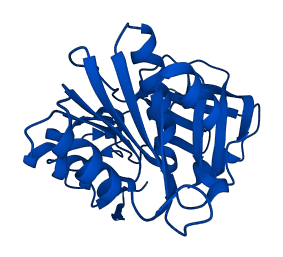
Descriptions
The autoinhibited protein was predicted that may have potential autoinhibitory elements via cis-regPred.
Autoinhibitory domains (AIDs)
Target domain |
|
Relief mechanism |
|
Assay |
cis-regPred |
Accessory elements
No accessory elements
Autoinhibited structure

Activated structure
1 structures for Q58841
| Entry ID | Method | Resolution | Chain | Position | Source |
|---|---|---|---|---|---|
| AF-Q58841-F1 | Predicted | AlphaFoldDB |
No variants for Q58841
| Variant ID(s) | Position | Change | Description | Diseaes Association | Provenance |
|---|---|---|---|---|---|
| No variants for Q58841 | |||||
No associated diseases with Q58841
3 regional properties for Q58841
No GO annotations of cellular component
| Name | Definition |
|---|---|
| No GO annotations for cellular component |
4 GO annotations of molecular function
| Name | Definition |
|---|---|
| 2 iron, 2 sulfur cluster binding | Binding to a 2 iron, 2 sulfur (2Fe-2S) cluster; this cluster consists of two iron atoms, with two inorganic sulfur atoms found between the irons and acting as bridging ligands. |
| electron transfer activity | Any molecular entity that serves as an electron acceptor and electron donor in an electron transport chain. An electron transport chain is a process in which a series of electron carriers operate together to transfer electrons from donors to any of several different terminal electron acceptors to generate a transmembrane electrochemical gradient. |
| flavin adenine dinucleotide binding | Binding to FAD, flavin-adenine dinucleotide, the coenzyme or the prosthetic group of various flavoprotein oxidoreductase enzymes, in either the oxidized form, FAD, or the reduced form, FADH2. |
| metal ion binding | Binding to a metal ion. |
1 GO annotations of biological process
| Name | Definition |
|---|---|
| 'de novo' UMP biosynthetic process | The chemical reactions and pathways resulting in the formation of UMP, uridine monophosphate, starting with the synthesis of (S)-dihydroorotate from bicarbonate; UMP biosynthesis may either occur via reduction by quinone, NAD(+) or oxygen. |
No homologous proteins in AiPD
| UniProt AC | Gene Name | Protein Name | Species | Evidence Code |
|---|---|---|---|---|
| No homologous proteins | ||||
| 10 | 20 | 30 | 40 | 50 | 60 |
| MEKPVICRIK | EIIEESPTVK | TFVVDKDFDF | KPGQFAMLWL | PGVDEKPFGF | SSKNSFSVAR |
| 70 | 80 | 90 | 100 | 110 | 120 |
| VGEFTKKMHE | LKEGDIIGVR | GPYGTYFEPI | GDKVLAVAGG | IGAAPIITAV | EEFSKQGIEI |
| 130 | 140 | 150 | 160 | 170 | 180 |
| TTILGARTKE | ELLFLDRFEK | VSRLEICTDD | GSFGFKGFTT | EKMKEVLKEE | KFDLIITCGP |
| 190 | 200 | 210 | 220 | 230 | 240 |
| EIMMKKVVEI | ANEYNIPVQV | SMERYMKCGI | GICGQCCVDD | EGLCVCKDGP | VFWGDKLKFI |
| 250 | |||||
| REFGKYKRDA | SGKKIYY |