Q57527
Gene name |
HI_1170 |
Protein name |
Uncharacterized PabA-like protein HI_1170 |
Names |
|
Species |
Haemophilus influenzae (strain ATCC 51907 / DSM 11121 / KW20 / Rd) |
KEGG Pathway |
hin:HI_1170 |
EC number |
|
Protein Class |
|
Descriptions
The autoinhibited protein was predicted that may have potential autoinhibitory elements via cis-regPred.
Autoinhibitory domains (AIDs)
Target domain |
|
Relief mechanism |
|
Assay |
cis-regPred |
Accessory elements
No accessory elements
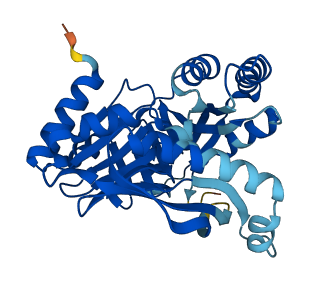
Autoinhibited structure

Activated structure
1 structures for Q57527
| Entry ID | Method | Resolution | Chain | Position | Source |
|---|---|---|---|---|---|
| AF-Q57527-F1 | Predicted | AlphaFoldDB |
No variants for Q57527
| Variant ID(s) | Position | Change | Description | Diseaes Association | Provenance |
|---|---|---|---|---|---|
| No variants for Q57527 | |||||
No associated diseases with Q57527
1 regional properties for Q57527
| Type | Name | Position | InterPro Accession |
|---|---|---|---|
| domain | Chorismate-utilising enzyme, C-terminal | 76 - 319 | IPR015890 |
1 GO annotations of cellular component
| Name | Definition |
|---|---|
| cytoplasm | The contents of a cell excluding the plasma membrane and nucleus, but including other subcellular structures. |
1 GO annotations of molecular function
| Name | Definition |
|---|---|
| 4-amino-4-deoxychorismate synthase activity | Catalysis of the reaction: L-glutamine + chorismate = 4-amino-4-deoxychorismate + L-glutamate. It is composed of two enzymatic activities (which may be present on one or two polypeptides); the first is a glutaminase which yields ammonia from glutamine, releasing glutamate. The ammonia is used by the second activity which catalyzes the amination of chorismate to form 4-amino-4-deoxychorismate. |
1 GO annotations of biological process
| Name | Definition |
|---|---|
| para-aminobenzoic acid biosynthetic process | The chemical reactions and pathways resulting in the formation of para-aminobenzoic acid, an intermediate in the synthesis of folic acid, a compound which some organisms, e.g. prokaryotes, eukaryotic microbes, and plants, can synthesize de novo. Others, notably mammals, cannot. In yeast, it is present as a factor in the B complex of vitamins. |
No homologous proteins in AiPD
| UniProt AC | Gene Name | Protein Name | Species | Evidence Code |
|---|---|---|---|---|
| No homologous proteins | ||||
| 10 | 20 | 30 | 40 | 50 | 60 |
| MAQSTMQHFI | EQANHYGKQR | TPFFFLIDFE | KEKPLICPLE | NSAQQGIYFD | ILGKRNCTIS |
| 70 | 80 | 90 | 100 | 110 | 120 |
| PRPLPLNFTK | HPMPFSHYQQ | GFKLVQSELQ | KGNSYLLNLT | YPTEISGNLS | LEQIFHQTNA |
| 130 | 140 | 150 | 160 | 170 | 180 |
| PYKLWLQDQF | VCFSPECFVN | IHDNNIFTYP | MKGTINATLP | DAENQLLTNE | KEQREHYTIV |
| 190 | 200 | 210 | 220 | 230 | 240 |
| DLMRNDLSMV | AEHIQVKKFR | YIDRIKTQKG | KILQTSSEIY | GKLNENWQNQ | IGDILATLLP |
| 250 | 260 | 270 | 280 | 290 | 300 |
| AGSISGAPKE | KTTQIIQQAE | KQKRGYYTGI | FGIFDGKTLQ | SAVAIRFISQ | VDEKFYFHSG |
| 310 | 320 | ||||
| GGITIHSNAQ | DEYEELLEKV | YLPIEGAD |