Q56YN8
Gene name |
SMC3 (TTN7, At2g27170, T22O13.6) |
Protein name |
Structural maintenance of chromosomes protein 3 |
Names |
SMC protein 3, SMC-3, Chromosome segregation protein SMC-3, Cohesin complex subunit SMC-3, Protein TITAN7 |
Species |
Arabidopsis thaliana (Mouse-ear cress) |
KEGG Pathway |
ath:AT2G27170 |
EC number |
|
Protein Class |
|
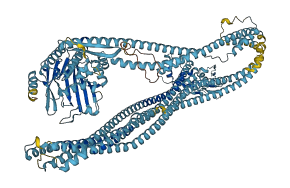
Descriptions
The autoinhibited protein was predicted that may have potential autoinhibitory elements via cis-regPred.
Autoinhibitory domains (AIDs)
Target domain |
|
Relief mechanism |
|
Assay |
cis-regPred |
Accessory elements
No accessory elements
Autoinhibited structure

Activated structure
1 structures for Q56YN8
| Entry ID | Method | Resolution | Chain | Position | Source |
|---|---|---|---|---|---|
| AF-Q56YN8-F1 | Predicted | AlphaFoldDB |
53 variants for Q56YN8
| Variant ID(s) | Position | Change | Description | Diseaes Association | Provenance |
|---|---|---|---|---|---|
| ENSVATH05603805 | 58 | S>C | No | 1000Genomes | |
| tmp_2_11616404_A_T | 81 | V>E | No | 1000Genomes | |
| ENSVATH00250828 | 229 | D>E | No | 1000Genomes | |
| tmp_2_11615127_G_C | 236 | R>G | No | 1000Genomes | |
| ENSVATH05603782 | 245 | A>T | No | 1000Genomes | |
| ENSVATH05603780 | 256 | M>T | No | 1000Genomes | |
| ENSVATH13428081 | 260 | V>L | No | 1000Genomes | |
| ENSVATH13428079 | 289 | E>K | No | 1000Genomes | |
| ENSVATH05603778 | 292 | E>K | No | 1000Genomes | |
| tmp_2_11614681_T_C | 297 | K>E | No | 1000Genomes | |
| ENSVATH13428078 | 306 | E>D | No | 1000Genomes | |
| tmp_2_11614644_A_T | 309 | V>E | No | 1000Genomes | |
| ENSVATH05603765 | 353 | S>G | No | 1000Genomes | |
| tmp_2_11614297_C_T | 364 | R>K | No | 1000Genomes | |
| tmp_2_11613662_G_A | 422 | R>C | No | 1000Genomes | |
| ENSVATH05603755 | 437 | H>Y | No | 1000Genomes | |
| tmp_2_11613607_T_C | 440 | E>G | No | 1000Genomes | |
| tmp_2_11613580_G_A | 449 | S>F | No | 1000Genomes | |
| ENSVATH05603753 | 482 | E>Q | No | 1000Genomes | |
| ENSVATH05603752 | 488 | T>A | No | 1000Genomes | |
| tmp_2_11612992_C_T | 544 | V>I | No | 1000Genomes | |
| tmp_2_11612763_G_A | 587 | P>S | No | 1000Genomes | |
| ENSVATH13428054 | 599 | P>L | No | 1000Genomes | |
| ENSVATH05603732 | 711 | L>F | No | 1000Genomes | |
| tmp_2_11611969_T_G | 743 | I>L | No | 1000Genomes | |
| tmp_2_11611968_A_C | 743 | I>S | No | 1000Genomes | |
| ENSVATH05603729 | 751 | G>A | No | 1000Genomes | |
| ENSVATH14559125 | 775 | L>F | No | 1000Genomes | |
| tmp_2_11611742_C_G | 785 | E>Q | No | 1000Genomes | |
| tmp_2_11611691_A_T | 802 | F>I | No | 1000Genomes | |
| ENSVATH13428023 | 834 | Q>H | No | 1000Genomes | |
| tmp_2_11611374_C_T | 850 | G>D | No | 1000Genomes | |
| ENSVATH05603723 | 862 | S>L | No | 1000Genomes | |
| ENSVATH01906017 | 884 | I>V | No | 1000Genomes | |
| tmp_2_11611161_T_C | 886 | K>E | No | 1000Genomes | |
| tmp_2_11611028_T_G | 906 | Q>H | No | 1000Genomes | |
| tmp_2_11611026_T_C | 907 | D>G | No | 1000Genomes | |
| ENSVATH00250824 | 917 | S>T | No | 1000Genomes | |
| ENSVATH13428017 | 919 | R>H | No | 1000Genomes | |
| ENSVATH14559112 | 921 | T>M | No | 1000Genomes | |
| tmp_2_11610689_A_T | 951 | N>K | No | 1000Genomes | |
| ENSVATH05603711 | 951 | N>T | No | 1000Genomes | |
| ENSVATH13428002 | 959 | L>V | No | 1000Genomes | |
| tmp_2_11610420_C_T | 1014 | R>Q | No | 1000Genomes | |
| tmp_2_11610369_C_T | 1031 | R>K | No | 1000Genomes | |
| ENSVATH01906011 | 1055 | N>H | No | 1000Genomes | |
| ENSVATH05603695 | 1066 | G>D | No | 1000Genomes | |
| ENSVATH14559106 | 1086 | S>T | No | 1000Genomes | |
| tmp_2_11609652_T_A | 1094 | Q>H | No | 1000Genomes | |
| tmp_2_11609483_C_T | 1151 | D>N | No | 1000Genomes | |
| ENSVATH05603691 | 1152 | Y>F | No | 1000Genomes | |
| ENSVATH05603688 | 1169 | A>T | No | 1000Genomes | |
| ENSVATH05603686 | 1188 | S>L | No | 1000Genomes |
No associated diseases with Q56YN8
Functions
8 GO annotations of cellular component
| Name | Definition |
|---|---|
| chromatin | The ordered and organized complex of DNA, protein, and sometimes RNA, that forms the chromosome. |
| chromosome, centromeric region | The region of a chromosome that includes the centromeric DNA and associated proteins. In monocentric chromosomes, this region corresponds to a single area of the chromosome, whereas in holocentric chromosomes, it is evenly distributed along the chromosome. |
| cohesin complex | A protein complex that is required for sister chromatid cohesion in eukaryotes. The cohesin complex forms a molecular ring complex, and is composed of structural maintenance of chromosomes (SMC) and kleisin proteins. For example, in yeast, the complex is composed of the SMC proteins Smc1p and Smc3p, and the kleisin protein Scc1p. In vertebrates, the complex is composed of the SMC1 (SMC1A or SMC1B) and SMC3 heterodimer attached via their hinge domains to a kleisin (RAD21, REC8 or RAD21L) which links them, and one STAG protein (STAG1, STAG2 or STAG3). |
| cytoplasm | The contents of a cell excluding the plasma membrane and nucleus, but including other subcellular structures. |
| nuclear matrix | The dense fibrillar network lying on the inner side of the nuclear membrane. |
| nucleus | A membrane-bounded organelle of eukaryotic cells in which chromosomes are housed and replicated. In most cells, the nucleus contains all of the cell's chromosomes except the organellar chromosomes, and is the site of RNA synthesis and processing. In some species, or in specialized cell types, RNA metabolism or DNA replication may be absent. |
| plasmodesma | A fine cytoplasmic channel, found in all higher plants, that connects the cytoplasm of one cell to that of an adjacent cell. |
| spindle | The array of microtubules and associated molecules that forms between opposite poles of a eukaryotic cell during mitosis or meiosis and serves to move the duplicated chromosomes apart. |
5 GO annotations of molecular function
| Name | Definition |
|---|---|
| ATP binding | Binding to ATP, adenosine 5'-triphosphate, a universally important coenzyme and enzyme regulator. |
| ATP hydrolysis activity | Catalysis of the reaction: ATP + H2O = ADP + H+ phosphate. ATP hydrolysis is used in some reactions as an energy source, for example to catalyze a reaction or drive transport against a concentration gradient. |
| chromatin binding | Binding to chromatin, the network of fibers of DNA, protein, and sometimes RNA, that make up the chromosomes of the eukaryotic nucleus during interphase. |
| cohesin loading activity | Facilitating a conformational change to load a cohesin complex around sister chromatids, driven by ATP hydrolysis. |
| double-stranded DNA binding | Binding to double-stranded DNA. |
6 GO annotations of biological process
| Name | Definition |
|---|---|
| cell division | The process resulting in division and partitioning of components of a cell to form more cells; may or may not be accompanied by the physical separation of a cell into distinct, individually membrane-bounded daughter cells. |
| chromosome segregation | The process in which genetic material, in the form of chromosomes, is organized into specific structures and then physically separated and apportioned to two or more sets. In eukaryotes, chromosome segregation begins with the condensation of chromosomes, includes chromosome separation, and ends when chromosomes have completed movement to the spindle poles. |
| DNA repair | The process of restoring DNA after damage. Genomes are subject to damage by chemical and physical agents in the environment (e.g. UV and ionizing radiations, chemical mutagens, fungal and bacterial toxins, etc.) and by free radicals or alkylating agents endogenously generated in metabolism. DNA is also damaged because of errors during its replication. A variety of different DNA repair pathways have been reported that include direct reversal, base excision repair, nucleotide excision repair, photoreactivation, bypass, double-strand break repair pathway, and mismatch repair pathway. |
| meiotic cell cycle | Progression through the phases of the meiotic cell cycle, in which canonically a cell replicates to produce four offspring with half the chromosomal content of the progenitor cell via two nuclear divisions. |
| mitotic sister chromatid cohesion | The cell cycle process in which the sister chromatids of a replicated chromosome are joined along the entire length of the chromosome, from their formation in S phase through metaphase during a mitotic cell cycle. This cohesion cycle is critical for high fidelity chromosome transmission. |
| sister chromatid cohesion | The cell cycle process in which the sister chromatids of a replicated chromosome become tethered to each other. |
1 homologous proteins in AiPD
| UniProt AC | Gene Name | Protein Name | Species | Evidence Code |
|---|---|---|---|---|
| Q9UQE7 | SMC3 | Structural maintenance of chromosomes protein 3 | Homo sapiens (Human) | PR |
| 10 | 20 | 30 | 40 | 50 | 60 |
| MFIKQVIIEG | FKSYKEQVAT | EEFSNKVNCV | VGANGSGKSN | FFHAIRFVLS | DIYQNLRSED |
| 70 | 80 | 90 | 100 | 110 | 120 |
| RHALLHEGAG | HQVVSAFVEI | VFDNSDNRFP | VDKEEIRLRR | TVGLKKDDYF | LDGKHITKGE |
| 130 | 140 | 150 | 160 | 170 | 180 |
| VMNLLESAGF | SRANPYYVVQ | QGKIASLTLM | KDIERLDLLK | EIGGTRVYEE | RRRESLRIMQ |
| 190 | 200 | 210 | 220 | 230 | 240 |
| ETGNKRKQII | EVVHYLDERL | RELDEEKEEL | RKYQQLDKQR | KSLEYTIYDK | ELHDAREKLE |
| 250 | 260 | 270 | 280 | 290 | 300 |
| QVEVARTKAS | EESTKMYDRV | EKAQDDSKSL | DESLKELTKE | LQTLYKEKET | VEAQQTKALK |
| 310 | 320 | 330 | 340 | 350 | 360 |
| KKTKLELDVK | DFQDRITGNI | QSKNDALEQL | NTVEREMQDS | LRELEAIKPL | YESQVDKENQ |
| 370 | 380 | 390 | 400 | 410 | 420 |
| TSKRINELEK | TLSILYQKQG | RATQFSNKAA | RDKWLRKEIE | DLKRVLDSNT | VQEQKLQDEI |
| 430 | 440 | 450 | 460 | 470 | 480 |
| LRLNTDLTER | DEHIKKHEVE | IGELESRISK | SHELFNTKKR | ERDEEQRKRK | EKWGEESQLS |
| 490 | 500 | 510 | 520 | 530 | 540 |
| SEIDKLKTEL | ERAKKNLDHA | TPGDVRRGLN | SIRRICADYR | INGVFGPLVE | LVDCDEKFFT |
| 550 | 560 | 570 | 580 | 590 | 600 |
| AVEVTAGNSL | FNVVVENDDI | STKIIRHLNS | LKGGRVTFLP | LNRIKAPRVN | YPKDSDAIPL |
| 610 | 620 | 630 | 640 | 650 | 660 |
| LKKLKFDSKF | EPALGQVFGR | TVVCRDLNVA | TRVAKNDDLD | CITMEGDQVS | RKGGMTGGFY |
| 670 | 680 | 690 | 700 | 710 | 720 |
| DHRRSKLRFM | NIIMQNTKSI | NEKEKELEDV | RRQLQVIDQQ | ITQLVTEQQR | LEADWTLCKL |
| 730 | 740 | 750 | 760 | 770 | 780 |
| QVEQLKQEIA | NANKQKHAIH | KAIEYKEKLL | GDIRTRIDQV | RSSMSMKEAE | MGTELVDHLT |
| 790 | 800 | 810 | 820 | 830 | 840 |
| PEEREQLSKL | NPEIKDLKEK | KFAYQADRIE | RETRKAELEA | NIATNLKRRI | TELQATIASI |
| 850 | 860 | 870 | 880 | 890 | 900 |
| DDDSLPSSAG | TKEQELDDAK | LSVNEAAKEL | KSVCDSIDEK | TKQIKKIKDE | KAKLKTLEDD |
| 910 | 920 | 930 | 940 | 950 | 960 |
| CKGTLQDLDK | KLEELFSLRN | TLLAKQDEYT | KKIRGLGPLS | SDAFDTYKRK | NIKELQKMLH |
| 970 | 980 | 990 | 1000 | 1010 | 1020 |
| RCSEQLQQFS | HVNKKALDQY | VNFTEQREEL | QNRQAELDAG | DEKIKELITV | LDQRKDESIE |
| 1030 | 1040 | 1050 | 1060 | 1070 | 1080 |
| RTFKGVAHHF | RDVFSELVQD | GYGNLIIMKK | KDLDNDDEDD | DDDDGGREAV | TEGRVEKYIG |
| 1090 | 1100 | 1110 | 1120 | 1130 | 1140 |
| VKVKVSFTGQ | GETQLMKQLS | GGQKTVVALA | LIFAIQRCDP | APFYLFDEID | AALDPQYRTA |
| 1150 | 1160 | 1170 | 1180 | 1190 | 1200 |
| VGNLIRRLAD | DYGTQFITTT | FRPELVRVAD | KIYGVFHKNR | VSIVNVISKD | QALDFIEKDQ |
| SHDT |