Q55GV3
Gene name |
pakC (DDB_G0267450) |
Protein name |
Serine/threonine-protein kinase pakC |
Names |
dPAKc |
Species |
Dictyostelium discoideum (Slime mold) |
KEGG Pathway |
ddi:DDB_G0267450 |
EC number |
2.7.11.1: Protein-serine/threonine kinases |
Protein Class |
|
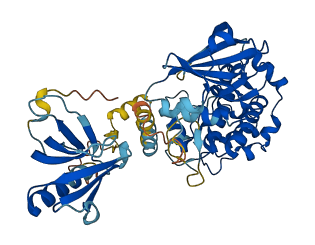
Descriptions
The autoinhibited protein was predicted that may have potential autoinhibitory elements via cis-regPred.
Autoinhibitory domains (AIDs)
Target domain |
|
Relief mechanism |
|
Assay |
cis-regPred |
Accessory elements
343-366 (Activation loop from InterPro)
Target domain |
204-458 (Protein kinase domain) |
Relief mechanism |
|
Assay |
|
Autoinhibited structure

Activated structure
1 structures for Q55GV3
| Entry ID | Method | Resolution | Chain | Position | Source |
|---|---|---|---|---|---|
| AF-Q55GV3-F1 | Predicted | AlphaFoldDB |
No variants for Q55GV3
| Variant ID(s) | Position | Change | Description | Diseaes Association | Provenance |
|---|---|---|---|---|---|
| No variants for Q55GV3 | |||||
No associated diseases with Q55GV3
10 regional properties for Q55GV3
| Type | Name | Position | InterPro Accession |
|---|---|---|---|
| repeat | WD40 repeat | 97 - 262 | IPR001680-1 |
| repeat | WD40 repeat | 265 - 410 | IPR001680-2 |
| domain | LIS1 homology motif | 7 - 39 | IPR006594 |
| conserved_site | WD40 repeat, conserved site | 165 - 179 | IPR019775-1 |
| conserved_site | WD40 repeat, conserved site | 207 - 221 | IPR019775-2 |
| conserved_site | WD40 repeat, conserved site | 311 - 325 | IPR019775-3 |
| conserved_site | WD40 repeat, conserved site | 395 - 409 | IPR019775-4 |
| repeat | G-protein beta WD-40 repeat | 123 - 137 | IPR020472-1 |
| repeat | G-protein beta WD-40 repeat | 207 - 221 | IPR020472-2 |
| repeat | G-protein beta WD-40 repeat | 311 - 325 | IPR020472-3 |
Functions
| Description | ||
|---|---|---|
| EC Number | 2.7.11.1 | Protein-serine/threonine kinases |
| Subcellular Localization |
|
|
| PANTHER Family | ||
| PANTHER Subfamily | ||
| PANTHER Protein Class | ||
| PANTHER Pathway Category | No pathway information available | |
3 GO annotations of cellular component
| Name | Definition |
|---|---|
| cytoplasm | The contents of a cell excluding the plasma membrane and nucleus, but including other subcellular structures. |
| cytosol | The part of the cytoplasm that does not contain organelles but which does contain other particulate matter, such as protein complexes. |
| plasma membrane | The membrane surrounding a cell that separates the cell from its external environment. It consists of a phospholipid bilayer and associated proteins. |
6 GO annotations of molecular function
| Name | Definition |
|---|---|
| ATP binding | Binding to ATP, adenosine 5'-triphosphate, a universally important coenzyme and enzyme regulator. |
| metal ion binding | Binding to a metal ion. |
| phosphatidylinositol-3,4-bisphosphate binding | Binding to phosphatidylinositol-3,4-bisphosphate, a derivative of phosphatidylinositol in which the inositol ring is phosphorylated at the 3' and 4' positions. |
| protein serine kinase activity | Catalysis of the reactions: ATP + protein serine = ADP + protein serine phosphate. |
| protein serine/threonine kinase activity | Catalysis of the reactions: ATP + protein serine = ADP + protein serine phosphate, and ATP + protein threonine = ADP + protein threonine phosphate. |
| small GTPase binding | Binding to a small monomeric GTPase. |
7 GO annotations of biological process
| Name | Definition |
|---|---|
| chemotaxis to cAMP | The directed movement of a motile cell or organism in response to the presence of 3',5'-cAMP. |
| establishment or maintenance of cell polarity | Any cellular process that results in the specification, formation or maintenance of anisotropic intracellular organization or cell growth patterns. |
| intracellular signal transduction | The process in which a signal is passed on to downstream components within the cell, which become activated themselves to further propagate the signal and finally trigger a change in the function or state of the cell. |
| mitotic cytokinesis | A cell cycle process that results in the division of the cytoplasm of a cell after mitosis, resulting in the separation of the original cell into two daughter cells. |
| negative regulation of pseudopodium assembly | Any process that stops, prevents, or reduces the frequency, rate or extent of the assembly of pseudopodia. |
| protein phosphorylation | The process of introducing a phosphate group on to a protein. |
| regulation of MAPK cascade | Any process that modulates the frequency, rate or extent of signal transduction mediated by the MAP kinase (MAPK) cascade. |
No homologous proteins in AiPD
| UniProt AC | Gene Name | Protein Name | Species | Evidence Code |
|---|---|---|---|---|
| No homologous proteins | ||||
| 10 | 20 | 30 | 40 | 50 | 60 |
| MISLDLSPTL | WKSPDKEGEL | KKQGHVVKNW | KKRKFIIQND | MLFYFKDKEE | RPVGAVPLRM |
| 70 | 80 | 90 | 100 | 110 | 120 |
| SRCYENKSLG | KPNCFELVSP | RINKTFFIQA | NTPDEMASWM | KAVEKGSEYS | TVSQPFNLKH |
| 130 | 140 | 150 | 160 | 170 | 180 |
| EVHVDFNSAT | GFSGLPKEWE | VILKSSNVSK | QEVLDKPSEW | LSVLEFQAGR | TMEKSNSQNL |
| 190 | 200 | 210 | 220 | 230 | 240 |
| SALPDESNLT | LSDLVTKEDP | TKIYKNMTKI | GEGAAGEVFV | ATSSKNNKRV | AIKKIEINND |
| 250 | 260 | 270 | 280 | 290 | 300 |
| NAKLLVTEIA | IMKTSHHDNI | VNYIDSYIVN | DRELWVAMEF | MGGGCLTDIL | EAFDNIKMSE |
| 310 | 320 | 330 | 340 | 350 | 360 |
| IQIAYVVKET | LKALQYIHSL | HRIHRDIKSD | NILLGSEGSV | KIADFGYAAQ | LTQKQQKRNT |
| 370 | 380 | 390 | 400 | 410 | 420 |
| VVGTPYWMAP | ELIRGHDYGV | KVDIWSLGIM | MMEMAEGEPP | YMDFPPLRAL | FLITTKGIPP |
| 430 | 440 | 450 | 460 | 470 | |
| LKETTKWSKT | FQDFFSKCLD | INVANRPDAT | DLLKHPFMDL | ACDSSEFKPL | IQAARNV |