Q55D85
Gene name |
cas1 (DDB_G0269226) |
Protein name |
Cycloartenol synthase |
Names |
2,3-epoxysqualene--cycloartenol cyclase, Oxidosqualene cyclase |
Species |
Dictyostelium discoideum (Slime mold) |
KEGG Pathway |
ddi:DDB_G0269226 |
EC number |
5.4.99.8: Transferring other groups |
Protein Class |
|
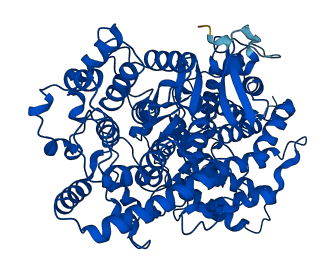
Descriptions
The autoinhibited protein was predicted that may have potential autoinhibitory elements via cis-regPred.
Autoinhibitory domains (AIDs)
Target domain |
|
Relief mechanism |
|
Assay |
cis-regPred |
Accessory elements
No accessory elements
Autoinhibited structure

Activated structure
1 structures for Q55D85
| Entry ID | Method | Resolution | Chain | Position | Source |
|---|---|---|---|---|---|
| AF-Q55D85-F1 | Predicted | AlphaFoldDB |
No variants for Q55D85
| Variant ID(s) | Position | Change | Description | Diseaes Association | Provenance |
|---|---|---|---|---|---|
| No variants for Q55D85 | |||||
No associated diseases with Q55D85
Functions
| Description | ||
|---|---|---|
| EC Number | 5.4.99.8 | Transferring other groups |
| Subcellular Localization |
|
|
| PANTHER Family | ||
| PANTHER Subfamily | ||
| PANTHER Protein Class | ||
| PANTHER Pathway Category | No pathway information available | |
1 GO annotations of cellular component
| Name | Definition |
|---|---|
| lipid droplet | An intracellular non-membrane-bounded organelle comprising a matrix of coalesced lipids surrounded by a phospholipid monolayer. May include associated proteins. |
2 GO annotations of molecular function
| Name | Definition |
|---|---|
| cycloartenol synthase activity | Catalysis of the reaction: (S)-2,3-epoxysqualene = cycloartenol. |
| lanosterol synthase activity | Catalysis of the reaction: (S)-2,3-epoxysqualene = lanosterol. This is a cyclization reaction that forms the sterol nucleus. |
3 GO annotations of biological process
| Name | Definition |
|---|---|
| cholesterol biosynthetic process | The chemical reactions and pathways resulting in the formation of cholesterol, cholest-5-en-3 beta-ol, the principal sterol of vertebrates and the precursor of many steroids, including bile acids and steroid hormones. |
| sterol biosynthetic process | The chemical reactions and pathways resulting in the formation of sterols, steroids with one or more hydroxyl groups and a hydrocarbon side-chain in the molecule. |
| triterpenoid biosynthetic process | The chemical reactions and pathways resulting in the formation of triterpenoid compounds, terpenoids with six isoprene units. |
No homologous proteins in AiPD
| UniProt AC | Gene Name | Protein Name | Species | Evidence Code |
|---|---|---|---|---|
| No homologous proteins | ||||
| 10 | 20 | 30 | 40 | 50 | 60 |
| MTTTNWSLKV | DRGRQTWEYS | QEKKEATDVD | IHLLRLKEPG | THCPEGCDLN | RAKTPQQAIK |
| 70 | 80 | 90 | 100 | 110 | 120 |
| KAFQYFSKVQ | TEDGHWAGDY | GGPMFLLPGL | VITCYVTGYQ | LPESTQREII | RYLFNRQNPV |
| 130 | 140 | 150 | 160 | 170 | 180 |
| DGGWGLHIEA | HSDIFGTTLQ | YVSLRLLGVP | ADHPSVVKAR | TFLLQNGGAT | GIPSWGKFWL |
| 190 | 200 | 210 | 220 | 230 | 240 |
| ATLNAYDWNG | LNPIPIEFWL | LPYNLPIAPG | RWWCHCRMVY | LPMSYIYAKK | TTGPLTDLVK |
| 250 | 260 | 270 | 280 | 290 | 300 |
| DLRREIYCQE | YEKINWSEQR | NNISKLDMYY | EHTSLLNVIN | GSLNAYEKVH | SKWLRDKAID |
| 310 | 320 | 330 | 340 | 350 | 360 |
| YTFDHIRYED | EQTKYIDIGP | VNKTVNMLCV | WDREGKSPAF | YKHADRLKDY | LWLSFDGMKM |
| 370 | 380 | 390 | 400 | 410 | 420 |
| QGYNGSQLWD | TAFTIQAFME | SGIANQFQDC | MKLAGHYLDI | SQVPEDARDM | KHYHRHYSKG |
| 430 | 440 | 450 | 460 | 470 | 480 |
| AWPFSTVDHG | WPISDCTAEG | IKSALALRSL | PFIEPISLDR | IADGINVLLT | LQNGDGGWAS |
| 490 | 500 | 510 | 520 | 530 | 540 |
| YENTRGPKWL | EKFNPSEVFQ | NIMIDYSYVE | CSAACIQAMS | AFRKHAPNHP | RIKEINRSIA |
| 550 | 560 | 570 | 580 | 590 | 600 |
| RGVKFIKSIQ | RQDGSWLGSW | GICFTYGTWF | GIEGLVASGE | PLTSPSIVKA | CKFLASKQRA |
| 610 | 620 | 630 | 640 | 650 | 660 |
| DGGWGESFKS | NVTKEYVQHE | TSQVVNTGWA | LLSLMSAKYP | DRECIERGIK | FLIQRQYPNG |
| 670 | 680 | 690 | 700 | ||
| DFPQESIIGV | FNFNCMISYS | NYKNIFPLWA | LSRYNQLYLK | SKI |