Q553Y0
Gene name |
p2xC (DDB_G0275191) |
Protein name |
P2X receptor C |
Names |
P2XC |
Species |
Dictyostelium discoideum (Slime mold) |
KEGG Pathway |
ddi:DDB_G0275191 |
EC number |
|
Protein Class |
|
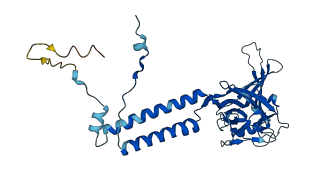
Descriptions
The autoinhibited protein was predicted that may have potential autoinhibitory elements via cis-regPred.
Autoinhibitory domains (AIDs)
Target domain |
|
Relief mechanism |
|
Assay |
cis-regPred |
Accessory elements
No accessory elements
Autoinhibited structure

Activated structure
1 structures for Q553Y0
| Entry ID | Method | Resolution | Chain | Position | Source |
|---|---|---|---|---|---|
| AF-Q553Y0-F1 | Predicted | AlphaFoldDB |
No variants for Q553Y0
| Variant ID(s) | Position | Change | Description | Diseaes Association | Provenance |
|---|---|---|---|---|---|
| No variants for Q553Y0 | |||||
No associated diseases with Q553Y0
No regional properties for Q553Y0
| Type | Name | Position | InterPro Accession |
|---|---|---|---|
| No domain, repeats, and functional sites for Q553Y0 | |||
2 GO annotations of cellular component
| Name | Definition |
|---|---|
| contractile vacuolar membrane | The lipid bilayer surrounding the contractile vacuole. |
| integral component of membrane | The component of a membrane consisting of the gene products and protein complexes having at least some part of their peptide sequence embedded in the hydrophobic region of the membrane. |
2 GO annotations of molecular function
| Name | Definition |
|---|---|
| ATP-gated ion channel activity | Enables the transmembrane transfer of an ion by a channel that opens when ATP has been bound by the channel complex or one of its constituent parts. |
| ATP-sensitive calcium-release channel activity | Enables the transmembrane transfer of a calcium ion from intracellular stores by a channel that opens when a ATP has been bound by the channel complex or one of its constituent parts. |
3 GO annotations of biological process
| Name | Definition |
|---|---|
| calcium ion transmembrane transport | A process in which a calcium ion is transported from one side of a membrane to the other by means of some agent such as a transporter or pore. |
| cellular hypotonic response | Any process that results in a change in state or activity of a cell (in terms of movement, secretion, enzyme production, gene expression, etc.) as a result of detection of, or exposure to, a hypotonic environment, i.e. an environment with a lower concentration of solutes than the organism or cell. |
| regulation of calcium-mediated signaling | Any process that modulates the frequency, rate or extent of calcium-mediated signaling, the process in which a cell uses calcium ions to convert an extracellular signal into a response. |
No homologous proteins in AiPD
| UniProt AC | Gene Name | Protein Name | Species | Evidence Code |
|---|---|---|---|---|
| No homologous proteins | ||||
| 10 | 20 | 30 | 40 | 50 | 60 |
| MLDWDSILAY | NTIKVVRIRD | RRLGILHLIF | MIAIISYVVI | YSAIIKKGYL | SIEEPVGSIR |
| 70 | 80 | 90 | 100 | 110 | 120 |
| TSLWSPNQFN | GNESYCKNNA | KPYPYEKLDC | VYYDDALALY | PIGDDVGFTA | STRIEISDQK |
| 130 | 140 | 150 | 160 | 170 | 180 |
| ANCSLMNPSC | KFKTFNYSNV | YLADIESFTV | LIDHTMYAPS | SQIQFNGGDL | SGYVLDQNGN |
| 190 | 200 | 210 | 220 | 230 | 240 |
| EIQLNESVNV | IGVEGKPDVL | EISKLLEFAG | VNLDDPSLTN | SSNPIRYDGC | VLFVFIEYSN |
| 250 | 260 | 270 | 280 | 290 | 300 |
| TFSYDLNKIK | YVYSIKLVDD | TIYNIPEVVI | LDDVNSRLYY | KRHAIRLIFI | QTGVIGSFNF |
| 310 | 320 | 330 | 340 | 350 | 360 |
| QSLLLTLVSG | LGLLTVSTLI | VDQLAIRFLP | QRKSYSSLKF | QTTESFKMKK | KIVNDDGEDK |
| LYHNIEAL |