Q553K4
Gene name |
nramp2 (mntH, DDB_G0275815) |
Protein name |
Natural resistance-associated macrophage protein 2 homolog |
Names |
|
Species |
Dictyostelium discoideum (Slime mold) |
KEGG Pathway |
ddi:DDB_G0275815 |
EC number |
|
Protein Class |
|
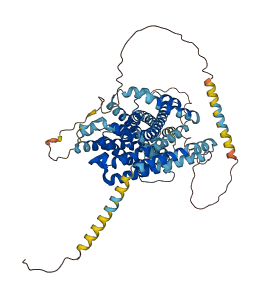
Descriptions
The autoinhibited protein was predicted that may have potential autoinhibitory elements via cis-regPred.
Autoinhibitory domains (AIDs)
Target domain |
|
Relief mechanism |
|
Assay |
cis-regPred |
Accessory elements
No accessory elements
Autoinhibited structure

Activated structure
1 structures for Q553K4
| Entry ID | Method | Resolution | Chain | Position | Source |
|---|---|---|---|---|---|
| AF-Q553K4-F1 | Predicted | AlphaFoldDB |
No variants for Q553K4
| Variant ID(s) | Position | Change | Description | Diseaes Association | Provenance |
|---|---|---|---|---|---|
| No variants for Q553K4 | |||||
No associated diseases with Q553K4
5 regional properties for Q553K4
| Type | Name | Position | InterPro Accession |
|---|---|---|---|
| repeat | Pumilio RNA-binding repeat | 114 - 149 | IPR001313-1 |
| repeat | Pumilio RNA-binding repeat | 150 - 187 | IPR001313-2 |
| repeat | Pumilio RNA-binding repeat | 355 - 390 | IPR001313-3 |
| repeat | Pumilio RNA-binding repeat | 538 - 575 | IPR001313-4 |
| repeat | Pumilio RNA-binding repeat | 576 - 613 | IPR001313-5 |
3 GO annotations of cellular component
| Name | Definition |
|---|---|
| contractile vacuolar membrane | The lipid bilayer surrounding the contractile vacuole. |
| integral component of membrane | The component of a membrane consisting of the gene products and protein complexes having at least some part of their peptide sequence embedded in the hydrophobic region of the membrane. |
| plasma membrane | The membrane surrounding a cell that separates the cell from its external environment. It consists of a phospholipid bilayer and associated proteins. |
4 GO annotations of molecular function
| Name | Definition |
|---|---|
| cadmium ion transmembrane transporter activity | Enables the transfer of cadmium (Cd) ions from one side of a membrane to the other. |
| ferrous iron transmembrane transporter activity | Enables the transfer of ferrous iron (Fe(II) or Fe2+) ions from one side of a membrane to the other. |
| manganese ion transmembrane transporter activity | Enables the transfer of manganese (Mn) ions from one side of a membrane to the other. |
| symporter activity | Enables the active transport of a solute across a membrane by a mechanism whereby two or more species are transported together in the same direction in a tightly coupled process not directly linked to a form of energy other than chemiosmotic energy. |
7 GO annotations of biological process
| Name | Definition |
|---|---|
| aggregation involved in sorocarp development | The process whose specific outcome is the progression of the aggregate over time, from its formation to the point when a slug is formed. Aggregate development begins in response to starvation and continues by the chemoattractant-mediated movement of cells toward each other. The aggregate is a multicellular structure that gives rise to the slug. |
| cellular manganese ion homeostasis | Any process involved in the maintenance of an internal steady state of manganese ions at the level of a cell. |
| defense response to bacterium | Reactions triggered in response to the presence of a bacterium that act to protect the cell or organism. |
| iron ion export across plasma membrane | The directed movement of iron ions from inside of a cell, across the plasma membrane and into the extracellular region. |
| iron ion homeostasis | Any process involved in the maintenance of an internal steady state of iron ions within an organism or cell. |
| iron ion transport | The directed movement of iron (Fe) ions into, out of or within a cell, or between cells, by means of some agent such as a transporter or pore. |
| response to bacterium | Any process that results in a change in state or activity of a cell or an organism (in terms of movement, secretion, enzyme production, gene expression, etc.) as a result of a stimulus from a bacterium. |
No homologous proteins in AiPD
| UniProt AC | Gene Name | Protein Name | Species | Evidence Code |
|---|---|---|---|---|
| No homologous proteins | ||||
| 10 | 20 | 30 | 40 | 50 | 60 |
| MNNNNNNKKL | NKENLNEIEN | WNEIELTDYK | KQGLDEGTSS | NIYLFESNGN | VVNGSIEDSP |
| 70 | 80 | 90 | 100 | 110 | 120 |
| KQQQQQQQQQ | QQQQQQQQQQ | QQQQQNIISS | DEEIEDKPFQ | DRDSNIGDGS | DIDSSGDSID |
| 130 | 140 | 150 | 160 | 170 | 180 |
| IENTDYSILV | PFEDEENNNG | SKSKFSIKKL | KSFLGPALFI | SVGYMDPGNW | ATDLEGGSRF |
| 190 | 200 | 210 | 220 | 230 | 240 |
| GYQLMWVLLF | SNIMALFLQT | LVIKLALVTK | NDLAQQCRKE | YSKTVNIFLW | LILELAIIST |
| 250 | 260 | 270 | 280 | 290 | 300 |
| DLAEVIGTAI | GLNILFGLPL | IAGVAITSLD | TLLFLAIQRW | GIRKLELLIL | LLLSMITMCF |
| 310 | 320 | 330 | 340 | 350 | 360 |
| VIELFLSKPI | ASEVFSGFVP | RLNSDSVMVA | TGIVGATTMP | HNLFLHGSVV | KSRKIPNDRR |
| 370 | 380 | 390 | 400 | 410 | 420 |
| KSVIKQAYRY | NVIDTVLALN | CAFFVNIAIL | MLAASVFWKS | NIQVTELSEA | YRLLTKLMDG |
| 430 | 440 | 450 | 460 | 470 | 480 |
| KLAAVLFGLG | LFLAGQSSTI | TGTMAGQIVM | EGFIKLRIKP | WLRRFITRLL | AIIPAAIVII |
| 490 | 500 | 510 | 520 | 530 | 540 |
| VLGDKGTYTL | LIISQVLLSI | GLPFAVVPLI | IFTSSYEIMG | EFKNRLSIII | INSIIALFII |
| 550 | 560 | 570 | 580 | 590 | 600 |
| GLNLATIFQL | INDFLHNDSI | ISKCLTIIFL | IPLSIALCCL | LLWLIISKIN | FFTNLLSKIF |
| 610 | 620 | ||||
| NNNNNNNNKN | IINNNNNYSG | NTINNQTIQ |