Q54XP4
Gene name |
crnkl1 (crn, DDB_G0278819) |
Protein name |
Crooked neck-like protein 1 |
Names |
Crooked neck homolog |
Species |
Dictyostelium discoideum (Slime mold) |
KEGG Pathway |
ddi:DDB_G0278819 |
EC number |
|
Protein Class |
|
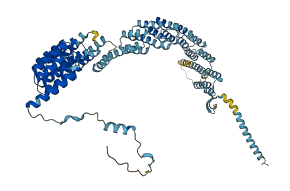
Descriptions
The autoinhibited protein was predicted that may have potential autoinhibitory elements via cis-regPred.
Autoinhibitory domains (AIDs)
Target domain |
|
Relief mechanism |
|
Assay |
cis-regPred |
Accessory elements
No accessory elements
Autoinhibited structure

Activated structure
1 structures for Q54XP4
| Entry ID | Method | Resolution | Chain | Position | Source |
|---|---|---|---|---|---|
| AF-Q54XP4-F1 | Predicted | AlphaFoldDB |
No variants for Q54XP4
| Variant ID(s) | Position | Change | Description | Diseaes Association | Provenance |
|---|---|---|---|---|---|
| No variants for Q54XP4 | |||||
No associated diseases with Q54XP4
4 regional properties for Q54XP4
6 GO annotations of cellular component
| Name | Definition |
|---|---|
| nuclear speck | A discrete extra-nucleolar subnuclear domain, 20-50 in number, in which splicing factors are seen to be localized by immunofluorescence microscopy. |
| nucleus | A membrane-bounded organelle of eukaryotic cells in which chromosomes are housed and replicated. In most cells, the nucleus contains all of the cell's chromosomes except the organellar chromosomes, and is the site of RNA synthesis and processing. In some species, or in specialized cell types, RNA metabolism or DNA replication may be absent. |
| post-mRNA release spliceosomal complex | A spliceosomal complex that is formed following the release of the spliced product from the post-spliceosomal complex and contains the excised intron and three snRNPs, including U5. |
| Prp19 complex | A protein complex consisting of Prp19 and associated proteins that is involved in the transition from the precatalytic spliceosome to the activated form that catalyzes step 1 of splicing, and which remains associated with the spliceosome through the second catalytic step. It is widely conserved, found in both yeast and mammals, though the exact composition varies. In S. cerevisiae, it contains Prp19p, Ntc20p, Snt309p, Isy1p, Syf2p, Cwc2p, Prp46p, Clf1p, Cef1p, and Syf1p. |
| spliceosomal complex | Any of a series of ribonucleoprotein complexes that contain snRNA(s) and small nuclear ribonucleoproteins (snRNPs), and are formed sequentially during the spliceosomal splicing of one or more substrate RNAs, and which also contain the RNA substrate(s) from the initial target RNAs of splicing, the splicing intermediate RNA(s), to the final RNA products. During cis-splicing, the initial target RNA is a single, contiguous RNA transcript, whether mRNA, snoRNA, etc., and the released products are a spliced RNA and an excised intron, generally as a lariat structure. During trans-splicing, there are two initial substrate RNAs, the spliced leader RNA and a pre-mRNA. |
| U2-type catalytic step 2 spliceosome | A spliceosomal complex that contains the U2, U5 and U6 snRNPs bound to a splicing intermediate in which the first catalytic cleavage of the 5' splice site has occurred. The precise subunit composition differs significantly from that of the catalytic step 1, or activated, spliceosome, and includes many proteins in addition to those found in the U2, U5 and U6 snRNPs. |
1 GO annotations of molecular function
| Name | Definition |
|---|---|
| RNA binding | Binding to an RNA molecule or a portion thereof. |
2 GO annotations of biological process
| Name | Definition |
|---|---|
| mRNA splicing, via spliceosome | The joining together of exons from one or more primary transcripts of messenger RNA (mRNA) and the excision of intron sequences, via a spliceosomal mechanism, so that mRNA consisting only of the joined exons is produced. |
| spliceosomal complex assembly | The aggregation, arrangement and bonding together of a spliceosomal complex, a ribonucleoprotein apparatus that catalyzes nuclear mRNA splicing via transesterification reactions. |
No homologous proteins in AiPD
| UniProt AC | Gene Name | Protein Name | Species | Evidence Code |
|---|---|---|---|---|
| No homologous proteins | ||||
| 10 | 20 | 30 | 40 | 50 | 60 |
| MNQNRTGGVS | KVKNKSAAPV | QITAEQILRV | AHENQQTLPK | APPKQVITDQ | EELEDYRLRK |
| 70 | 80 | 90 | 100 | 110 | 120 |
| RQQYESLLGR | NRKTAAIYIK | YAAWEESQKD | LTRARSVFER | FLDIDHRIPT | VWIKYAEMEM |
| 130 | 140 | 150 | 160 | 170 | 180 |
| KNKNINLARN | IWDRAVCLLP | RVSQLWFKYT | FMEDMLGNYP | AARAIFERWM | QWKPEPQAWN |
| 190 | 200 | 210 | 220 | 230 | 240 |
| SYLKFEQRLK | LFENTRLIFE | KYILVHPYIK | TWIKYTKFEE | RLGNIENART | IFQRAIEFLG |
| 250 | 260 | 270 | 280 | 290 | 300 |
| EDGNDEQLFI | AFAKFEEKYK | EIERARVIYK | YAIDHVPKSR | AKDLFDTFTN | FEKQHGDRIG |
| 310 | 320 | 330 | 340 | 350 | 360 |
| IEDVVLGKKR | FQYEEEIKKN | SKNYDIWFDY | LKMEEINGEI | EKTREIYERS | IGNLPPTNEK |
| 370 | 380 | 390 | 400 | 410 | 420 |
| KHWKRYIYLW | INYALFEELI | SKDMERARSV | YSECIKLIPH | KEFSFSKIWI | LYANFEIRQL |
| 430 | 440 | 450 | 460 | 470 | 480 |
| NLDKARLIYG | QAIGRNPKSK | IFDQYIHLEI | ELGNFDRVRT | LYEKYLEIMP | DNCDAWCKFA |
| 490 | 500 | 510 | 520 | 530 | 540 |
| QLETELGETV | RARAIFELAI | QQPNLDRPEV | VWKDFIDSEI | QLKQFDFVKQ | LYRKLLEKTN |
| 550 | 560 | 570 | 580 | 590 | 600 |
| HVKVWIGFIK | FVHSIKDKQQ | QKQRQQQQEE | DGDSNTTKKD | GGDDDNNDDI | NKPTREIFIE |
| 610 | 620 | 630 | 640 | 650 | 660 |
| AHKSLSNSDK | EERLLLLESW | KEFEQTFGNQ | ETLNQVLKKI | PQRVIKRRSD | GNGGIEEYFD |
| 670 | 680 | 690 | 700 | ||
| YIFPEEEKST | QTSLKLLEAA | QRWKKLKQQQ | ELQKQQELQK | QQQDS |