Q54W20
Gene name |
abcD3 (DDB_G0279919) |
Protein name |
ABC transporter D family member 3 |
Names |
ABC transporter ABCD.3 |
Species |
Dictyostelium discoideum (Slime mold) |
KEGG Pathway |
ddi:DDB_G0279919 |
EC number |
|
Protein Class |
|
Descriptions
The autoinhibited protein was predicted that may have potential autoinhibitory elements via cis-regPred.
Autoinhibitory domains (AIDs)
Target domain |
|
Relief mechanism |
|
Assay |
cis-regPred |
Accessory elements
No accessory elements
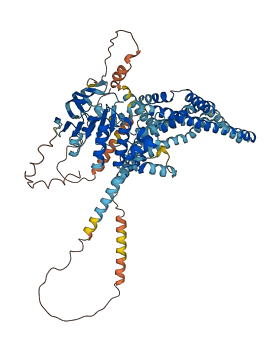
Autoinhibited structure

Activated structure
1 structures for Q54W20
| Entry ID | Method | Resolution | Chain | Position | Source |
|---|---|---|---|---|---|
| AF-Q54W20-F1 | Predicted | AlphaFoldDB |
No variants for Q54W20
| Variant ID(s) | Position | Change | Description | Diseaes Association | Provenance |
|---|---|---|---|---|---|
| No variants for Q54W20 | |||||
No associated diseases with Q54W20
5 regional properties for Q54W20
| Type | Name | Position | InterPro Accession |
|---|---|---|---|
| domain | ABC transporter-like, ATP-binding domain | 507 - 737 | IPR003439 |
| domain | AAA+ ATPase domain | 532 - 720 | IPR003593 |
| domain | ABC transporter type 1, transmembrane domain | 74 - 283 | IPR011527-1 |
| domain | ABC transporter type 1, transmembrane domain | 317 - 417 | IPR011527-2 |
| conserved_site | ABC transporter-like, conserved site | 642 - 656 | IPR017871 |
2 GO annotations of cellular component
| Name | Definition |
|---|---|
| ATP-binding cassette (ABC) transporter complex | A complex for the transport of metabolites into and out of the cell, typically comprised of four domains; two membrane-associated domains and two ATP-binding domains at the intracellular face of the membrane, that form a central pore through the plasma membrane. Each of the four core domains may be encoded as a separate polypeptide or the domains can be fused in any one of a number of ways into multidomain polypeptides. In Bacteria and Archaebacteria, ABC transporters also include substrate binding proteins to bind substrate external to the cytoplasm and deliver it to the transporter. |
| peroxisomal membrane | The lipid bilayer surrounding a peroxisome. |
4 GO annotations of molecular function
| Name | Definition |
|---|---|
| ABC-type transporter activity | Primary active transporter characterized by two nucleotide-binding domains and two transmembrane domains. Uses the energy generated from ATP hydrolysis to drive the transport of a substance across a membrane. |
| ATP binding | Binding to ATP, adenosine 5'-triphosphate, a universally important coenzyme and enzyme regulator. |
| ATPase-coupled transmembrane transporter activity | Primary active transporter of a solute across a membrane, via the reaction: ATP + H2O = ADP + phosphate, to directly drive the transport of a substance across a membrane. The transport protein may be transiently phosphorylated (P-type transporters), or not (ABC-type transporters and other families of transporters). Primary active transport occurs up the solute's concentration gradient and is driven by a primary energy source. |
| long-chain fatty acid transporter activity | Enables the transfer of long-chain fatty acids from one side of a membrane to the other. A long-chain fatty acid is a fatty acid with a chain length between C13 and C22. |
4 GO annotations of biological process
| Name | Definition |
|---|---|
| fatty acid beta-oxidation | A fatty acid oxidation process that results in the complete oxidation of a long-chain fatty acid. Fatty acid beta-oxidation begins with the addition of coenzyme A to a fatty acid, and occurs by successive cycles of reactions during each of which the fatty acid is shortened by a two-carbon fragment removed as acetyl coenzyme A; the cycle continues until only two or three carbons remain (as acetyl-CoA or propionyl-CoA respectively). |
| long-chain fatty acid import into peroxisome | The directed movement of long-chain fatty acids into a peroxisome. A long-chain fatty acid is a fatty acid with a chain length between C13 and C22. |
| peroxisome organization | A process that is carried out at the cellular level which results in the assembly, arrangement of constituent parts, or disassembly of a peroxisome. A peroxisome is a small, membrane-bounded organelle that uses dioxygen (O2) to oxidize organic molecules. |
| very long-chain fatty acid catabolic process | The chemical reactions and pathways resulting in the breakdown of a fatty acid which has a chain length greater than C22. |
No homologous proteins in AiPD
| UniProt AC | Gene Name | Protein Name | Species | Evidence Code |
|---|---|---|---|---|
| No homologous proteins | ||||
| 10 | 20 | 30 | 40 | 50 | 60 |
| MKKNNVNNIT | ETLNSSSSSS | SSSGSSSDEE | VKSKLNFNQT | DEMLKKIKEN | KFDWALFKRF |
| 70 | 80 | 90 | 100 | 110 | 120 |
| IKIVIILYEK | PVIPLLLFLL | LFGSGVSQTY | ISKFTGILLS | NIYGSLTSGD | KFLFVSSLIK |
| 130 | 140 | 150 | 160 | 170 | 180 |
| GCFAIGGSAL | FDAIIKFIVS | IMAWNWRKTL | CLYIQNVYFK | KSLFYKILAF | DDRIDNPDQR |
| 190 | 200 | 210 | 220 | 230 | 240 |
| ITSDIDNFTT | LLSSIVSQCI | TGPMVVVYYT | YLCYTTIDWY | APLIVYGYFF | LGYFINKLVM |
| 250 | 260 | 270 | 280 | 290 | 300 |
| SPMVSINYLQ | DKLEGDFRYL | HQRIRNFSES | IALYNLSKEK | QQKKSTTSVD | NLDYYDDDHH |
| 310 | 320 | 330 | 340 | 350 | 360 |
| YHHHHDDGEE | SDEYTDKTKI | INRKNKNSKN | KRSALLKRSN | KNIKNEELLV | EEEQAKQQFE |
| 370 | 380 | 390 | 400 | 410 | 420 |
| ALLKNKKRVI | FWQFGLNTTS | DMFTFFSPLI | NYFIISIPVF | FLSSKAALEP | AQVTVQSYNC |
| 430 | 440 | 450 | 460 | 470 | 480 |
| IMLASGFSQY | INVSQSISDL | SGYISRISTM | IEVCKKVMGD | TSLDIEITKL | NEKDKTKSLP |
| 490 | 500 | 510 | 520 | 530 | 540 |
| NSLIINNRDT | SINTDFRHIS | LNEGESITLD | DVTYFTPKGT | QLYEKISICI | KKGNNLLIMG |
| 550 | 560 | 570 | 580 | 590 | 600 |
| PSGSGKSSLI | RIINGLWPFF | KGSINRPENE | DMFFLPQQPY | LIFGTLEEQI | LYPFSKKQKR |
| 610 | 620 | 630 | 640 | 650 | 660 |
| IPKSIMRELF | QRFDIDYLLD | RERFIKKSAQ | VNDLTHNWLN | QLSPGEQQLI | AIIRLIYHKP |
| 670 | 680 | 690 | 700 | 710 | 720 |
| KFALMDESTS | SIPQSLEERV | YSVAKELGIT | IISVGHRISL | LKYHSTLLRF | DKDKNWYLED |
| 730 | 740 | ||||
| IINQNNQSNN | INTINIDNNT | NKIAEDSVFD |