Q54UM1
Gene name |
hop2 (DDB_G0280989) |
Protein name |
Homologous-pairing protein 2 homolog |
Names |
|
Species |
Dictyostelium discoideum (Slime mold) |
KEGG Pathway |
ddi:DDB_G0280989 |
EC number |
|
Protein Class |
|
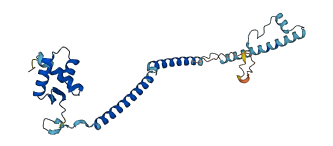
Descriptions
The autoinhibited protein was predicted that may have potential autoinhibitory elements via cis-regPred.
Autoinhibitory domains (AIDs)
Target domain |
|
Relief mechanism |
|
Assay |
cis-regPred |
Accessory elements
No accessory elements
Autoinhibited structure

Activated structure
1 structures for Q54UM1
| Entry ID | Method | Resolution | Chain | Position | Source |
|---|---|---|---|---|---|
| AF-Q54UM1-F1 | Predicted | AlphaFoldDB |
No variants for Q54UM1
| Variant ID(s) | Position | Change | Description | Diseaes Association | Provenance |
|---|---|---|---|---|---|
| No variants for Q54UM1 | |||||
No associated diseases with Q54UM1
2 GO annotations of cellular component
| Name | Definition |
|---|---|
| condensed nuclear chromosome | A highly compacted molecule of DNA and associated proteins resulting in a cytologically distinct nuclear chromosome. |
| DNA recombinase auxiliary factor complex | A protein complex that binds to a recombinase and incrseases its activity. |
2 GO annotations of molecular function
| Name | Definition |
|---|---|
| double-stranded DNA binding | Binding to double-stranded DNA. |
| recombinase activator activity | Binds to and increases the activity of a recombinase. |
3 GO annotations of biological process
| Name | Definition |
|---|---|
| homologous chromosome pairing at meiosis | The meiotic cell cycle process where side by side pairing and physical juxtaposition of homologous chromosomes is created during meiotic prophase. Homologous chromosome pairing begins when the chromosome arms begin to pair from the clustered telomeres and ends when synaptonemal complex or linear element assembly is complete. |
| meiotic joint molecule formation | The conversion of the paired broken DNA and homologous duplex DNA into a four-stranded branched intermediate, known as a joint molecule, formed during meiotic recombination. These joint molecules contain Holliday junctions on either side of heteroduplex DNA. |
| meiotic strand invasion involved in reciprocal meiotic recombination | The cell cycle process in which double strand breaks are formed and repaired through a double Holliday junction intermediate resulting in meiotic recombination. Meiotic recombination is the cell cycle process in which double strand breaks are formed and repaired through a double Holliday junction intermediate. |
No homologous proteins in AiPD
| UniProt AC | Gene Name | Protein Name | Species | Evidence Code |
|---|---|---|---|---|
| No homologous proteins | ||||
| 10 | 20 | 30 | 40 | 50 | 60 |
| MSKKITKKDE | VEENILNLIN | KANRPYNYQM | IEAAFPSMGK | TQIVKTLKSL | GEQGKLTFKE |
| 70 | 80 | 90 | 100 | 110 | 120 |
| YNKAIIYWRI | QDTGPKLDEQ | GYEIPQESIH | DLNRKLDGIN | RQLEVEQDTL | KSLISQSKQL |
| 130 | 140 | 150 | 160 | 170 | 180 |
| NNQLSDEQIQ | KEVNQLSTEN | KELESKLLTF | QTKEIMSDKD | KQRLDDTIKK | ARSEWVKRKA |
| 190 | 200 | 210 | 220 | 230 | 240 |
| LFRDILDQVL | ERSNKKKKDL | QEDIGWETDE | DLKIQMIPDY | SKPLSQQTLS | STNDESPFKK |
| QKK |