Q54PY7
Gene name |
ucpC (slc25a11, DDB_G0284225) |
Protein name |
Probable mitochondrial 2-oxoglutarate/malate carrier protein |
Names |
OGCP, Mitochondrial substrate carrier family protein ucpC, Solute carrier family 25 member 11 homolog |
Species |
Dictyostelium discoideum (Slime mold) |
KEGG Pathway |
ddi:DDB_G0284225 |
EC number |
|
Protein Class |
|
Descriptions
The autoinhibited protein was predicted that may have potential autoinhibitory elements via cis-regPred.
Autoinhibitory domains (AIDs)
Target domain |
|
Relief mechanism |
|
Assay |
cis-regPred |
Accessory elements
No accessory elements
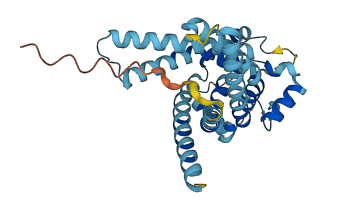
Autoinhibited structure

Activated structure
1 structures for Q54PY7
| Entry ID | Method | Resolution | Chain | Position | Source |
|---|---|---|---|---|---|
| AF-Q54PY7-F1 | Predicted | AlphaFoldDB |
No variants for Q54PY7
| Variant ID(s) | Position | Change | Description | Diseaes Association | Provenance |
|---|---|---|---|---|---|
| No variants for Q54PY7 | |||||
No associated diseases with Q54PY7
3 regional properties for Q54PY7
| Type | Name | Position | InterPro Accession |
|---|---|---|---|
| repeat | Mitochondrial substrate/solute carrier | 22 - 115 | IPR018108-1 |
| repeat | Mitochondrial substrate/solute carrier | 118 - 212 | IPR018108-2 |
| repeat | Mitochondrial substrate/solute carrier | 219 - 312 | IPR018108-3 |
3 GO annotations of cellular component
| Name | Definition |
|---|---|
| integral component of membrane | The component of a membrane consisting of the gene products and protein complexes having at least some part of their peptide sequence embedded in the hydrophobic region of the membrane. |
| mitochondrial inner membrane | The inner, i.e. lumen-facing, lipid bilayer of the mitochondrial envelope. It is highly folded to form cristae. |
| mitochondrion | A semiautonomous, self replicating organelle that occurs in varying numbers, shapes, and sizes in the cytoplasm of virtually all eukaryotic cells. It is notably the site of tissue respiration. |
8 GO annotations of molecular function
| Name | Definition |
|---|---|
| antiporter activity | Enables the active transport of a solute across a membrane by a mechanism whereby two or more species are transported in opposite directions in a tightly coupled process not directly linked to a form of energy other than chemiosmotic energy. The reaction is: solute A(out) + solute B(in) = solute A(in) + solute B(out). |
| dicarboxylic acid transmembrane transporter activity | Enables the transfer of dicarboxylic acids from one side of a membrane to the other. A dicarboxylic acid is an organic acid with two COOH groups. |
| malate transmembrane transporter activity | Enables the transfer of malate from one side of a membrane to the other. Malate is a chiral hydroxydicarboxylic acid, hydroxybutanedioic acid. The (+) enantiomer is an important intermediate in metabolism as a component of both the TCA cycle and the glyoxylate cycle. |
| oxaloacetate transmembrane transporter activity | Enables the transfer of oxaloacetate, the anion of oxobutanedioic acid, from one side of a membrane to the other. |
| succinate transmembrane transporter activity | Enables the transfer of succinate, the dianion of ethane dicarboxylic acid, from one side of a membrane to the other. |
| sulfate transmembrane transporter activity | Enables the transfer of sulfate ions, SO4(2-), from one side of a membrane to the other. |
| thiosulfate transmembrane transporter activity | Enables the transfer of thiosulfate ions, S2O3(2-), from one side of a membrane to the other. |
| transmembrane transporter activity | Enables the transfer of a substance, usually a specific substance or a group of related substances, from one side of a membrane to the other. |
7 GO annotations of biological process
| Name | Definition |
|---|---|
| dicarboxylic acid transport | The directed movement of dicarboxylic acids into, out of or within a cell, or between cells, by means of some agent such as a transporter or pore. |
| malate transmembrane transport | A process in which a malate ion is transported across a membrane. |
| oxaloacetate transport | The directed movement of oxaloacetate, the anion of oxobutanedioic acid, into, out of or within a cell, or between cells, by means of some agent such as a transporter or pore. |
| phosphate ion transmembrane transport | The process in which a phosphate is transported across a membrane. |
| succinate transmembrane transport | The process in which succinate is transported across a membrane. |
| sulfate transport | The directed movement of sulfate into, out of or within a cell, or between cells, by means of some agent such as a transporter or pore. |
| thiosulfate transport | The directed movement of thiosulfate into, out of or within a cell, or between cells, by means of some agent such as a transporter or pore. |
No homologous proteins in AiPD
| UniProt AC | Gene Name | Protein Name | Species | Evidence Code |
|---|---|---|---|---|
| No homologous proteins | ||||
| 10 | 20 | 30 | 40 | 50 | 60 |
| MSSFNTQNKN | VLQTPIPAPT | PQSQLKQFVI | GGLAGMLSSA | FTHPIDSLKV | RMQLQGEGTG |
| 70 | 80 | 90 | 100 | 110 | 120 |
| VGPKRGALKM | LVHINQTEGF | FTLYKGLSAS | LLRQATYTTT | RFGLYDLIKD | IVAKDDKPLP |
| 130 | 140 | 150 | 160 | 170 | 180 |
| FTQKIMVGML | SGAGGAIVGT | PADLTMVRMQ | ADGKLPFNLR | RNYKNVFDGI | FRISKEEGII |
| 190 | 200 | 210 | 220 | 230 | 240 |
| SLWKGCSPNL | IRAMFMTAGQ | VSSYDQTKQL | MLASGYFHDD | IKTHLIASTT | AAFVAAVATS |
| 250 | 260 | 270 | 280 | 290 | 300 |
| PLDVIKTRIM | NSPKTVTGEL | QYKGTFDCLS | KTLRAEGFKA | FYKGFNPYFM | RLGPQTILTF |
| 310 | |||||
| IFVEQLNILW | KKSQSYFK |