Q54PW5
Gene name |
dph1 (DDB_G0284257) |
Protein name |
2-(3-amino-3-carboxypropyl)histidine synthase subunit 1 |
Names |
Diphthamide biosynthesis protein 1, Diphtheria toxin resistance protein 1, S-adenosyl-L-methionine:L-histidine 3-amino-3-carboxypropyltransferase 1 |
Species |
Dictyostelium discoideum (Slime mold) |
KEGG Pathway |
ddi:DDB_G0284257 |
EC number |
2.5.1.108: Transferring alkyl or aryl groups, other than methyl groups |
Protein Class |
|
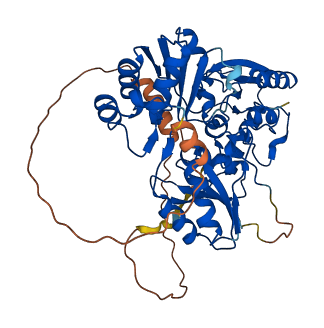
Descriptions
The autoinhibited protein was predicted that may have potential autoinhibitory elements via cis-regPred.
Autoinhibitory domains (AIDs)
Target domain |
|
Relief mechanism |
|
Assay |
cis-regPred |
Accessory elements
No accessory elements
Autoinhibited structure

Activated structure
1 structures for Q54PW5
| Entry ID | Method | Resolution | Chain | Position | Source |
|---|---|---|---|---|---|
| AF-Q54PW5-F1 | Predicted | AlphaFoldDB |
No variants for Q54PW5
| Variant ID(s) | Position | Change | Description | Diseaes Association | Provenance |
|---|---|---|---|---|---|
| No variants for Q54PW5 | |||||
No associated diseases with Q54PW5
No regional properties for Q54PW5
| Type | Name | Position | InterPro Accession |
|---|---|---|---|
| No domain, repeats, and functional sites for Q54PW5 | |||
Functions
| Description | ||
|---|---|---|
| EC Number | 2.5.1.108 | Transferring alkyl or aryl groups, other than methyl groups |
| Subcellular Localization |
|
|
| PANTHER Family | ||
| PANTHER Subfamily | ||
| PANTHER Protein Class | ||
| PANTHER Pathway Category | No pathway information available | |
1 GO annotations of cellular component
| Name | Definition |
|---|---|
| protein-containing complex | A stable assembly of two or more macromolecules, i.e. proteins, nucleic acids, carbohydrates or lipids, in which at least one component is a protein and the constituent parts function together. |
2 GO annotations of molecular function
| Name | Definition |
|---|---|
| 2-(3-amino-3-carboxypropyl)histidine synthase activity | Catalysis of the reaction S-adenosyl-L-methionine + L-histidine- = S-methyl-5-thioadenosine + 2-[(3S)-3-amino-3-carboxypropyl]-L-histidine- |
| 4 iron, 4 sulfur cluster binding | Binding to a 4 iron, 4 sulfur (4Fe-4S) cluster; this cluster consists of four iron atoms, with the inorganic sulfur atoms found between the irons and acting as bridging ligands. |
1 GO annotations of biological process
| Name | Definition |
|---|---|
| peptidyl-diphthamide biosynthetic process from peptidyl-histidine | The modification of peptidyl-histidine to 2'-(3-carboxamido-3-(trimethylammonio)propyl)-L-histidine, known as diphthamide, found in translation elongation factor EF-2. The process occurs in eukaryotes and archaea but not eubacteria. |
No homologous proteins in AiPD
| UniProt AC | Gene Name | Protein Name | Species | Evidence Code |
|---|---|---|---|---|
| No homologous proteins | ||||
| 10 | 20 | 30 | 40 | 50 | 60 |
| MSDSNNIEDN | VVINTITNTD | TNDTTPPTTD | TNTTPSVTLK | RRFVGKKKIA | AQQQQQNENI |
| 70 | 80 | 90 | 100 | 110 | 120 |
| DNVTTTKTTT | TTTTTTTPIT | KDIVTTEKKV | KVFGRGLAMA | AQQIPDEIMN | DKELNLAVKI |
| 130 | 140 | 150 | 160 | 170 | 180 |
| LPSNYNFEIF | KTIWRIKQAS | AKRVALQFPE | GLLMYSCIIS | DIIEKFASVE | TIIMGDVTYG |
| 190 | 200 | 210 | 220 | 230 | 240 |
| ACCVDDYTAR | SLGADFMVHY | GHSCLIPIDV | SEIKMLYVFV | DIQFDLQHFI | ETLKFNFKQT |
| 250 | 260 | 270 | 280 | 290 | 300 |
| QKLIMVSTIQ | FSASLQSSRE | PLSEYFSNIF | IPQEKPLSPG | EILGCTSPKI | KFTSPDGDEE |
| 310 | 320 | 330 | 340 | 350 | 360 |
| NNEIVIYLGD | GRFHLESIMI | SNPHVKSYRY | DPYSKVFSLE | KYDFQEMYKI | RRDAIETASK |
| 370 | 380 | 390 | 400 | 410 | 420 |
| ATKFGIILGT | LGRQGSPKIL | DHLEQLLKSN | GKHYTTVLLS | EIFPAKLDMF | SDIESWIQIA |
| 430 | 440 | 450 | 460 | 470 | |
| CPRLSIDWGY | AFTTPLLNPY | EAEVCLGGIN | WQSVYPMDFY | SKEGGKWTNY | SK |