Q54N47
Gene name |
bcaA (DDB_G0285509) |
Protein name |
Branched-chain-amino-acid aminotransferase |
Names |
|
Species |
Dictyostelium discoideum (Slime mold) |
KEGG Pathway |
ddi:DDB_G0285509 |
EC number |
2.6.1.42: Transaminases |
Protein Class |
|
Descriptions
The autoinhibited protein was predicted that may have potential autoinhibitory elements via cis-regPred.
Autoinhibitory domains (AIDs)
Target domain |
|
Relief mechanism |
|
Assay |
cis-regPred |
Accessory elements
No accessory elements
Autoinhibited structure

Activated structure
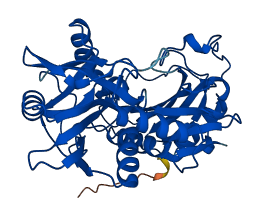
1 structures for Q54N47
| Entry ID | Method | Resolution | Chain | Position | Source |
|---|---|---|---|---|---|
| AF-Q54N47-F1 | Predicted | AlphaFoldDB |
No variants for Q54N47
| Variant ID(s) | Position | Change | Description | Diseaes Association | Provenance |
|---|---|---|---|---|---|
| No variants for Q54N47 | |||||
No associated diseases with Q54N47
1 regional properties for Q54N47
| Type | Name | Position | InterPro Accession |
|---|---|---|---|
| conserved_site | Aminotransferase, class IV, conserved site | 246 - 281 | IPR018300 |
Functions
| Description | ||
|---|---|---|
| EC Number | 2.6.1.42 | Transaminases |
| Subcellular Localization |
|
|
| PANTHER Family | ||
| PANTHER Subfamily | ||
| PANTHER Protein Class | ||
| PANTHER Pathway Category | No pathway information available | |
1 GO annotations of cellular component
| Name | Definition |
|---|---|
| mitochondrion | A semiautonomous, self replicating organelle that occurs in varying numbers, shapes, and sizes in the cytoplasm of virtually all eukaryotic cells. It is notably the site of tissue respiration. |
5 GO annotations of molecular function
| Name | Definition |
|---|---|
| branched-chain-amino-acid transaminase activity | Catalysis of the reaction: a branched-chain amino acid + 2-oxoglutarate = L-glutamate + a 2-oxocarboxylate derived from the branched-chain amino acid. |
| L-isoleucine transaminase activity | Catalysis of the reaction: 2-oxoglutarate + L-isoleucine = (S)-3-methyl-2-oxopentanoic acid + L-glutamic acid. |
| L-leucine transaminase activity | Catalysis of the reaction: 2-oxoglutarate + L-leucine = 4-methyl-2-oxopentanoate + L-glutamatic acid. |
| L-leucine:2-oxoglutarate aminotransferase activity | Catalysis of the reaction: L-leucine + 2-oxoglutarate = 4-methyl-2-oxopentanoate + L-glutamate. |
| L-valine transaminase activity | Catalysis of the reaction: 2-oxoglutarate + L-valine = 3-methyl-2-oxobutanoic acid + L-glutamatic acid. |
2 GO annotations of biological process
| Name | Definition |
|---|---|
| branched-chain amino acid biosynthetic process | The chemical reactions and pathways resulting in the formation of amino acids containing a branched carbon skeleton, comprising isoleucine, leucine and valine. |
| cellular amino acid biosynthetic process | The chemical reactions and pathways resulting in the formation of amino acids, organic acids containing one or more amino substituents. |
No homologous proteins in AiPD
| UniProt AC | Gene Name | Protein Name | Species | Evidence Code |
|---|---|---|---|---|
| No homologous proteins | ||||
| 10 | 20 | 30 | 40 | 50 | 60 |
| MFGRFIRQYS | TSKNIINVNE | LIVEKTKTPF | QKYTDKTKLV | FGKQFSDHMI | EVQWTKEEGW |
| 70 | 80 | 90 | 100 | 110 | 120 |
| GVPKISGYHN | LSIPPSASVL | HYALECFEGM | KAYKDSNGKI | RLFRPDQNMN | RFLNSAKRIC |
| 130 | 140 | 150 | 160 | 170 | 180 |
| LPEFNKEAVI | ELIKKLCVLD | KDWIPEGKGY | SLYLRPTLIA | TQNSLGVGAS | NSALMFVIAS |
| 190 | 200 | 210 | 220 | 230 | 240 |
| PVGPYYPEGF | KPVKLIADDQ | YVRAWAGGSG | AFKLGSNYAP | TIFPQLEAAK | KGFSQVLWLL |
| 250 | 260 | 270 | 280 | 290 | 300 |
| NDYVTEVGTM | NMFVFWNNAQ | GEKELITPPL | GDGTILPGVT | RDSILKLTQQ | WGEFKITEKN |
| 310 | 320 | 330 | 340 | 350 | 360 |
| FTMTELAKAI | KEGRVFEAFG | AGTAAIVSPI | ESISYKGENY | SIPIDASLNC | GPLTKRISDS |
| 370 | |||||
| IMAIQYGETN | SDWSVIVD |