Q54K32
Gene name |
rgaA (DG1029, rasGAP1, DDB_G0287585) |
Protein name |
Ras GTPase-activating-like protein rgaA |
Names |
DGAP1, Developmental gene 1029 protein |
Species |
Dictyostelium discoideum (Slime mold) |
KEGG Pathway |
ddi:DDB_G0287585 |
EC number |
|
Protein Class |
|
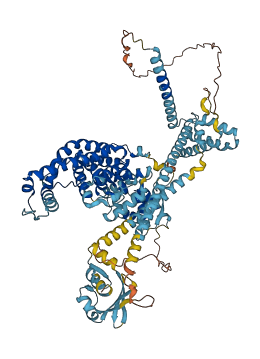
Descriptions
The autoinhibited protein was predicted that may have potential autoinhibitory elements via cis-regPred.
Autoinhibitory domains (AIDs)
Target domain |
|
Relief mechanism |
|
Assay |
cis-regPred |
Accessory elements
No accessory elements
Autoinhibited structure

Activated structure
1 structures for Q54K32
| Entry ID | Method | Resolution | Chain | Position | Source |
|---|---|---|---|---|---|
| AF-Q54K32-F1 | Predicted | AlphaFoldDB |
No variants for Q54K32
| Variant ID(s) | Position | Change | Description | Diseaes Association | Provenance |
|---|---|---|---|---|---|
| No variants for Q54K32 | |||||
No associated diseases with Q54K32
Functions
6 GO annotations of cellular component
| Name | Definition |
|---|---|
| basal cortex | The region that lies just beneath the plasma membrane on the basal edge of a cell. |
| cell cortex | The region of a cell that lies just beneath the plasma membrane and often, but not always, contains a network of actin filaments and associated proteins. |
| cell trailing edge | The area of a motile cell opposite to the direction of movement. |
| cleavage furrow | The cleavage furrow is a plasma membrane invagination at the cell division site. The cleavage furrow begins as a shallow groove and eventually deepens to divide the cytoplasm. |
| lateral part of motile cell | The area of a motile cell perpendicular to the direction of movement. |
| plasma membrane | The membrane surrounding a cell that separates the cell from its external environment. It consists of a phospholipid bilayer and associated proteins. |
6 GO annotations of molecular function
| Name | Definition |
|---|---|
| actin filament binding | Binding to an actin filament, also known as F-actin, a helical filamentous polymer of globular G-actin subunits. |
| alpha-catenin binding | Binding to catenin complex alpha subunit. |
| calmodulin binding | Binding to calmodulin, a calcium-binding protein with many roles, both in the calcium-bound and calcium-free states. |
| GTPase activator activity | Binds to and increases the activity of a GTPase, an enzyme that catalyzes the hydrolysis of GTP. |
| protein kinase regulator activity | Modulates the activity of a protein kinase, an enzyme which phosphorylates a protein. |
| small GTPase binding | Binding to a small monomeric GTPase. |
16 GO annotations of biological process
| Name | Definition |
|---|---|
| actin cytoskeleton organization | A process that is carried out at the cellular level which results in the assembly, arrangement of constituent parts, or disassembly of cytoskeletal structures comprising actin filaments and their associated proteins. |
| activation of GTPase activity | Any process that initiates the activity of an inactive GTPase through the replacement of GDP by GTP. |
| cell motility | Any process involved in the controlled self-propelled movement of a cell that results in translocation of the cell from one place to another. |
| chemotaxis to cAMP | The directed movement of a motile cell or organism in response to the presence of 3',5'-cAMP. |
| culmination involved in sorocarp development | The process whose specific outcome is the progression of the culminant over time, from its formation to the mature structure. Culmination begins with a morphogenetic change of the finger-like or migratory slug giving rise to an organized structure containing a stalk and a sorus. This process is the final stage of sorocarp development. |
| epithelium-like organization | The organization of a polarized cell layer during morphogenesis in protozoa; an example is found during culmination in D. discoideum, involving alpha and beta catenins. |
| MAPK cascade | An intracellular protein kinase cascade containing at least a MAPK, a MAPKK and a MAP3K. The cascade can also contain an additional tiers: the upstream MAP4K. The kinases in each tier phosphorylate and activate the kinase in the downstream tier to transmit a signal within a cell. |
| mitotic cytokinesis | A cell cycle process that results in the division of the cytoplasm of a cell after mitosis, resulting in the separation of the original cell into two daughter cells. |
| negative regulation of asexual reproduction | Any process that stops, prevents or reduces the frequency, rate or extent of asexual reproduction. |
| positive regulation of cytoskeleton organization | Any process that activates or increases the frequency, rate or extent of the formation, arrangement of constituent parts, or disassembly of cytoskeletal structures. |
| protein localization | Any process in which a protein is transported to, or maintained in, a specific location. |
| regulation of actin cytoskeleton organization | Any process that modulates the frequency, rate or extent of the formation, arrangement of constituent parts, or disassembly of cytoskeletal structures comprising actin filaments and their associated proteins. |
| sorocarp development | The process whose specific outcome is the progression of the sorocarp over time, from its formation to the mature structure. The process begins with the aggregation of individual cells and ends with the mature sorocarp. The sorocarp is a structure containing a spore-bearing sorus that sits on top of a stalk. An example of this process is found in Dictyostelium discoideum. |
| sorocarp stalk cell differentiation | The process in which a relatively unspecialized cell acquires specialized features of a sorocarp stalk cell, any of the cellulose-covered cells that form the stalk of a sorocarp. An example of this process is found in Dictyostelium discoideum. |
| sorocarp stalk morphogenesis | The process in which the sorocarp stalk is generated and organized. The sorocarp stalk is a tubular structure that consists of cellulose-covered cells stacked on top of each other and surrounded by an acellular stalk tube composed of cellulose and glycoprotein. An example of this process is found in Dictyostelium discoideum. |
| sporulation resulting in formation of a cellular spore | The process in which a relatively unspecialized cell acquires the specialized features of a cellular spore, a cell form that can be used for dissemination, for survival of adverse conditions because of its heat and dessication resistance, and/or for reproduction. |
No homologous proteins in AiPD
| UniProt AC | Gene Name | Protein Name | Species | Evidence Code |
|---|---|---|---|---|
| No homologous proteins | ||||
| 10 | 20 | 30 | 40 | 50 | 60 |
| MNKEEYSDIS | DSESEEVHET | NNHNEHEHEE | EDDTPEIVVP | ERKFLKEDED | YSVPFPVMRE |
| 70 | 80 | 90 | 100 | 110 | 120 |
| CLVLLLQSRR | ILRDMMYYRF | KMDRFLSGNL | SVFEIQNLLH | SQREDKESDW | IAEIQELKRN |
| 130 | 140 | 150 | 160 | 170 | 180 |
| LVSEVRRNHT | LERDLNRLDK | RIALLIKNRG | NIQDVLADKA | GLKAPKHKGD | QKKPELINDP |
| 190 | 200 | 210 | 220 | 230 | 240 |
| KKLEAYQNLF | YLLQTEPKYL | AGLVYLIQPE | QMESFLGTVI | LTLFGDAFTP | REEFLLLSLY |
| 250 | 260 | 270 | 280 | 290 | 300 |
| RLSIQKEMAN | IATVGDFLKA | DTVVPKMIIT | YNKRKQGTDY | LKAVIGPILS | NVIKQELNLE |
| 310 | 320 | 330 | 340 | 350 | 360 |
| LKPNLVYAAI | ISEQEIRTGE | KSTLDRNVSH | EKALEVPEVT | KTIKARVDQL | ISICEQFLDG |
| 370 | 380 | 390 | 400 | 410 | 420 |
| IISSLNRLPY | GIRWICKQIY | QIAEKNFTKS | TQDEILKVIG | YFIYYRFIQV | AMVSPEEYDL |
| 430 | 440 | 450 | 460 | 470 | 480 |
| VGREIHPTAR | KNLINVSKVL | QALFNFAQFG | SSEKHFIPLN | GWITSHMGDI | KNYLQEIIEV |
| 490 | 500 | 510 | 520 | 530 | 540 |
| GEPEDYLQVD | KYMELTQKTK | PVIIISLPEI | CNTHQLISKN | LDSLVAKGEK | DDPMRIIMKE |
| 550 | 560 | 570 | 580 | 590 | 600 |
| LDEFGPPPDI | AADDDREVQL | TLSNKFQKTI | EEELSPGESL | LSQTKEMVIS | LLRALPTLPE |
| 610 | 620 | 630 | 640 | 650 | 660 |
| QKDQSDEPPN | LVDVLNKARQ | ADPSLEPEIK | KILDNLKKLE | EYNLTTSADN | YSSFLKAVAL |
| 670 | 680 | 690 | 700 | 710 | 720 |
| EVVNRAEIRE | QQKKEKQRLT | TSLNNLRKHQ | KYLNEQIAQY | NQYLQDCRLK | HYQNKSKKKK |
| 730 | 740 | 750 | 760 | 770 | 780 |
| KGDGAKVGPF | KFSFSELHKK | GVIVDSEVPQ | ITRKKIKFVI | SSDTVGVFDV | SAKMAGIDVQ |
| 790 | 800 | 810 | 820 | ||
| TMRLELDDLL | ELNSIGTTTL | ELDQITLDVN | MTIHLLNKLF | LY |