Q54IR8
Gene name |
washc5 |
Protein name |
WASH complex subunit 5 |
Names |
WASH complex subunit strumpellin homolog |
Species |
Dictyostelium discoideum (Slime mold) |
KEGG Pathway |
ddi:DDB_G0288569 |
EC number |
|
Protein Class |
|
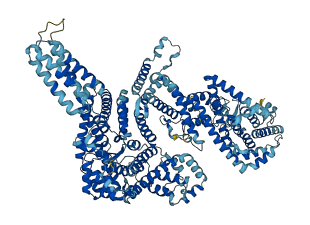
Descriptions
The autoinhibited protein was predicted that may have potential autoinhibitory elements via cis-regPred.
Autoinhibitory domains (AIDs)
Target domain |
|
Relief mechanism |
|
Assay |
cis-regPred |
Accessory elements
No accessory elements
Autoinhibited structure

Activated structure
1 structures for Q54IR8
| Entry ID | Method | Resolution | Chain | Position | Source |
|---|---|---|---|---|---|
| AF-Q54IR8-F1 | Predicted | AlphaFoldDB |
No variants for Q54IR8
| Variant ID(s) | Position | Change | Description | Diseaes Association | Provenance |
|---|---|---|---|---|---|
| No variants for Q54IR8 | |||||
No associated diseases with Q54IR8
No regional properties for Q54IR8
| Type | Name | Position | InterPro Accession |
|---|---|---|---|
| No domain, repeats, and functional sites for Q54IR8 | |||
4 GO annotations of cellular component
| Name | Definition |
|---|---|
| cytoplasm | The contents of a cell excluding the plasma membrane and nucleus, but including other subcellular structures. |
| endosome | A vacuole to which materials ingested by endocytosis are delivered. |
| phagolysosome membrane | The lipid bilayer surrounding a phagolysosome. |
| WASH complex | A protein complex that localizes at the surface of endosomes, where it recruits and activates the Arp2/3 complex to induce actin polymerization. In human, the WASH complex is composed of F-actin-capping protein subunits alpha and beta, WASH1, FAM21, KIAA1033, KIAA0196 and CCDC53. |
1 GO annotations of molecular function
| Name | Definition |
|---|---|
| identical protein binding | Binding to an identical protein or proteins. |
9 GO annotations of biological process
| Name | Definition |
|---|---|
| actin filament polymerization | Assembly of actin filaments by the addition of actin monomers to a filament. |
| endosome fission | The process by which early and late endosomes undergo budding and fission reactions that separate regions destined for lysosomal degradation from carriers to be recycled to the plasma membrane. |
| endosome organization | A process that is carried out at the cellular level which results in the assembly, arrangement of constituent parts, or disassembly of endosomes. |
| exocytosis | A process of secretion by a cell that results in the release of intracellular molecules (e.g. hormones, matrix proteins) contained within a membrane-bounded vesicle. Exocytosis can occur either by full fusion, when the vesicle collapses into the plasma membrane, or by a kiss-and-run mechanism that involves the formation of a transient contact, a pore, between a granule (for exemple of chromaffin cells) and the plasma membrane. The latter process most of the time leads to only partial secretion of the granule content. Exocytosis begins with steps that prepare vesicles for fusion with the membrane (tethering and docking) and ends when molecules are secreted from the cell. |
| lysosome organization | A process that is carried out at the cellular level which results in the assembly, arrangement of constituent parts, or disassembly of a lysosome. A lysosome is a cytoplasmic, membrane-bounded organelle that is found in most animal cells and that contains a variety of hydrolases. |
| phagocytosis | A vesicle-mediated transport process that results in the engulfment of external particulate material by phagocytes and their delivery to the lysosome. The particles are initially contained within phagocytic vacuoles (phagosomes), which then fuse with primary lysosomes to effect digestion of the particles. |
| phagosome reneutralization | Any process that increases the pH of the phagosome, measured by the concentration of the hydrogen ion, as part of the process of phagosome maturation. |
| protein-containing complex organization | Any process in which macromolecules aggregate, disaggregate, or are modified, resulting in the formation, disassembly, or alteration of a protein complex. |
| regulation of actin nucleation | Any process that modulates the frequency, rate or extent of actin nucleation, the initial step in the formation of an actin filament in which actin monomers combine to form a new filament. |
No homologous proteins in AiPD
| UniProt AC | Gene Name | Protein Name | Species | Evidence Code |
|---|---|---|---|---|
| No homologous proteins | ||||
| 10 | 20 | 30 | 40 | 50 | 60 |
| MVKEFLGEGS | QAGQNLLRLV | SRGNAIIAEL | LRLSAHIPSV | FKLEDRNEAR | KYQDILLDFK |
| 70 | 80 | 90 | 100 | 110 | 120 |
| YLSNPDFYES | KIEENADLVD | LETEFRDNHI | DILIRFYHLF | ESIYKYIMDL | EHYIVDVEKG |
| 130 | 140 | 150 | 160 | 170 | 180 |
| FYIHLTIEAI | LINGDGKQLL | SEAVYLYGVM | LILMDNLIEG | PVRERMLISY | LRNKGPVDLP |
| 190 | 200 | 210 | 220 | 230 | 240 |
| LIDEVCKLCK | STGYIPGSPK | KPPNYPEEYF | RRVELPENVI | SMIVGRLRSD | DLYNGTESFP |
| 250 | 260 | 270 | 280 | 290 | 300 |
| QPEHRSVALS | TQACMIYVIL | YFIPDILNNK | NSIMREIVDK | FFPDNWVISF | FLGFTIDLSV |
| 310 | 320 | 330 | 340 | 350 | 360 |
| AWEPYKAAKT | AMGNTIIQSN | IQYQTQRFWK | EVSELNKLVD | DLLVDGLLVE | EYIVDNVHKI |
| 370 | 380 | 390 | 400 | 410 | 420 |
| ITTLRRCNVT | IRWVMLHSNA | SQKKFKDLVL | MGGSQEDVLY | LLLNTAQLEF | VFKNIFQQLL |
| 430 | 440 | 450 | 460 | 470 | 480 |
| ATKEEKWEEN | KKLASDSMVE | LSEYFSGEKA | LTRVKKNENL | QKWFGEISQK | ISQLDSTDST |
| 490 | 500 | 510 | 520 | 530 | 540 |
| STGRKIQQLS | LALEEVEQFQ | QIDSSIQVKQ | FLIETRQFLT | KMIKIVNIKE | EVLVNLSVCA |
| 550 | 560 | 570 | 580 | 590 | 600 |
| DMSYAWEIVN | NYVDQMQKGI | KSDPKCVLKL | RATFLKLVSI | LDLPLVRIAQ | CSSPDLISVS |
| 610 | 620 | 630 | 640 | 650 | 660 |
| EYYSGELVGY | VRKVLEIVPK | QMFLILKQII | NMQTNNIQEM | PTKVEKERLR | DFAQLDQRYD |
| 670 | 680 | 690 | 700 | 710 | 720 |
| LARATHSVSV | FTEGILAMET | TLVGIIEVDP | KQLLEDGIRK | ELVLQIALAM | DKTLIFSGKP |
| 730 | 740 | 750 | 760 | 770 | 780 |
| YQAPSNKQQQ | QEIELLQRLK | ELSNILDGFR | RSFQYIQDYV | NIQGLKIWQE | EFSRIVNFYV |
| 790 | 800 | 810 | 820 | 830 | 840 |
| EQECNSFLKK | KVYDWQSQYQ | SVAIPIPKFP | SQSDQNSQQS | VNMIGRLARE | LLNQTNCKTT |
| 850 | 860 | 870 | 880 | 890 | 900 |
| LYLNQIGWFD | PSSGKELVGI | NTWSILHQSV | GIFGLTGLDK | LFSFMMVKDL | QVFVSQTRSL |
| 910 | 920 | 930 | 940 | 950 | 960 |
| VEKSLKGFLN | EFEDYLRPTT | NIPDTMIRYQ | QALDKTKLLY | PIFIDVLTKI | GQIQLIRRQI |
| 970 | 980 | 990 | 1000 | 1010 | 1020 |
| SNQLNFHCKI | DSNMLFSSLD | IMNKSLLNDI | ESHFQRPDSN | PYPSDDNTLL | FDLAQYLDTA |
| 1030 | 1040 | 1050 | 1060 | 1070 | 1080 |
| GINDPFTKIY | ITTSPLEQFP | CLLFLFVLSQ | VSKFQFNSKL | NVMSSKKQKN | SYDWTPFIIG |
| 1090 | 1100 | 1110 | 1120 | 1130 | 1140 |
| CITILQQFHS | LHTQKFLAFV | GQYIKSHINI | ALANPKENNK | DDADYPEDVI | GLLRFLEDFC |
| 1150 | 1160 | ||||
| KYSHTSRKIV | EGYVPPYIFD | YYNN |