Q54IK1
Gene name |
ragA (DDB_G0288701) |
Protein name |
Ras-related GTP-binding protein A |
Names |
|
Species |
Dictyostelium discoideum (Slime mold) |
KEGG Pathway |
ddi:DDB_G0288701 |
EC number |
|
Protein Class |
|
Descriptions
The autoinhibited protein was predicted that may have potential autoinhibitory elements via cis-regPred.
Autoinhibitory domains (AIDs)
Target domain |
|
Relief mechanism |
|
Assay |
cis-regPred |
Accessory elements
No accessory elements
Autoinhibited structure

Activated structure
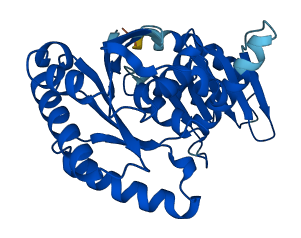
1 structures for Q54IK1
| Entry ID | Method | Resolution | Chain | Position | Source |
|---|---|---|---|---|---|
| AF-Q54IK1-F1 | Predicted | AlphaFoldDB |
No variants for Q54IK1
| Variant ID(s) | Position | Change | Description | Diseaes Association | Provenance |
|---|---|---|---|---|---|
| No variants for Q54IK1 | |||||
No associated diseases with Q54IK1
1 regional properties for Q54IK1
| Type | Name | Position | InterPro Accession |
|---|---|---|---|
| domain | Small GTP-binding protein domain | 3 - 141 | IPR005225 |
3 GO annotations of cellular component
| Name | Definition |
|---|---|
| Gtr1-Gtr2 GTPase complex | A heterodimer GTPase complex. In S. cerevisiae, this complex contains Gtr1p and Gtr2p proteins. |
| lysosome | A small lytic vacuole that has cell cycle-independent morphology found in most animal cells and that contains a variety of hydrolases, most of which have their maximal activities in the pH range 5-6. The contained enzymes display latency if properly isolated. About 40 different lysosomal hydrolases are known and lysosomes have a great variety of morphologies and functions. |
| nucleus | A membrane-bounded organelle of eukaryotic cells in which chromosomes are housed and replicated. In most cells, the nucleus contains all of the cell's chromosomes except the organellar chromosomes, and is the site of RNA synthesis and processing. In some species, or in specialized cell types, RNA metabolism or DNA replication may be absent. |
2 GO annotations of molecular function
| Name | Definition |
|---|---|
| GTP binding | Binding to GTP, guanosine triphosphate. |
| GTPase activity | Catalysis of the reaction: GTP + H2O = GDP + H+ + phosphate. |
5 GO annotations of biological process
| Name | Definition |
|---|---|
| cellular response to amino acid stimulus | Any process that results in a change in state or activity of a cell (in terms of movement, secretion, enzyme production, gene expression, etc.) as a result of an amino acid stimulus. An amino acid is a carboxylic acids containing one or more amino groups. |
| cellular response to starvation | Any process that results in a change in state or activity of a cell (in terms of movement, secretion, enzyme production, gene expression, etc.) as a result of deprivation of nourishment. |
| phosphate ion transport | The directed movement of phosphate into, out of or within a cell, or between cells, by means of some agent such as a transporter or pore. |
| positive regulation of TOR signaling | Any process that activates or increases the frequency, rate or extent of TOR signaling. |
| regulation of autophagy | Any process that modulates the frequency, rate or extent of autophagy. Autophagy is the process in which cells digest parts of their own cytoplasm. |
No homologous proteins in AiPD
| UniProt AC | Gene Name | Protein Name | Species | Evidence Code |
|---|---|---|---|---|
| No homologous proteins | ||||
| 10 | 20 | 30 | 40 | 50 | 60 |
| MKRKVLLMGR | SESGKTSMRS | IIFANYIARD | TMRLGVTIDV | EHSHVRFLGN | LVLNLWDCGG |
| 70 | 80 | 90 | 100 | 110 | 120 |
| QEGFLESYLT | TQRDHIFRNV | EVLIYVFDIE | SREHQKDIKN | YKSCIEAISQ | NSKDAKIFCL |
| 130 | 140 | 150 | 160 | 170 | 180 |
| IHKMDLVPED | QRDTLFKNKE | QEIRQASLPL | KPTCFRTSIW | DETLYKAWSS | IVYSLIPNVK |
| 190 | 200 | 210 | 220 | 230 | 240 |
| VLEYNLDKFC | KICEADEVVL | FEKATFLVIS | HSARKVHKDV | HRFEKISTII | KQFFLSCSKS |
| 250 | 260 | 270 | 280 | 290 | 300 |
| QANFQAMEVR | NSNFAAFIDA | FTSNTYIMVI | MSDPTIESSA | TLLNIQVAKS | HFEKFINSTS |
| N |