Q54G78
Gene name |
ssrp1 (ssrp, DDB_G0290331) |
Protein name |
FACT complex subunit SSRP1 |
Names |
Facilitates chromatin transcription complex subunit SSRP1, Structure-specific recognition protein |
Species |
Dictyostelium discoideum (Slime mold) |
KEGG Pathway |
ddi:DDB_G0290331 |
EC number |
|
Protein Class |
|
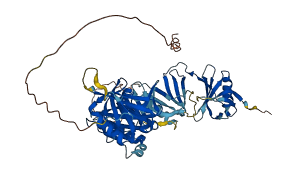
Descriptions
The autoinhibited protein was predicted that may have potential autoinhibitory elements via cis-regPred.
Autoinhibitory domains (AIDs)
Target domain |
|
Relief mechanism |
|
Assay |
cis-regPred |
Accessory elements
No accessory elements
Autoinhibited structure

Activated structure
1 structures for Q54G78
| Entry ID | Method | Resolution | Chain | Position | Source |
|---|---|---|---|---|---|
| AF-Q54G78-F1 | Predicted | AlphaFoldDB |
No variants for Q54G78
| Variant ID(s) | Position | Change | Description | Diseaes Association | Provenance |
|---|---|---|---|---|---|
| No variants for Q54G78 | |||||
No associated diseases with Q54G78
3 regional properties for Q54G78
1 GO annotations of cellular component
| Name | Definition |
|---|---|
| FACT complex | A histone chaperone complex that facilitates nucleosome disassembly and reassembly upon DNA or RNA polymerase passage. |
4 GO annotations of molecular function
| Name | Definition |
|---|---|
| DNA binding | Any molecular function by which a gene product interacts selectively and non-covalently with DNA (deoxyribonucleic acid). |
| histone binding | Binding to a histone, any of a group of water-soluble proteins found in association with the DNA of eukaryotic or archaeal chromosomes. They are involved in the condensation and coiling of chromosomes during cell division and have also been implicated in gene regulation and DNA replication. They may be chemically modified (methylated, acetlyated and others) to regulate gene transcription. |
| identical protein binding | Binding to an identical protein or proteins. |
| nucleosome binding | Binding to a nucleosome, a complex comprised of DNA wound around a multisubunit core and associated proteins, which forms the primary packing unit of DNA into higher order structures. |
3 GO annotations of biological process
| Name | Definition |
|---|---|
| DNA repair | The process of restoring DNA after damage. Genomes are subject to damage by chemical and physical agents in the environment (e.g. UV and ionizing radiations, chemical mutagens, fungal and bacterial toxins, etc.) and by free radicals or alkylating agents endogenously generated in metabolism. DNA is also damaged because of errors during its replication. A variety of different DNA repair pathways have been reported that include direct reversal, base excision repair, nucleotide excision repair, photoreactivation, bypass, double-strand break repair pathway, and mismatch repair pathway. |
| DNA replication | The cellular metabolic process in which a cell duplicates one or more molecules of DNA. DNA replication begins when specific sequences, known as origins of replication, are recognized and bound by initiation proteins, and ends when the original DNA molecule has been completely duplicated and the copies topologically separated. The unit of replication usually corresponds to the genome of the cell, an organelle, or a virus. The template for replication can either be an existing DNA molecule or RNA. |
| regulation of chromatin organization | Any process that modulates the frequency, rate or extent of chromatin organization. |
No homologous proteins in AiPD
| UniProt AC | Gene Name | Protein Name | Species | Evidence Code |
|---|---|---|---|---|
| No homologous proteins | ||||
| 10 | 20 | 30 | 40 | 50 | 60 |
| MSSSSNPVSQ | FNNISLGGRI | SGTRGILKFT | TNNITWKSEN | GKIETVSSSD | IKRANWARVT |
| 70 | 80 | 90 | 100 | 110 | 120 |
| PRIFQLILSI | KGGATVKFDG | FKEQDYEVVR | KYLSDQYNVS | PLEIIELSSK | GCNWGEVKVN |
| 130 | 140 | 150 | 160 | 170 | 180 |
| GPMIQFTTDH | GKVGFEFPIS | EVSQSVIGAN | NKNELTLEFH | HDKAMDDDDE | TMVEMRFFTP |
| 190 | 200 | 210 | 220 | 230 | 240 |
| IRPSKEGEEG | GKEKKVGEDG | EEDEEDEEDA | EKEEEISALE | QFQQTIMNKS | DMVSNVGKSL |
| 250 | 260 | 270 | 280 | 290 | 300 |
| VVFSAIQFLT | PRGRIDIEMY | PTFLKLHGKT | HDYKVPYESI | SRLFQFFRPD | QKHIFFIISL |
| 310 | 320 | 330 | 340 | 350 | 360 |
| DPPIRQGQTK | YAHLVIQFQA | EENIHLELNL | TDELQQKFKD | QLSPIMNGNA | NALICKILKA |
| 370 | 380 | 390 | 400 | 410 | 420 |
| LTGKKITIPG | NFQSDSGANS | IKCSLKANEG | YLYPLERCFF | FVHKPPTYIK | FEDISNIEFA |
| 430 | 440 | 450 | 460 | 470 | 480 |
| RYGAPSVRGG | SNRTFDLSIN | LKNSTSIQFV | NIQREEYPSL | FNFLKEKKLS | ILNPVTTGPA |
| 490 | 500 | 510 | 520 | ||
| MIIDDDDSDD | DDYEPSESGS | ESDEGSASDE | SEEESEEDKK | AKKKQKK |