Q54FM3
Gene name |
eif2b4 (DDB_G0290759) |
Protein name |
Translation initiation factor eIF-2B subunit delta |
Names |
eIF-2B GDP-GTP exchange factor subunit delta |
Species |
Dictyostelium discoideum (Slime mold) |
KEGG Pathway |
ddi:DDB_G0290759 |
EC number |
|
Protein Class |
|
Descriptions
The autoinhibited protein was predicted that may have potential autoinhibitory elements via cis-regPred.
Autoinhibitory domains (AIDs)
Target domain |
|
Relief mechanism |
|
Assay |
cis-regPred |
Accessory elements
No accessory elements
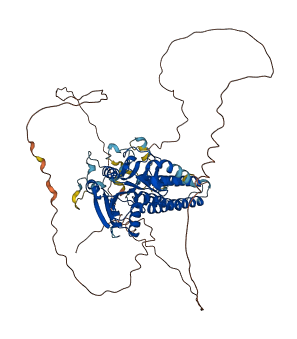
Autoinhibited structure

Activated structure
1 structures for Q54FM3
| Entry ID | Method | Resolution | Chain | Position | Source |
|---|---|---|---|---|---|
| AF-Q54FM3-F1 | Predicted | AlphaFoldDB |
No variants for Q54FM3
| Variant ID(s) | Position | Change | Description | Diseaes Association | Provenance |
|---|---|---|---|---|---|
| No variants for Q54FM3 | |||||
No associated diseases with Q54FM3
4 regional properties for Q54FM3
| Type | Name | Position | InterPro Accession |
|---|---|---|---|
| domain | Translation elongation factor P/YeiP, central | 66 - 126 | IPR001059 |
| domain | Translation elongation factor, KOW-like | 3 - 60 | IPR013185 |
| conserved_site | Translation elongation factor P/YeiP, conserved site | 150 - 169 | IPR013852 |
| domain | Elongation factor P, C-terminal | 129 - 184 | IPR015365 |
1 GO annotations of cellular component
| Name | Definition |
|---|---|
| eukaryotic translation initiation factor 2B complex | A multisubunit guanine nucleotide exchange factor which catalyzes the exchange of GDP bound to initiation factor eIF2 for GTP, generating active eIF2-GTP. In humans, it is composed of five subunits, alpha, beta, delta, gamma and epsilon. |
1 GO annotations of molecular function
| Name | Definition |
|---|---|
| translation initiation factor activity | Functions in the initiation of ribosome-mediated translation of mRNA into a polypeptide. |
1 GO annotations of biological process
| Name | Definition |
|---|---|
| translational initiation | The process preceding formation of the peptide bond between the first two amino acids of a protein. This includes the formation of a complex of the ribosome, mRNA or circRNA, and an initiation complex that contains the first aminoacyl-tRNA. |
No homologous proteins in AiPD
| UniProt AC | Gene Name | Protein Name | Species | Evidence Code |
|---|---|---|---|---|
| No homologous proteins | ||||
| 10 | 20 | 30 | 40 | 50 | 60 |
| MSSFGKNSSY | RDTGASLKEL | GDYLDSKQEG | KPTHQKTIGF | DTNTSPVSIP | TIISPPLGSN |
| 70 | 80 | 90 | 100 | 110 | 120 |
| NSNYGKSPKS | SYDNKQTSPL | LSASNNRKNN | NNNNNNNNAT | SPKDSSIIGK | NNVNSDLSKV |
| 130 | 140 | 150 | 160 | 170 | 180 |
| SSSLNELKFE | KQPIGSTSST | PTSTPSSTPS | SSTPSSTPST | PNTNSQQQQQ | QQQQQKKQQQ |
| 190 | 200 | 210 | 220 | 230 | 240 |
| QQPKQPQQPK | QQSKQQATQQ | DKKDKEQQQQ | QQDKQDKESN | EIKGSKEVAK | DGQHGVKQFD |
| 250 | 260 | 270 | 280 | 290 | 300 |
| DPKQRGKITK | KKIIKVGESS | RSVQLFNHLP | QYNSEFSMGV | SVSTDEPNEK | YPIHPDIISL |
| 310 | 320 | 330 | 340 | 350 | 360 |
| GLKYAEFKIA | GSNARAIAMM | TAFIQIFKDY | VAAPDKVYSR | ELDSLLKRNI | QFLVDCRPIS |
| 370 | 380 | 390 | 400 | 410 | 420 |
| ISMGNSINYV | KHKLSLTNNM | SHEGARDYLI | KSINEFIERI | QMADNAIVKH | GCSKINDGDV |
| 430 | 440 | 450 | 460 | 470 | 480 |
| ILTYASSHVV | ELIIQQAIQD | KKKFRLIIVD | SRPKHEGREL | LHRLVLHGVK | ITYIMLHAVS |
| 490 | 500 | 510 | 520 | 530 | 540 |
| YIMKEVTKVF | VGAYSVLSNG | NLISRSGTSL | VASMAKFYNV | PFIVCCETYK | FTERVQLDSI |
| 550 | 560 | 570 | 580 | 590 | 600 |
| CFNQIGNPQD | LVQNLGEKEG | SKSLLENWES | YSTLKLLNLM | YDLTPIELID | MVITEFGMLP |
| 610 | |||||
| PTSIPVVLRE | YRKEVISIN |