Q54FH7
Gene name |
zmpste24 (DDB_G0290849) |
Protein name |
CAAX prenyl protease 1 homolog |
Names |
Prenyl protein-specific endoprotease 1 |
Species |
Dictyostelium discoideum (Slime mold) |
KEGG Pathway |
ddi:DDB_G0290849 |
EC number |
3.4.24.84: Metalloendopeptidases |
Protein Class |
|
Descriptions
The autoinhibited protein was predicted that may have potential autoinhibitory elements via cis-regPred.
Autoinhibitory domains (AIDs)
Target domain |
|
Relief mechanism |
|
Assay |
cis-regPred |
Accessory elements
No accessory elements
Autoinhibited structure

Activated structure
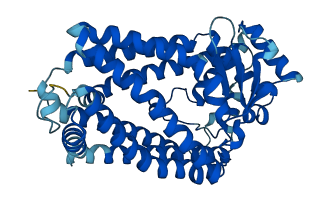
1 structures for Q54FH7
| Entry ID | Method | Resolution | Chain | Position | Source |
|---|---|---|---|---|---|
| AF-Q54FH7-F1 | Predicted | AlphaFoldDB |
No variants for Q54FH7
| Variant ID(s) | Position | Change | Description | Diseaes Association | Provenance |
|---|---|---|---|---|---|
| No variants for Q54FH7 | |||||
1 associated diseases with Q54FH7
[MIM: 619079]: Inflammatory bowel disease 30 (IBD30)
A chronic, relapsing inflammation of the gastrointestinal tract with a complex etiology and a multifactorial inheritance pattern. It is subdivided into Crohn disease and ulcerative colitis phenotypes. Crohn disease may affect any part of the gastrointestinal tract from the mouth to the anus, but most frequently it involves the terminal ileum and colon. Bowel inflammation is transmural and discontinuous. It may contain granulomas or be associated with intestinal or perianal fistulas. In contrast, in ulcerative colitis, the inflammation is continuous and limited to rectal and colonic mucosal layers; fistulas and granulomas are not observed. Both diseases include extraintestinal inflammation of the skin, eyes, or joints. . Note=The disease may be caused by variants affecting the gene represented in this entry. A number of groups have studied the possible association between variant rs2043211 and inflammatory bowel disease (PubMed:17030188, PubMed:19319132, PubMed:23506543, PubMed:26462578). According to some studies involving a limited number of patients, this variant is associated with inflammatory bowel disease (PubMed:17030188, PubMed:19319132, PubMed:23506543). Such association is however not confirmed in studies involving a large number of patients (PubMed:26462578). Discrepancies between studies may be caused by the variable consequences of this polymorphism in the different isoforms (PubMed:29408806). Whereas rs2043211 introduces a stop codon after 'Cys-10' (Cys10Ter) in isoform 1, and therefore the likely formation of a downstream transcriptional start site for this isoform, it causes Ile-102 variation in isoform 5, due to the upstream start site (PubMed:29408806). Moreover, most patients bearing this polymorphism continue to express the slightly smaller but fully functional isoform 7, as a result of transcription downstream of the rs2043211 polymorphism (PubMed:29408806). .
Without disease ID
- A chronic, relapsing inflammation of the gastrointestinal tract with a complex etiology and a multifactorial inheritance pattern. It is subdivided into Crohn disease and ulcerative colitis phenotypes. Crohn disease may affect any part of the gastrointestinal tract from the mouth to the anus, but most frequently it involves the terminal ileum and colon. Bowel inflammation is transmural and discontinuous. It may contain granulomas or be associated with intestinal or perianal fistulas. In contrast, in ulcerative colitis, the inflammation is continuous and limited to rectal and colonic mucosal layers; fistulas and granulomas are not observed. Both diseases include extraintestinal inflammation of the skin, eyes, or joints. . Note=The disease may be caused by variants affecting the gene represented in this entry. A number of groups have studied the possible association between variant rs2043211 and inflammatory bowel disease (PubMed:17030188, PubMed:19319132, PubMed:23506543, PubMed:26462578). According to some studies involving a limited number of patients, this variant is associated with inflammatory bowel disease (PubMed:17030188, PubMed:19319132, PubMed:23506543). Such association is however not confirmed in studies involving a large number of patients (PubMed:26462578). Discrepancies between studies may be caused by the variable consequences of this polymorphism in the different isoforms (PubMed:29408806). Whereas rs2043211 introduces a stop codon after 'Cys-10' (Cys10Ter) in isoform 1, and therefore the likely formation of a downstream transcriptional start site for this isoform, it causes Ile-102 variation in isoform 5, due to the upstream start site (PubMed:29408806). Moreover, most patients bearing this polymorphism continue to express the slightly smaller but fully functional isoform 7, as a result of transcription downstream of the rs2043211 polymorphism (PubMed:29408806). .
6 regional properties for Q54FH7
| Type | Name | Position | InterPro Accession |
|---|---|---|---|
| domain | Arf GTPase activating protein | 1 - 124 | IPR001164 |
| repeat | Ankyrin repeat | 132 - 228 | IPR002110 |
| domain | GIT, Spa2 homology (SHD) domain | 266 - 296 | IPR013724-1 |
| domain | GIT, Spa2 homology (SHD) domain | 330 - 360 | IPR013724-2 |
| domain | ARF GTPase-activating protein GIT1, C-terminal | 641 - 753 | IPR022018 |
| domain | Arf GTPase-activating protein GIT1/2, coiled-coil domain | 414 - 478 | IPR032352 |
Functions
| Description | ||
|---|---|---|
| EC Number | 3.4.24.84 | Metalloendopeptidases |
| Subcellular Localization |
|
|
| PANTHER Family | ||
| PANTHER Subfamily | ||
| PANTHER Protein Class | ||
| PANTHER Pathway Category | No pathway information available | |
1 GO annotations of cellular component
| Name | Definition |
|---|---|
| integral component of endoplasmic reticulum membrane | The component of the endoplasmic reticulum membrane consisting of the gene products and protein complexes having at least some part of their peptide sequence embedded in the hydrophobic region of the membrane. |
2 GO annotations of molecular function
| Name | Definition |
|---|---|
| metal ion binding | Binding to a metal ion. |
| metalloendopeptidase activity | Catalysis of the hydrolysis of internal, alpha-peptide bonds in a polypeptide chain by a mechanism in which water acts as a nucleophile, one or two metal ions hold the water molecule in place, and charged amino acid side chains are ligands for the metal ions. |
1 GO annotations of biological process
| Name | Definition |
|---|---|
| CAAX-box protein processing | The second process in a series of specific posttranslational modifications to the CAAX box region of CAAX box proteins, in which the last three amino acids of the protein (AAX) are removed by proteolysis. |
No homologous proteins in AiPD
| UniProt AC | Gene Name | Protein Name | Species | Evidence Code |
|---|---|---|---|---|
| No homologous proteins | ||||
| 10 | 20 | 30 | 40 | 50 | 60 |
| MVNYFIISIS | FFLLEHFYSF | YLNFRQSKLL | KNLTKVPEYC | KDRITQEDFK | KSQEYSKAKL |
| 70 | 80 | 90 | 100 | 110 | 120 |
| DYKTLTSTIQ | VLTTLLSFYY | PVYPYFWNLS | LELAEKIGYP | NEIIRSCFFF | AFTVGVSVIT |
| 130 | 140 | 150 | 160 | 170 | 180 |
| EIPFSYYYQF | ILEEKFGYNR | MTRTLFIKDK | IISTLLMIGF | GLPILSLAIF | IINWSGPQLW |
| 190 | 200 | 210 | 220 | 230 | 240 |
| FYCWLLLVAI | TLLSITIYPT | FIQPLFNKFT | PVDGELAESI | FALAKRVGFP | ASKDTIFVVD |
| 250 | 260 | 270 | 280 | 290 | 300 |
| NSKRDGHMNA | YFYGLFGTKR | IVLYDTLVNE | LDKEELLAVM | GHEFGHYKMS | HTLKQMLLVQ |
| 310 | 320 | 330 | 340 | 350 | 360 |
| VHLVTLLYAF | SLLINDDQLY | QQFGFVSSKD | SVLVGLTLFM | FLYSPIDRIF | SLLINIFSRK |
| 370 | 380 | 390 | 400 | 410 | 420 |
| YEFQADDFAV | ELGFLNSNHL | FKLHFKELGC | LVYDPLYSAY | HHSHPTLVER | SNNIDKKVAL |
| YKLKNK |