Q53201
Gene name |
NGR_a01310 (y4uI) |
Protein name |
Putative transposase y4uI |
Names |
|
Species |
Sinorhizobium fredii (strain NBRC 101917 / NGR234) |
KEGG Pathway |
rhi:NGR_a01310 |
EC number |
|
Protein Class |
|
Descriptions
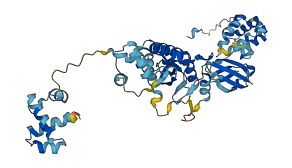
The autoinhibited protein was predicted that may have potential autoinhibitory elements via cis-regPred.
Autoinhibitory domains (AIDs)
Target domain |
|
Relief mechanism |
|
Assay |
cis-regPred |
Accessory elements
No accessory elements
Autoinhibited structure

Activated structure
1 structures for Q53201
| Entry ID | Method | Resolution | Chain | Position | Source |
|---|---|---|---|---|---|
| AF-Q53201-F1 | Predicted | AlphaFoldDB |
No variants for Q53201
| Variant ID(s) | Position | Change | Description | Diseaes Association | Provenance |
|---|---|---|---|---|---|
| No variants for Q53201 | |||||
No associated diseases with Q53201
No GO annotations of cellular component
| Name | Definition |
|---|---|
| No GO annotations for cellular component |
1 GO annotations of molecular function
| Name | Definition |
|---|---|
| DNA binding | Any molecular function by which a gene product interacts selectively and non-covalently with DNA (deoxyribonucleic acid). |
3 GO annotations of biological process
| Name | Definition |
|---|---|
| DNA integration | The process in which a DNA segment is incorporated into another, usually larger, DNA molecule such as a chromosome. |
| DNA recombination | Any process in which a new genotype is formed by reassortment of genes resulting in gene combinations different from those that were present in the parents. In eukaryotes genetic recombination can occur by chromosome assortment, intrachromosomal recombination, or nonreciprocal interchromosomal recombination. Interchromosomal recombination occurs by crossing over. In bacteria it may occur by genetic transformation, conjugation, transduction, or F-duction. |
| transposition | Any process involved in mediating the movement of discrete segments of DNA between nonhomologous sites. |
No homologous proteins in AiPD
| UniProt AC | Gene Name | Protein Name | Species | Evidence Code |
|---|---|---|---|---|
| No homologous proteins | ||||
| 10 | 20 | 30 | 40 | 50 | 60 |
| MPTRRLLMRQ | VREILKLRLD | VGLSNRIIAK | QLGVGETSVR | DTLKRLHREG | LTWPLPDTIS |
| 70 | 80 | 90 | 100 | 110 | 120 |
| DRELEQRLYG | TPGKKAGRRK | QSEPDWSAVA | RELKRKHVTL | QVLWEEYIAR | DPDGFRYSRY |
| 130 | 140 | 150 | 160 | 170 | 180 |
| CELFRNWHGR | LPLVMRQSHA | GGEKLFVDYA | GDKVAVVDRK | TGVVRDAHIF | VAVMGASSLS |
| 190 | 200 | 210 | 220 | 230 | 240 |
| FALATWSEQL | PDWIEAHNAA | YRFFGGVTQL | LVSDNTKCAV | IKACHFDPMV | NRSYTDMARH |
| 250 | 260 | 270 | 280 | 290 | 300 |
| YSTAVFPARP | RKPRDKAKVE | NCVGIVERWL | LGRLRNRTFY | SLADLNKAIA | DLITRLNDER |
| 310 | 320 | 330 | 340 | 350 | 360 |
| VIRQYGKTRR | ALFDELDAPN | LKPLPAEPWV | HAEWRRCRVG | IDYHIELSRH | FYSVPYRFAR |
| 370 | 380 | 390 | 400 | 410 | 420 |
| SEVEVRYTIR | TVEIFLGGDR | IAAHVRGSSN | GRHTTVAVHM | PPNHQRYREW | TPAKIRSEAK |
| 430 | 440 | 450 | 460 | 470 | 480 |
| RIGPMLRVLV | DRIIEKRAHP | EQGYRACVGI | IGLERRFGVD | RLEAAAQRAL | EFQVLNYPGI |
| 490 | 500 | 510 | |||
| KSILEKELDR | LPRSERLEQE | PIQHSNLRGS | EYYH |