Q51368
Gene name |
tonB (PA5531) |
Protein name |
Protein TonB |
Names |
|
Species |
Pseudomonas aeruginosa (strain ATCC 15692 / DSM 22644 / CIP 104116 / JCM 14847 / LMG 12228 / 1C / PRS 101 / PAO1) |
KEGG Pathway |
pae:PA5531 |
EC number |
|
Protein Class |
|
Descriptions
The autoinhibited protein was predicted that may have potential autoinhibitory elements via cis-regPred.
Autoinhibitory domains (AIDs)
Target domain |
|
Relief mechanism |
|
Assay |
cis-regPred |
Accessory elements
No accessory elements
Autoinhibited structure

Activated structure
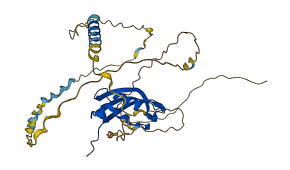
3 structures for Q51368
| Entry ID | Method | Resolution | Chain | Position | Source |
|---|---|---|---|---|---|
| 6FIP | NMR | - | A | 247-342 | PDB |
| 6I97 | X-ray | 335 A | D/E | 251-340 | PDB |
| AF-Q51368-F1 | Predicted | AlphaFoldDB |
No variants for Q51368
| Variant ID(s) | Position | Change | Description | Diseaes Association | Provenance |
|---|---|---|---|---|---|
| No variants for Q51368 | |||||
No associated diseases with Q51368
4 regional properties for Q51368
| Type | Name | Position | InterPro Accession |
|---|---|---|---|
| domain | Protein kinase domain | 13 - 271 | IPR000719 |
| active_site | Serine/threonine-protein kinase, active site | 131 - 143 | IPR008271 |
| domain | Calcium/calmodulin-dependent protein kinase II, association-domain | 346 - 473 | IPR013543 |
| binding_site | Protein kinase, ATP binding site | 19 - 42 | IPR017441 |
3 GO annotations of cellular component
| Name | Definition |
|---|---|
| integral component of membrane | The component of a membrane consisting of the gene products and protein complexes having at least some part of their peptide sequence embedded in the hydrophobic region of the membrane. |
| outer membrane-bounded periplasmic space | The region between the inner (cytoplasmic or plasma) membrane and outer membrane of organisms with two membranes such as Gram negative bacteria. These periplasmic spaces are relatively thick and contain a thin peptidoglycan layer (PGL), also referred to as a thin cell wall. |
| plasma membrane protein complex | Any protein complex that is part of the plasma membrane. |
2 GO annotations of molecular function
| Name | Definition |
|---|---|
| energy transducer activity | The biological transducer activity that accepts energy and converts it to another form, often by transfer to another molecule within the cell. |
| siderophore transmembrane transporter activity | Enables the transfer of a solute or solutes from one side of a membrane to the other according to the reaction: siderophore-iron(out) + H+(out) = siderophore-iron(in) + H+(in). |
6 GO annotations of biological process
| Name | Definition |
|---|---|
| bacterial-type flagellum-dependent swarming motility | Bacterial-type flagellum-dependent cell motility in which the action of numerous flagella results in the smooth movement of a group of cells along a solid surface. Swarming motility is observed in groups of bacteria. |
| cellular response to antibiotic | Any process that results in a change in state or activity of a cell (in terms of movement, secretion, enzyme production, gene expression, etc.) as a result of an antibiotic stimulus. An antibiotic is a chemical substance produced by a microorganism which has the capacity to inhibit the growth of or to kill other microorganisms. |
| iron import into cell | The directed movement of iron ions from outside of a cell into the cytoplasmic compartment. This may occur via transport across the plasma membrane or via endocytosis. |
| protein transport | The directed movement of proteins into, out of or within a cell, or between cells, by means of some agent such as a transporter or pore. |
| single-species biofilm formation | A process in which planktonically growing microorganisms of the same species grow at a liquid-air interface or on a solid substrate under the flow of a liquid and produce extracellular polymers that facilitate matrix formation, resulting in a change in the organisms' growth rate and gene transcription. |
| type IV pilus-dependent motility | Any process involved in the controlled movement of a bacterial cell which is dependent on the presence of type IV pili. Includes social gliding motility and twitching motility. |
No homologous proteins in AiPD
| UniProt AC | Gene Name | Protein Name | Species | Evidence Code |
|---|---|---|---|---|
| No homologous proteins | ||||
| 10 | 20 | 30 | 40 | 50 | 60 |
| MSPQPSRSPD | RFSLAALAED | HPTAPAQGDE | SESLPCVNAQ | RGEPNLRVVD | CSGARRDEEV |
| 70 | 80 | 90 | 100 | 110 | 120 |
| AVEEVLIPYA | HGSDPEDVPG | EPPKSRWWLS | SGAAVAMHVA | IIGALVWVMP | TPAELNLGHG |
| 130 | 140 | 150 | 160 | 170 | 180 |
| ELPKTMQVNF | VQLEKKAEPT | PQPPAAAPEP | TPPKIEEPKP | EPPKPKPVEK | PKPKPKPKPK |
| 190 | 200 | 210 | 220 | 230 | 240 |
| PVENAIPKAK | PKPEPKPKPE | PEPSTEASSQ | PSPSSAAPPP | APTVGQSTPG | AQTAPSGSQG |
| 250 | 260 | 270 | 280 | 290 | 300 |
| PAGLPSGSLN | DSDIKPLRMD | PPVYPRMAQA | RGIEGRVKVL | FTITSDGRID | DIQVLESVPS |
| 310 | 320 | 330 | 340 | ||
| RMFDREVRQA | MAKWRFEPRV | SGGKIVARQA | TKMFFFKIEK | RR |