Q51152
Gene name |
NMB0075 |
Protein name |
Uncharacterized protein NMB0075 |
Names |
|
Species |
Neisseria meningitidis serogroup B (strain MC58) |
KEGG Pathway |
nme:NMB0075 |
EC number |
|
Protein Class |
|
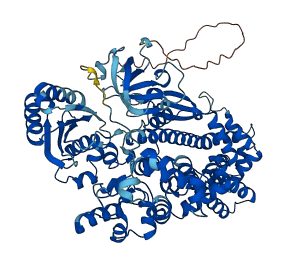
Descriptions
The autoinhibited protein was predicted that may have potential autoinhibitory elements via cis-regPred.
Autoinhibitory domains (AIDs)
Target domain |
|
Relief mechanism |
|
Assay |
cis-regPred |
Accessory elements
No accessory elements
Autoinhibited structure

Activated structure
1 structures for Q51152
| Entry ID | Method | Resolution | Chain | Position | Source |
|---|---|---|---|---|---|
| AF-Q51152-F1 | Predicted | AlphaFoldDB |
No variants for Q51152
| Variant ID(s) | Position | Change | Description | Diseaes Association | Provenance |
|---|---|---|---|---|---|
| No variants for Q51152 | |||||
No associated diseases with Q51152
7 regional properties for Q51152
| Type | Name | Position | InterPro Accession |
|---|---|---|---|
| domain | S1 domain | 637 - 709 | IPR003029 |
| domain | YqgF/RNase H-like domain | 318 - 413 | IPR006641 |
| domain | Tex-like protein, N-terminal | 7 - 188 | IPR018974 |
| domain | RNA-binding domain, S1 | 638 - 709 | IPR022967 |
| domain | Tex protein, YqgF-like domain | 319 - 440 | IPR032639 |
| domain | HHH domain 9 | 550 - 619 | IPR041692 |
| domain | Tex, S1 domain | 640 - 707 | IPR044146 |
1 GO annotations of cellular component
| Name | Definition |
|---|---|
| cytosol | The part of the cytoplasm that does not contain organelles but which does contain other particulate matter, such as protein complexes. |
2 GO annotations of molecular function
| Name | Definition |
|---|---|
| mRNA binding | Binding to messenger RNA (mRNA), an intermediate molecule between DNA and protein. mRNA includes UTR and coding sequences, but does not contain introns. |
| structural constituent of ribosome | The action of a molecule that contributes to the structural integrity of the ribosome. |
2 GO annotations of biological process
| Name | Definition |
|---|---|
| nucleobase-containing compound metabolic process | Any cellular metabolic process involving nucleobases, nucleosides, nucleotides and nucleic acids. |
| translation | The cellular metabolic process in which a protein is formed, using the sequence of a mature mRNA or circRNA molecule to specify the sequence of amino acids in a polypeptide chain. Translation is mediated by the ribosome, and begins with the formation of a ternary complex between aminoacylated initiator methionine tRNA, GTP, and initiation factor 2, which subsequently associates with the small subunit of the ribosome and an mRNA or circRNA. Translation ends with the release of a polypeptide chain from the ribosome. |
No homologous proteins in AiPD
| UniProt AC | Gene Name | Protein Name | Species | Evidence Code |
|---|---|---|---|---|
| No homologous proteins | ||||
| 10 | 20 | 30 | 40 | 50 | 60 |
| MNITQILSQE | LSATAAQITA | AVELLDDGAT | VPFIARYRKE | ATGGLDDTQL | RRLAERLQYL |
| 70 | 80 | 90 | 100 | 110 | 120 |
| RELEERKAVV | LKSIEEQGKL | SDDLRAQIEA | ADNKTALEDL | YLPYKPKRRT | KAQIAREHGL |
| 130 | 140 | 150 | 160 | 170 | 180 |
| QPLADVLLAE | QSQDVEAAAQ | GYLNENVPDA | KAALDGARAI | LMEQFAEDAE | LIGTLRDKLW |
| 190 | 200 | 210 | 220 | 230 | 240 |
| NEAEIHAQVV | EGKETEGEKF | SDYFDHREPV | RTMPSHRALA | VLRGRNEGVL | NIALKYQPDD |
| 250 | 260 | 270 | 280 | 290 | 300 |
| TPITRQSEYE | QIIACRFKVS | DGHKWLRDTV | RLTWRAKIFL | SLELEALGRL | KEAADTDAIT |
| 310 | 320 | 330 | 340 | 350 | 360 |
| VFARNLKDLL | LVAPAGRLTT | LGLDPGYRNG | VKCAVVDDTG | KLLDTVIVYL | HQENNMLATL |
| 370 | 380 | 390 | 400 | 410 | 420 |
| SRLIKQHGVK | LIAIGNGTAS | RETDKIAGEL | VRGMPEMGLH | KIVVSEAGAS | IYSASELAAR |
| 430 | 440 | 450 | 460 | 470 | 480 |
| EFPDLDVSLR | GAVSIARRLQ | DPLAELVKID | PKSIGVGQYQ | HDVNQNQLAK | SLDAVVEDCV |
| 490 | 500 | 510 | 520 | 530 | 540 |
| NAVGVDVNTA | SAPLLARISG | LNQTLAQNIV | AYRDENGAFD | SRKKLLKVPR | LGEKTFEQAA |
| 550 | 560 | 570 | 580 | 590 | 600 |
| GFLRINGGKE | PLDASAVHPE | AYPVVAKMLA | QQGISAAELI | GNRERVKQIK | ASDFTDERFG |
| 610 | 620 | 630 | 640 | 650 | 660 |
| LPTILDILSE | LEKPGRDPRG | EFQTASFAEG | IHEISDLQVG | MILEGVVSNV | ANFGAFVDIG |
| 670 | 680 | 690 | 700 | 710 | 720 |
| VHQDGLVHIS | ALSNKFVQDP | REVVKAGDVV | KVKVLEVDAA | RKRIALTMRL | DDEPGGAKHK |
| 730 | 740 | 750 | |||
| MPSENRSRER | TAGRKPQRND | RAPANSAMAD | AFAKLKR |