Q4ZRT7
Gene name |
pstB1 |
Protein name |
Phosphate import ATP-binding protein PstB 1 |
Names |
ABC phosphate transporter 1, Phosphate-transporting ATPase 1 |
Species |
Pseudomonas syringae pv syringae (strain B728a) |
KEGG Pathway |
psb:Psyr_3103 |
EC number |
7.3.2.1: Linked to the hydrolysis of a nucleoside triphosphate |
Protein Class |
|
Descriptions
The autoinhibited protein was predicted that may have potential autoinhibitory elements via cis-regPred.
Autoinhibitory domains (AIDs)
Target domain |
|
Relief mechanism |
|
Assay |
cis-regPred |
Accessory elements
No accessory elements
Autoinhibited structure

Activated structure
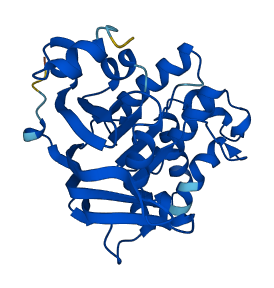
1 structures for Q4ZRT7
| Entry ID | Method | Resolution | Chain | Position | Source |
|---|---|---|---|---|---|
| AF-Q4ZRT7-F1 | Predicted | AlphaFoldDB |
No variants for Q4ZRT7
| Variant ID(s) | Position | Change | Description | Diseaes Association | Provenance |
|---|---|---|---|---|---|
| No variants for Q4ZRT7 | |||||
No associated diseases with Q4ZRT7
5 regional properties for Q4ZRT7
| Type | Name | Position | InterPro Accession |
|---|---|---|---|
| domain | Protein kinase domain | 60 - 323 | IPR000719 |
| domain | Serine-threonine/tyrosine-protein kinase, catalytic domain | 63 - 318 | IPR001245 |
| active_site | Tyrosine-protein kinase, active site | 182 - 194 | IPR008266 |
| binding_site | Protein kinase, ATP binding site | 66 - 92 | IPR017441 |
| domain | Tyrosine-protein kinase, catalytic domain | 60 - 319 | IPR020635 |
Functions
| Description | ||
|---|---|---|
| EC Number | 7.3.2.1 | Linked to the hydrolysis of a nucleoside triphosphate |
| Subcellular Localization |
|
|
| PANTHER Family | ||
| PANTHER Subfamily | ||
| PANTHER Protein Class | ||
| PANTHER Pathway Category | No pathway information available | |
1 GO annotations of cellular component
| Name | Definition |
|---|---|
| plasma membrane | The membrane surrounding a cell that separates the cell from its external environment. It consists of a phospholipid bilayer and associated proteins. |
3 GO annotations of molecular function
| Name | Definition |
|---|---|
| ATP binding | Binding to ATP, adenosine 5'-triphosphate, a universally important coenzyme and enzyme regulator. |
| ATPase-coupled phosphate ion transmembrane transporter activity | Enables the transfer of a solute or solutes from one side of a membrane to the other according to the reaction: ATP + H2O + phosphate(out) = ADP + phosphate + phosphate(in). |
| inorganic phosphate transmembrane transporter activity | Enables the transfer of a inorganic phosphate from one side of a membrane to the other, up its concentration gradient. The transporter binds the solute and undergoes a series of conformational changes. Transport works equally well in either direction and is driven by a chemiosmotic source of energy. Secondary active transporters include symporters and antiporters. |
No GO annotations of biological process
| Name | Definition |
|---|---|
| No GO annotations for biological process |
No homologous proteins in AiPD
| UniProt AC | Gene Name | Protein Name | Species | Evidence Code |
|---|---|---|---|---|
| No homologous proteins | ||||
| 10 | 20 | 30 | 40 | 50 | 60 |
| MNNLSLANEK | TKIQVRGLEF | FYNNQKSLKS | IDMTIPEKRI | TAIIGPSGCG | KSTLLRVFNR |
| 70 | 80 | 90 | 100 | 110 | 120 |
| IYAMYPKQEA | RGEVLLNGEN | ILAPGYSMNR | LRSHVGMVFQ | KPVPFPMSIY | DNISYAIKHH |
| 130 | 140 | 150 | 160 | 170 | 180 |
| EKLSRREMED | RVEQALRGAA | LWDEVKDKLK | QSATGLSGGQ | QQRLCIARTI | ALRPQVLLLD |
| 190 | 200 | 210 | 220 | 230 | 240 |
| EPTSALDPIS | TGRIEQLITE | LKEQFTVIIV | THNMQQAARC | SDYTAFMFMG | ELIEHGDTDT |
| 250 | |||||
| IFTKPSKTQT | EDYITGRFG |