Q4ZJM7
Gene name |
Otol1 |
Protein name |
Otolin-1 |
Names |
|
Species |
Mus musculus (Mouse) |
KEGG Pathway |
mmu:229389 |
EC number |
|
Protein Class |
|
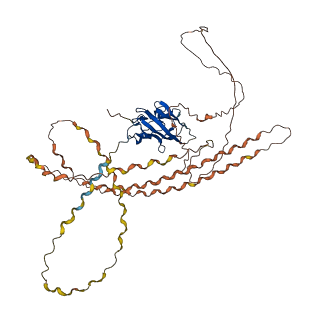
Descriptions
The autoinhibited protein was predicted that may have potential autoinhibitory elements via cis-regPred.
Autoinhibitory domains (AIDs)
Target domain |
|
Relief mechanism |
|
Assay |
cis-regPred |
Accessory elements
No accessory elements
Autoinhibited structure

Activated structure
1 structures for Q4ZJM7
| Entry ID | Method | Resolution | Chain | Position | Source |
|---|---|---|---|---|---|
| AF-Q4ZJM7-F1 | Predicted | AlphaFoldDB |
20 variants for Q4ZJM7
| Variant ID(s) | Position | Change | Description | Diseaes Association | Provenance |
|---|---|---|---|---|---|
| rs251273182 | 11 | L>F | No | EVA | |
| rs3388630228 | 19 | V>M | No | EVA | |
| rs238348388 | 20 | A>G | No | EVA | |
| rs3393177113 | 26 | T>K | No | EVA | |
| rs3388632217 | 30 | K>R | No | EVA | |
| rs3388632115 | 51 | F>L | No | EVA | |
| rs3388638066 | 83 | G>A | No | EVA | |
| rs3388635165 | 88 | A>G | No | EVA | |
| rs3388635176 | 89 | T>I | No | EVA | |
| rs248907808 | 91 | R>H | No | EVA | |
| rs260606842 | 140 | S>I | No | EVA | |
| rs3393196087 | 168 | Q>K | No | EVA | |
| rs3388624110 | 206 | S>A | No | EVA | |
| rs239358369 | 249 | R>Q | No | EVA | |
| rs3388635125 | 292 | G>C | No | EVA | |
| rs3388632271 | 345 | V>I | No | EVA | |
| rs3388632182 | 403 | G>A | No | EVA | |
| rs36663775 | 411 | V>M | No | EVA | |
| rs3413022446 | 464 | D>H | No | EVA | |
| rs37389056 | 479 | S>R | No | EVA |
No associated diseases with Q4ZJM7
3 regional properties for Q4ZJM7
| Type | Name | Position | InterPro Accession |
|---|---|---|---|
| domain | C1q domain | 341 - 478 | IPR001073 |
| repeat | Collagen triple helix repeat | 118 - 175 | IPR008160-1 |
| repeat | Collagen triple helix repeat | 244 - 341 | IPR008160-2 |
4 GO annotations of cellular component
| Name | Definition |
|---|---|
| collagen type IV trimer | A collagen heterotrimer containing type IV alpha chains; [alpha1(IV)]2alpha2(IV) trimers are commonly observed, although more type IV alpha chains exist and may be present in type IV trimers; type IV collagen triple helices associate to form 3 dimensional nets within basement membranes. |
| extracellular matrix | A structure lying external to one or more cells, which provides structural support, biochemical or biomechanical cues for cells or tissues. |
| extracellular region | The space external to the outermost structure of a cell. For cells without external protective or external encapsulating structures this refers to space outside of the plasma membrane. This term covers the host cell environment outside an intracellular parasite. |
| extracellular space | That part of a multicellular organism outside the cells proper, usually taken to be outside the plasma membranes, and occupied by fluid. |
2 GO annotations of molecular function
| Name | Definition |
|---|---|
| calcium ion binding | Binding to a calcium ion (Ca2+). |
| extracellular matrix structural constituent | The action of a molecule that contributes to the structural integrity of the extracellular matrix. |
4 GO annotations of biological process
| Name | Definition |
|---|---|
| collagen-activated tyrosine kinase receptor signaling pathway | The series of molecular signals initiated by collagen binding to its receptor on the surface of a target cell where the receptor possesses tyrosine kinase activity, and ending with the regulation of a downstream cellular process, e.g. transcription. |
| extracellular matrix organization | A process that is carried out at the cellular level which results in the assembly, arrangement of constituent parts, or disassembly of an extracellular matrix. |
| otolith mineralization | The precipitation of specific crystal forms of calcium carbonate with extracellular matrix proteins in the otolith organs of the vertebrate inner ear. |
| protein homooligomerization | The process of creating protein oligomers, compounds composed of a small number, usually between three and ten, of identical component monomers. Oligomers may be formed by the polymerization of a number of monomers or the depolymerization of a large protein polymer. |
No homologous proteins in AiPD
| UniProt AC | Gene Name | Protein Name | Species | Evidence Code |
|---|---|---|---|---|
| No homologous proteins | ||||
| 10 | 20 | 30 | 40 | 50 | 60 |
| MWIFSSLCAV | LTILAMDDVA | TEAKTTPYTK | FTKKSEGKEM | LKGLKPSSGF | FLDGEETVHT |
| 70 | 80 | 90 | 100 | 110 | 120 |
| ETAAMAEPTT | GSPALAMAES | TAGPSASATT | RLLPFESFSL | DTTGFVLNCC | HCCSFVTGQK |
| 130 | 140 | 150 | 160 | 170 | 180 |
| GEPGKMGKQG | PKGETGDTGS | PGHPGTTGPQ | GPKGQKGEKG | LKGDRGDQGA | GGIPGYPGKP |
| 190 | 200 | 210 | 220 | 230 | 240 |
| GEQGALGPKG | DKGTIGPAGT | KGQKGSKGEL | CGNGTKGEKG | DPGASGAHGF | IGEPGAKGEK |
| 250 | 260 | 270 | 280 | 290 | 300 |
| GGVGEKGYRG | DLGERGEKGQ | KGEKGMEGEK | GSRGDVGSEG | KRGSDGLPGL | RGDSGPKGEK |
| 310 | 320 | 330 | 340 | 350 | 360 |
| GEIGSPGFTG | PAGPKGELGS | KGVRGPTGKK | GSRGVKGSKG | EATQVPQSAF | SALLSKPFPP |
| 370 | 380 | 390 | 400 | 410 | 420 |
| PNVPIKFDKI | LSNDQGDYSP | VTGKFNCSVP | GTYIFSYHVT | VRGRPARISL | VARNRKQFKS |
| 430 | 440 | 450 | 460 | 470 | 480 |
| RETLYGQQVD | QASLLLILKL | SAGDQVWLEV | SKDWNGLYVG | PEDDSIFSGF | LLYPEETFSK |
| SP |