Q4WWE9
Gene name |
chl1 (AFUA_3G05590) |
Protein name |
ATP-dependent DNA helicase chl1 |
Names |
Chromosome loss protein 1 |
Species |
Neosartorya fumigata (strain ATCC MYA-4609 / Af293 / CBS 101355 / FGSC A1100) (Aspergillus fumigatus) |
KEGG Pathway |
afm:AFUA_3G05590 |
EC number |
3.6.4.12: Acting on ATP; involved in cellular and subcellular movement |
Protein Class |
|
Descriptions
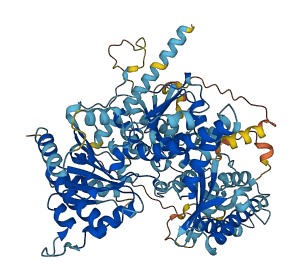
The autoinhibited protein was predicted that may have potential autoinhibitory elements via cis-regPred.
Autoinhibitory domains (AIDs)
Target domain |
|
Relief mechanism |
|
Assay |
cis-regPred |
Accessory elements
No accessory elements
Autoinhibited structure

Activated structure
1 structures for Q4WWE9
| Entry ID | Method | Resolution | Chain | Position | Source |
|---|---|---|---|---|---|
| AF-Q4WWE9-F1 | Predicted | AlphaFoldDB |
No variants for Q4WWE9
| Variant ID(s) | Position | Change | Description | Diseaes Association | Provenance |
|---|---|---|---|---|---|
| No variants for Q4WWE9 | |||||
No associated diseases with Q4WWE9
No regional properties for Q4WWE9
| Type | Name | Position | InterPro Accession |
|---|---|---|---|
| No domain, repeats, and functional sites for Q4WWE9 | |||
Functions
| Description | ||
|---|---|---|
| EC Number | 3.6.4.12 | Acting on ATP; involved in cellular and subcellular movement |
| Subcellular Localization |
|
|
| PANTHER Family | ||
| PANTHER Subfamily | ||
| PANTHER Protein Class | ||
| PANTHER Pathway Category | No pathway information available | |
3 GO annotations of cellular component
| Name | Definition |
|---|---|
| chromatin | The ordered and organized complex of DNA, protein, and sometimes RNA, that forms the chromosome. |
| nucleus | A membrane-bounded organelle of eukaryotic cells in which chromosomes are housed and replicated. In most cells, the nucleus contains all of the cell's chromosomes except the organellar chromosomes, and is the site of RNA synthesis and processing. In some species, or in specialized cell types, RNA metabolism or DNA replication may be absent. |
| site of double-strand break | A region of a chromosome at which a DNA double-strand break has occurred. DNA damage signaling and repair proteins accumulate at the lesion to respond to the damage and repair the DNA to form a continuous DNA helix. |
4 GO annotations of molecular function
| Name | Definition |
|---|---|
| ATP binding | Binding to ATP, adenosine 5'-triphosphate, a universally important coenzyme and enzyme regulator. |
| ATP hydrolysis activity | Catalysis of the reaction: ATP + H2O = ADP + H+ phosphate. ATP hydrolysis is used in some reactions as an energy source, for example to catalyze a reaction or drive transport against a concentration gradient. |
| DNA binding | Any molecular function by which a gene product interacts selectively and non-covalently with DNA (deoxyribonucleic acid). |
| DNA helicase activity | Unwinding of a DNA helix, driven by ATP hydrolysis. |
5 GO annotations of biological process
| Name | Definition |
|---|---|
| DNA duplex unwinding | The process in which interchain hydrogen bonds between two strands of DNA are broken or 'melted', generating a region of unpaired single strands. |
| DNA-templated DNA replication maintenance of fidelity | A DNA metabolic process that prevents or corrects errors to ensure that DNA is replicated accurately. Errors can be corrected either by intrinsic DNA polymerase proofreading activity or via mismatch repair. |
| establishment of sister chromatid cohesion | The process in which the sister chromatids of a replicated chromosome become associated with each other during S phase. |
| interstrand cross-link repair | Removal of a DNA interstrand crosslink (a covalent attachment of DNA bases on opposite strands of the DNA) and restoration of the DNA. DNA interstrand crosslinks occur when both strands of duplex DNA are covalently tethered together (e.g. by an exogenous or endogenous agent), thus preventing the strand unwinding necessary for essential DNA functions such as transcription and replication. |
| mitotic sister chromatid cohesion | The cell cycle process in which the sister chromatids of a replicated chromosome are joined along the entire length of the chromosome, from their formation in S phase through metaphase during a mitotic cell cycle. This cohesion cycle is critical for high fidelity chromosome transmission. |
No homologous proteins in AiPD
| UniProt AC | Gene Name | Protein Name | Species | Evidence Code |
|---|---|---|---|---|
| No homologous proteins | ||||
| 10 | 20 | 30 | 40 | 50 | 60 |
| MLEFAKRESA | RAVTEKRRAL | EARLEKIKVE | EEKQRHATDH | PKEARKRRRV | DTSSGDPGPE |
| 70 | 80 | 90 | 100 | 110 | 120 |
| QDDQFILDDY | DSDADERMAS | SKKLSDISGL | STSTLELLER | FKEQFSAPVE | DEIGHEDDDV |
| 130 | 140 | 150 | 160 | 170 | 180 |
| KIFYCSRTHS | QLSQFSSELR | RVKMPSSMPA | ELSTSDANTD | EVQERVKHLT | LGSRKNLCIN |
| 190 | 200 | 210 | 220 | 230 | 240 |
| PKVMSLGNAA | AINERCLELQ | QPGIAAEKRC | PYLPSKEDEG | QILQFRDHTL | ATIKDIEDMG |
| 250 | 260 | 270 | 280 | 290 | 300 |
| KLGKRMGICP | YYASRSVLKH | SENVLLKAQK | IVTLPYPLLL | QRSARDALDL | SIKNHVVIID |
| 310 | 320 | 330 | 340 | 350 | 360 |
| EAHNLMDAIC | NIHSVTIRLS | QLQTALLQLT | TYAHKHKARL | KGKNRSYIAQ | IIRLVSSIRD |
| 370 | 380 | 390 | 400 | 410 | 420 |
| HLRSILGQNL | PAEGTVDPSD | LMAGKGVDQI | NPYKLSRYLQ | ESKLARKVDG | YVEFLKNKNQ |
| 430 | 440 | 450 | 460 | 470 | 480 |
| QSDDKPSSPV | LFLVQSFLLS | LMNPSAEGRF | FYLKCHDDIQ | LRYMLLDPTN | QFREIVEDAR |
| 490 | 500 | 510 | 520 | 530 | 540 |
| AVILAGGTMS | PMSDYRNHLF | SYIAPSRLDT | FSYGHVIPPE | NLIAHTLVNG | VLGSEFDFTY |
| 550 | 560 | 570 | 580 | 590 | 600 |
| DSRDSEKMIL | DLGRTVATLC | QAIPDGVVAF | FPSYDYLSRI | VAIWRKPLEG | EKGETILSLI |
| 610 | 620 | 630 | 640 | 650 | 660 |
| EREKSILYEG | RDMGPKTDDL | LQEYTRTIDS | GQGALLLSVV | GGKLSEGINF | SDKLGRGVLI |
| 670 | 680 | 690 | 700 | 710 | 720 |
| IGLPFPNIRS | AVWQAKIQYV | EQKTYNSSSG | SEKDRQSIAK | AAGKDFYENA | CMRAVNQCIG |
| 730 | 740 | 750 | 760 | 770 | 780 |
| RAIRHRNDYA | AIVMIDRRYE | KANIQGKLPA | WIKESMLRRS | VRRPASALAA | DLSNFFSGRS |
| PR |