Q4WEH7
Gene name |
prp45 (AFUA_5G03050) |
Protein name |
Pre-mRNA-processing protein 45 |
Names |
|
Species |
Neosartorya fumigata (strain ATCC MYA-4609 / Af293 / CBS 101355 / FGSC A1100) (Aspergillus fumigatus) |
KEGG Pathway |
afm:AFUA_5G03050 |
EC number |
|
Protein Class |
|
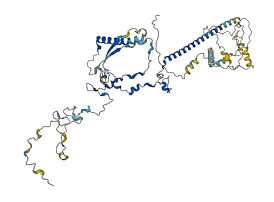
Descriptions
The autoinhibited protein was predicted that may have potential autoinhibitory elements via cis-regPred.
Autoinhibitory domains (AIDs)
Target domain |
|
Relief mechanism |
|
Assay |
cis-regPred |
Accessory elements
No accessory elements
Autoinhibited structure

Activated structure
1 structures for Q4WEH7
| Entry ID | Method | Resolution | Chain | Position | Source |
|---|---|---|---|---|---|
| AF-Q4WEH7-F1 | Predicted | AlphaFoldDB |
No variants for Q4WEH7
| Variant ID(s) | Position | Change | Description | Diseaes Association | Provenance |
|---|---|---|---|---|---|
| No variants for Q4WEH7 | |||||
No associated diseases with Q4WEH7
1 regional properties for Q4WEH7
| Type | Name | Position | InterPro Accession |
|---|---|---|---|
| domain | SKI-interacting protein SKIP, SNW domain | 191 - 349 | IPR004015 |
1 GO annotations of cellular component
| Name | Definition |
|---|---|
| spliceosomal complex | Any of a series of ribonucleoprotein complexes that contain snRNA(s) and small nuclear ribonucleoproteins (snRNPs), and are formed sequentially during the spliceosomal splicing of one or more substrate RNAs, and which also contain the RNA substrate(s) from the initial target RNAs of splicing, the splicing intermediate RNA(s), to the final RNA products. During cis-splicing, the initial target RNA is a single, contiguous RNA transcript, whether mRNA, snoRNA, etc., and the released products are a spliced RNA and an excised intron, generally as a lariat structure. During trans-splicing, there are two initial substrate RNAs, the spliced leader RNA and a pre-mRNA. |
No GO annotations of molecular function
| Name | Definition |
|---|---|
| No GO annotations for molecular function |
1 GO annotations of biological process
| Name | Definition |
|---|---|
| mRNA splicing, via spliceosome | The joining together of exons from one or more primary transcripts of messenger RNA (mRNA) and the excision of intron sequences, via a spliceosomal mechanism, so that mRNA consisting only of the joined exons is produced. |
No homologous proteins in AiPD
| UniProt AC | Gene Name | Protein Name | Species | Evidence Code |
|---|---|---|---|---|
| No homologous proteins | ||||
| 10 | 20 | 30 | 40 | 50 | 60 |
| MTSVAEGLFK | SLPKPKYTGE | DEEVPQHAQP | RGPRIVGADQ | IDQSQIVLRR | TGPPPYGNRA |
| 70 | 80 | 90 | 100 | 110 | 120 |
| GWRPRAAEDF | GDGGAFPEIL | VAQYPLDMGR | KGTATTSNAL | AVQVDAEGKV | KYDAIARRGH |
| 130 | 140 | 150 | 160 | 170 | 180 |
| SENRIVHASF | KDLIPLRQRV | DMGEISLDRP | SEEEVQAQME | KTKNALASLV | EGAVAAQKPK |
| 190 | 200 | 210 | 220 | 230 | 240 |
| NVKGGRRAEP | TFVRYTPANQ | MGDTTRKNDR | IMKIVERQQD | PMEPPKFKHK | KIPRGPPSPP |
| 250 | 260 | 270 | 280 | 290 | 300 |
| PPIMHSPPRK | LTAEDQEAWR | IPPPVSNWKN | PKGYTVPLDK | RLAADGRGLQ | DVTINDKFAQ |
| 310 | 320 | 330 | 340 | 350 | 360 |
| FAEALFTADR | HAREEVRLRA | QMQQKLAEKE | KAQKEEHLRA | LAQKAREERA | ASNRRDSRAR |
| 370 | 380 | 390 | 400 | 410 | 420 |
| SHTRSASRSP | SAYSRSATPS | DDEEAARERE | RIRRERRQDA | ERQLRQSRMG | TERRIQMMAR |
| 430 | 440 | 450 | 460 | 470 | 480 |
| EQNRDISEKV | ALGLAKPTQT | SESMWDSRLF | NQTSGLQSGF | NEDNPYDKPL | FAAQDAINSI |
| 490 | 500 | 510 | 520 | 530 | 540 |
| YRPRAQLDVD | DEEGAEGEMS | KIQKTNRFEV | LGKAKEGFRG | AAEAEARDGP | VQFEKDTTDP |
| 550 | 560 | 570 | |||
| FGIDSMIADV | TGGAGQKRYG | IQEVEREDRG | SKRARVDDD |