Q4VAH7
Gene name |
Hepacam2 (Miki) |
Protein name |
HEPACAM family member 2 |
Names |
Mitotic kinetics regulator |
Species |
Mus musculus (Mouse) |
KEGG Pathway |
mmu:101202 |
EC number |
|
Protein Class |
|
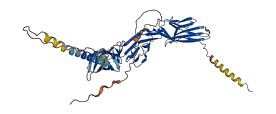
Descriptions
The autoinhibited protein was predicted that may have potential autoinhibitory elements via cis-regPred.
Autoinhibitory domains (AIDs)
Target domain |
|
Relief mechanism |
|
Assay |
cis-regPred |
Accessory elements
No accessory elements
Autoinhibited structure

Activated structure
1 structures for Q4VAH7
| Entry ID | Method | Resolution | Chain | Position | Source |
|---|---|---|---|---|---|
| AF-Q4VAH7-F1 | Predicted | AlphaFoldDB |
19 variants for Q4VAH7
| Variant ID(s) | Position | Change | Description | Diseaes Association | Provenance |
|---|---|---|---|---|---|
| rs32429568 | 14 | V>D | No | EVA | |
| rs261871746 | 40 | Y>H | No | EVA | |
| rs3388802570 | 42 | V>I | No | EVA | |
| rs3388815270 | 60 | T>I | No | EVA | |
| rs3388820501 | 173 | V>I | No | EVA | |
| rs3388802548 | 186 | S>G | No | EVA | |
| rs3388802576 | 196 | H>R | No | EVA | |
| rs3388813283 | 230 | E>D | No | EVA | |
| rs3396451456 | 288 | D>E | No | EVA | |
| rs3388802578 | 292 | H>L | No | EVA | |
| rs253162605 | 299 | H>R | No | EVA | |
| rs3396384770 | 364 | I>F | No | EVA | |
| rs3396389571 | 364 | I>M | No | EVA | |
| rs3388781726 | 423 | G>V | No | EVA | |
| rs242369270 | 434 | A>V | No | EVA | |
| rs3388814278 | 437 | G>V | No | EVA | |
| rs3388807879 | 439 | T>A | No | EVA | |
| rs3388793363 | 445 | G>V | No | EVA | |
| rs3388781720 | 455 | P>Q | No | EVA |
No associated diseases with Q4VAH7
6 regional properties for Q4VAH7
| Type | Name | Position | InterPro Accession |
|---|---|---|---|
| domain | Immunoglobulin subtype 2 | 165 - 227 | IPR003598 |
| domain | Immunoglobulin subtype | 39 - 142 | IPR003599-1 |
| domain | Immunoglobulin subtype | 158 - 236 | IPR003599-2 |
| domain | Immunoglobulin subtype | 256 - 334 | IPR003599-3 |
| domain | Immunoglobulin-like domain | 150 - 234 | IPR007110-1 |
| domain | Immunoglobulin-like domain | 236 - 332 | IPR007110-2 |
Functions
9 GO annotations of cellular component
| Name | Definition |
|---|---|
| centrosome | A structure comprised of a core structure (in most organisms, a pair of centrioles) and peripheral material from which a microtubule-based structure, such as a spindle apparatus, is organized. Centrosomes occur close to the nucleus during interphase in many eukaryotic cells, though in animal cells it changes continually during the cell-division cycle. |
| Golgi apparatus | A membrane-bound cytoplasmic organelle of the endomembrane system that further processes the core oligosaccharides (e.g. N-glycans) added to proteins in the endoplasmic reticulum and packages them into membrane-bound vesicles. The Golgi apparatus operates at the intersection of the secretory, lysosomal, and endocytic pathways. |
| Golgi membrane | The lipid bilayer surrounding any of the compartments of the Golgi apparatus. |
| integral component of membrane | The component of a membrane consisting of the gene products and protein complexes having at least some part of their peptide sequence embedded in the hydrophobic region of the membrane. |
| intracellular membrane-bounded organelle | Organized structure of distinctive morphology and function, bounded by a single or double lipid bilayer membrane and occurring within the cell. Includes the nucleus, mitochondria, plastids, vacuoles, and vesicles. Excludes the plasma membrane. |
| midbody | A thin cytoplasmic bridge formed between daughter cells at the end of cytokinesis. The midbody forms where the contractile ring constricts, and may persist for some time before finally breaking to complete cytokinesis. |
| mitotic spindle | A spindle that forms as part of mitosis. Mitotic and meiotic spindles contain distinctive complements of proteins associated with microtubules. |
| nucleoplasm | That part of the nuclear content other than the chromosomes or the nucleolus. |
| spindle | The array of microtubules and associated molecules that forms between opposite poles of a eukaryotic cell during mitosis or meiosis and serves to move the duplicated chromosomes apart. |
No GO annotations of molecular function
| Name | Definition |
|---|---|
| No GO annotations for molecular function |
2 GO annotations of biological process
| Name | Definition |
|---|---|
| cell division | The process resulting in division and partitioning of components of a cell to form more cells; may or may not be accompanied by the physical separation of a cell into distinct, individually membrane-bounded daughter cells. |
| centrosome cycle | The cell cycle process in which centrosome duplication and separation takes place. The centrosome cycle can operate with a considerable degree of independence from other processes of the cell cycle. |
No homologous proteins in AiPD
| UniProt AC | Gene Name | Protein Name | Species | Evidence Code |
|---|---|---|---|---|
| No homologous proteins | ||||
| 10 | 20 | 30 | 40 | 50 | 60 |
| MGQDAFMELL | RSMVGLSLCK | IHLLLIAGSC | LGLKVTVPSY | TVHGIRGQAL | YLPVHYGFHT |
| 70 | 80 | 90 | 100 | 110 | 120 |
| PASDIQIIWL | FERSHTMPKY | LLGSVNKSVV | PDLEYQHKFT | MMPPNASLLI | NPLQFTDEGN |
| 130 | 140 | 150 | 160 | 170 | 180 |
| YIVKVNIQGN | GTLSASQKIQ | VTVDDPVMKP | MVQFHPASGA | VEYVGNITLT | CQVEGGTRLV |
| 190 | 200 | 210 | 220 | 230 | 240 |
| YQWRKSGKPI | SINSSHSFSP | QNNTLWIVPV | TKEDIGNYTC | LVSNPVSEME | SDIIMPTIYY |
| 250 | 260 | 270 | 280 | 290 | 300 |
| GPYGLQVNSD | KGLKVGEVFT | VDLGEAVLFD | CSADSYPPNT | YSWIQRSDNT | THVIKHGPHL |
| 310 | 320 | 330 | 340 | 350 | 360 |
| EVASEKVAQK | TADYVCCAYN | NITGRRDETR | FTVIITSVGL | EKLAQRGKSL | SPLASITGIS |
| 370 | 380 | 390 | 400 | 410 | 420 |
| LFLIISMCLL | FLWKKYQPYK | AIRQKLEGRP | ESEYRKAQTF | SGHEDALSDF | GIYEFVTFPD |
| 430 | 440 | 450 | 460 | ||
| ASGVSRMSSR | SSPASDGVTG | QDIHGTIYEV | IQHIPEQQQE | NTE |