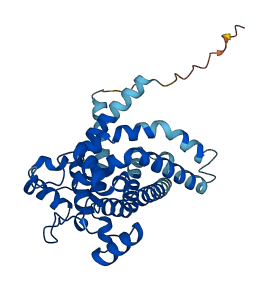
Descriptions
The autoinhibited protein was predicted that may have potential autoinhibitory elements via cis-regPred.
Autoinhibitory domains (AIDs)
Target domain |
|
Relief mechanism |
|
Assay |
cis-regPred |
Accessory elements
No accessory elements
Autoinhibited structure

Activated structure
1 structures for Q4R8M0
| Entry ID | Method | Resolution | Chain | Position | Source |
|---|---|---|---|---|---|
| AF-Q4R8M0-F1 | Predicted | AlphaFoldDB |
No variants for Q4R8M0
| Variant ID(s) | Position | Change | Description | Diseaes Association | Provenance |
|---|---|---|---|---|---|
| No variants for Q4R8M0 | |||||
No associated diseases with Q4R8M0
3 regional properties for Q4R8M0
| Type | Name | Position | InterPro Accession |
|---|---|---|---|
| repeat | Mitochondrial substrate/solute carrier | 18 - 113 | IPR018108-1 |
| repeat | Mitochondrial substrate/solute carrier | 122 - 216 | IPR018108-2 |
| repeat | Mitochondrial substrate/solute carrier | 219 - 309 | IPR018108-3 |
Functions
5 GO annotations of cellular component
| Name | Definition |
|---|---|
| membrane | A lipid bilayer along with all the proteins and protein complexes embedded in it an attached to it. |
| mitochondrial inner membrane | The inner, i.e. lumen-facing, lipid bilayer of the mitochondrial envelope. It is highly folded to form cristae. |
| mitochondrial permeability transition pore complex | A protein complex that connects the inner and outer membranes of animal mitochondria and acts as a pore that can open transiently to allow free diffusion of solutes between the mitochondrial matrix and the cytosol. The pore complex is formed of the voltage-dependent anion channel (VDAC), the adenine nucleotide translocase (ANT) and cyclophilin-D (CyP-D). |
| motile cilium | A cilium which may have a variable arrangement of axonemal microtubules and also contains molecular motors. It may beat with a whip-like pattern that promotes cell motility or transport of fluids and other cells across a cell surface, such as on epithelial cells that line the lumenal ducts of various tissues; or they may display a distinct twirling motion that directs fluid flow asymmetrically across the cellular surface to affect asymmetric body plan organization. Motile cilia can be found in single as well as multiple copies per cell. |
| plasma membrane | The membrane surrounding a cell that separates the cell from its external environment. It consists of a phospholipid bilayer and associated proteins. |
1 GO annotations of molecular function
| Name | Definition |
|---|---|
| ATP:ADP antiporter activity | Catalysis of the reaction: ATP(out) + ADP(in) = ATP(in) + ADP(out). |
6 GO annotations of biological process
| Name | Definition |
|---|---|
| cell differentiation | The process in which relatively unspecialized cells, e.g. embryonic or regenerative cells, acquire specialized structural and/or functional features that characterize the cells, tissues, or organs of the mature organism or some other relatively stable phase of the organism's life history. Differentiation includes the processes involved in commitment of a cell to a specific fate and its subsequent development to the mature state. |
| male meiosis I | A cell cycle process comprising the steps by which a cell progresses through male meiosis I, the first meiotic division in the male germline. |
| mitochondrial ADP transmembrane transport | The process in which ADP is transported across a mitochondrial membrane, into or out of the mitochondrion. |
| mitochondrial ATP transmembrane transport | The process in which ATP is transported across a mitochondrial membrane, into or out of the mitochondrion. |
| regulation of mitochondrial membrane permeability | Any process that modulates the frequency, rate or extent of the passage or uptake of molecules by the mitochondrial membrane. |
| spermatogenesis | The developmental process by which male germ line stem cells self renew or give rise to successive cell types resulting in the development of a spermatozoa. |
No homologous proteins in AiPD
| UniProt AC | Gene Name | Protein Name | Species | Evidence Code |
|---|---|---|---|---|
| No homologous proteins | ||||
| 10 | 20 | 30 | 40 | 50 | 60 |
| MHREPPKKKA | EKRLFDASSF | GKDLLAGGVA | AAVSKTAVAP | IERVKLLLQV | QASSKQISPE |
| 70 | 80 | 90 | 100 | 110 | 120 |
| ARYKGMVDCL | VRIPREQGFF | SFWRGNLANV | IRYFPTQALN | FAFKDKYKQL | FMSGVNKEKQ |
| 130 | 140 | 150 | 160 | 170 | 180 |
| FWRWFLANLA | SGGAAGATSL | CVVYPLDFAR | TRLGVDIGKG | PEERQFKGLG | DCIMKIAKSD |
| 190 | 200 | 210 | 220 | 230 | 240 |
| GIAGLYQGFG | VSVQGIIVYR | ASYFGAYDTV | KGLLPKPKKT | PFLVSFFIAQ | VVTTCSGILS |
| 250 | 260 | 270 | 280 | 290 | 300 |
| YPFDTVRRRM | MMQSGEAKRQ | YKGTLDCFVK | IYQHEGINSF | FRGAFSNVLR | GTGGALVLVL |
| 310 | |||||
| YDKIKEFFHI | DIGGR |