Q4R8B6
Gene name |
PFKFB4 (QtsA-12874) |
Protein name |
6-phosphofructo-2-kinase/fructose-2,6-bisphosphatase 4 |
Names |
6PF-2-K/Fru-2,6-P2ase 4, PFK/FBPase 4, 6PF-2-K/Fru-2,6-P2ase testis-type isozyme |
Species |
Macaca fascicularis (Crab-eating macaque) (Cynomolgus monkey) |
KEGG Pathway |
|
EC number |
3.1.3.46: Phosphoric monoester hydrolases |
Protein Class |
|
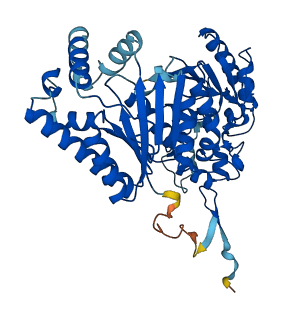
Descriptions
The autoinhibited protein was predicted that may have potential autoinhibitory elements via cis-regPred.
Autoinhibitory domains (AIDs)
Target domain |
|
Relief mechanism |
|
Assay |
cis-regPred |
Accessory elements
No accessory elements
Autoinhibited structure

Activated structure
1 structures for Q4R8B6
| Entry ID | Method | Resolution | Chain | Position | Source |
|---|---|---|---|---|---|
| AF-Q4R8B6-F1 | Predicted | AlphaFoldDB |
No variants for Q4R8B6
| Variant ID(s) | Position | Change | Description | Diseaes Association | Provenance |
|---|---|---|---|---|---|
| No variants for Q4R8B6 | |||||
No associated diseases with Q4R8B6
5 regional properties for Q4R8B6
| Type | Name | Position | InterPro Accession |
|---|---|---|---|
| domain | Zinc finger, LIM-type | 226 - 285 | IPR001781-1 |
| domain | Zinc finger, LIM-type | 286 - 343 | IPR001781-2 |
| domain | Zinc finger, LIM-type | 344 - 403 | IPR001781-3 |
| domain | Zinc finger, LIM-type | 404 - 461 | IPR001781-4 |
| domain | Paxillin/TGFB1I1, LIM domain 1 | 228 - 280 | IPR047075 |
Functions
| Description | ||
|---|---|---|
| EC Number | 3.1.3.46 | Phosphoric monoester hydrolases |
| Subcellular Localization |
|
|
| PANTHER Family | ||
| PANTHER Subfamily | ||
| PANTHER Protein Class | ||
| PANTHER Pathway Category | No pathway information available | |
No GO annotations of cellular component
| Name | Definition |
|---|---|
| No GO annotations for cellular component |
3 GO annotations of molecular function
| Name | Definition |
|---|---|
| 6-phosphofructo-2-kinase activity | Catalysis of the reaction: beta-D-fructose 6-phosphate + ATP = beta-D-fructose 2,6-bisphosphate + ADP + 2 H(+). |
| ATP binding | Binding to ATP, adenosine 5'-triphosphate, a universally important coenzyme and enzyme regulator. |
| fructose-2,6-bisphosphate 2-phosphatase activity | Catalysis of the reaction: D-fructose 2,6-bisphosphate + H2O = D-fructose-6-phosphate + phosphate. |
2 GO annotations of biological process
| Name | Definition |
|---|---|
| fructose 2,6-bisphosphate metabolic process | The chemical reactions and pathways involving fructose 2,6-bisphosphate. The D enantiomer is an important regulator of the glycolytic and gluconeogenic pathways. It inhibits fructose 1,6-bisphosphatase and activates phosphofructokinase. |
| fructose metabolic process | The chemical reactions and pathways involving fructose, the ketohexose arabino-2-hexulose. Fructose exists in a open chain form or as a ring compound. D-fructose is the sweetest of the sugars and is found free in a large number of fruits and honey. |
No homologous proteins in AiPD
| UniProt AC | Gene Name | Protein Name | Species | Evidence Code |
|---|---|---|---|---|
| No homologous proteins | ||||
| 10 | 20 | 30 | 40 | 50 | 60 |
| MASPRELTQN | PLKKIWMPYS | NGRPALHACQ | RGVCMTNCPT | LIVMVGLPAR | GKTYISKKLT |
| 70 | 80 | 90 | 100 | 110 | 120 |
| RYLNWIGVPT | REFNVGQYRR | NMVKTYKSFE | FFLPDNEEGL | KIRKQCALAA | LRDVRRFLSE |
| 130 | 140 | 150 | 160 | 170 | 180 |
| EGGHVAVFDA | TNTTRERRAT | IFNFGEQNGY | KTFFVESICV | DPEVIAANIV | QVKLGSPDYV |
| 190 | 200 | 210 | 220 | 230 | 240 |
| NRDSDEATED | FMRRIECYEN | SYESLDEDLD | RDLSYIKIMD | VGQSYVVNRV | ADHIQSRIVY |
| 250 | 260 | 270 | 280 | 290 | 300 |
| YLMNIHVTPR | SIYLCRHGES | ELNLKGRIGG | DPGLSPRGRE | FAKSLAQFIS | DQNIKDLKVW |
| 310 | 320 | 330 | 340 | 350 | 360 |
| TSQMKRTIQT | AEALGVPYEQ | WKVLNEIDAG | VCEEMTYEEI | QDNYPLEFAL | RDQDKYRYRY |
| 370 | 380 | 390 | 400 | 410 | 420 |
| PKGESYEDLV | QRLEPVIMEL | ERQENVLVIC | HQAVMRCLLA | YFLDKAAEQL | PYLKCPLHTV |
| 430 | 440 | 450 | 460 | ||
| LKLTPVAYGC | KVESIFLNVA | AVNTHRDRPQ | NVDISRPPEE | ALVTVPAHQ |