Descriptions
The autoinhibited protein was predicted that may have potential autoinhibitory elements via cis-regPred.
Autoinhibitory domains (AIDs)
Target domain |
|
Relief mechanism |
|
Assay |
cis-regPred |
Accessory elements
No accessory elements
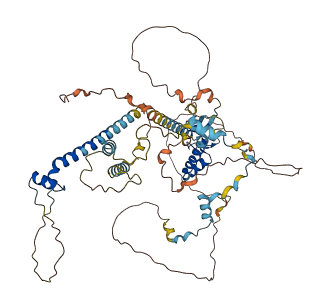
Autoinhibited structure

Activated structure
1 structures for Q4R707
| Entry ID | Method | Resolution | Chain | Position | Source |
|---|---|---|---|---|---|
| AF-Q4R707-F1 | Predicted | AlphaFoldDB |
No variants for Q4R707
| Variant ID(s) | Position | Change | Description | Diseaes Association | Provenance |
|---|---|---|---|---|---|
| No variants for Q4R707 | |||||
No associated diseases with Q4R707
Functions
6 GO annotations of cellular component
| Name | Definition |
|---|---|
| cell cortex | The region of a cell that lies just beneath the plasma membrane and often, but not always, contains a network of actin filaments and associated proteins. |
| cleavage furrow | The cleavage furrow is a plasma membrane invagination at the cell division site. The cleavage furrow begins as a shallow groove and eventually deepens to divide the cytoplasm. |
| cytoplasmic vesicle membrane | The lipid bilayer surrounding a cytoplasmic vesicle. |
| cytoskeleton | A cellular structure that forms the internal framework of eukaryotic and prokaryotic cells. The cytoskeleton includes intermediate filaments, microfilaments, microtubules, the microtrabecular lattice, and other structures characterized by a polymeric filamentous nature and long-range order within the cell. The various elements of the cytoskeleton not only serve in the maintenance of cellular shape but also have roles in other cellular functions, including cellular movement, cell division, endocytosis, and movement of organelles. |
| cytosol | The part of the cytoplasm that does not contain organelles but which does contain other particulate matter, such as protein complexes. |
| perinuclear region of cytoplasm | Cytoplasm situated near, or occurring around, the nucleus. |
1 GO annotations of molecular function
| Name | Definition |
|---|---|
| actin binding | Binding to monomeric or multimeric forms of actin, including actin filaments. |
10 GO annotations of biological process
| Name | Definition |
|---|---|
| actin cytoskeleton organization | A process that is carried out at the cellular level which results in the assembly, arrangement of constituent parts, or disassembly of cytoskeletal structures comprising actin filaments and their associated proteins. |
| actin nucleation | The initial step in the formation of an actin filament, in which actin monomers combine to form a new filament. Nucleation is slow relative to the subsequent addition of more monomers to extend the filament. |
| cleavage furrow formation | Generation of the cleavage furrow, a shallow groove in the cell surface near the old metaphase plate that marks the site of cytokinesis. This process includes the recruitment and localized activation of signals such as RhoA at the site of the future furrow to ensure that furrowing initiates at the correct site in the cell. |
| establishment of meiotic spindle localization | The cell cycle process in which the directed movement of the meiotic spindle to a specific location in the cell occurs. |
| formin-nucleated actin cable assembly | The aggregation, arrangement and bonding together of a set of components to form a formin-nucleated actin cable. A formin-nucleated actin cable is an actin filament bundle that consists of short filaments organized into bundles of uniform polarity, and is nucleated by formins. |
| intracellular transport | The directed movement of substances within a cell. |
| polar body extrusion after meiotic divisions | The cell cycle process in which two small cells are generated, as byproducts destined to degenerate, as a result of the first and second meiotic divisions of a primary oocyte during its development to a mature ovum. One polar body is formed in the first division of meiosis and the other in the second division; at each division, the cytoplasm divides unequally, so that the polar body is of much smaller size than the developing oocyte. At the second division in which a polar body is formed, the polar body and the developing oocyte each contain a haploid set of chromosomes. |
| positive regulation of double-strand break repair | Any process that activates or increases the frequency, rate or extent of double-strand break repair. |
| protein transport | The directed movement of proteins into, out of or within a cell, or between cells, by means of some agent such as a transporter or pore. |
| vesicle-mediated transport | A cellular transport process in which transported substances are moved in membrane-bounded vesicles; transported substances are enclosed in the vesicle lumen or located in the vesicle membrane. The process begins with a step that directs a substance to the forming vesicle, and includes vesicle budding and coating. Vesicles are then targeted to, and fuse with, an acceptor membrane. |
No homologous proteins in AiPD
| UniProt AC | Gene Name | Protein Name | Species | Evidence Code |
|---|---|---|---|---|
| No homologous proteins | ||||
| 10 | 20 | 30 | 40 | 50 | 60 |
| MANTVEADGS | NDEGYEAAEE | GPEDEEDEKR | EISAIRSYRD | VMKLCAAHLP | TESDAPNHYQ |
| 70 | 80 | 90 | 100 | 110 | 120 |
| AVCRALFAET | MELHTFLAKV | KSAKENLKKI | QEMEKSDESS | TDLEELKNAD | WARFWVQVMR |
| 130 | 140 | 150 | 160 | 170 | 180 |
| DLRNGVKLKK | VQERQYNPLP | IEYQLTPYEM | LMDDIRCKRY | TLRKVMVNGD | IPPRLKKSAH |
| 190 | 200 | 210 | 220 | 230 | 240 |
| EIILDFIRSR | PPLNPVSARK | LKPTPPRPRS | LHERILEEIK | AERKLRPVSP | EEIRRSRLDV |
| 250 | 260 | 270 | 280 | 290 | 300 |
| TTPESTKNLM | ESSMVNGGLT | SQTKENGLSS | AEQVPAQRKK | LLKAPTLAEL | DSSESEEETL |
| 310 | 320 | 330 | 340 | 350 | 360 |
| HKSTSSSSVS | PSFPEEPVLE | AVSTRKKPPK | FLPISSTPQP | ERRQPPQRRH | SIEKETPTNV |
| 370 | 380 | 390 | 400 | 410 | 420 |
| RQFLPPSRQS | SRSLEEFCYP | VECLALTVEE | VMHIRQVLVK | AELEKYQQYK | DIYTALKKGK |
| 430 | 440 | 450 | 460 | 470 | 480 |
| LCFCCRTRRF | SFFTWSYTCQ | FCKRPVCSQC | CKKMRLPSKP | YSTLPIFSLG | PSALQRGESS |
| 490 | 500 | 510 | 520 | 530 | 540 |
| MRSEKPSTAH | HRPLRSIARF | SSKSKSMDKS | DEELQFPKEL | MEDWSTMEVC | VDCKKFISEI |
| 550 | 560 | 570 | 580 | ||
| ISSSRRSLVL | ANKRARLKRK | TQSFYMSPPG | PSEYCPSERT | ISEI |