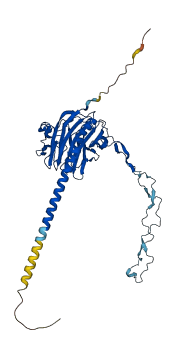
Descriptions
The autoinhibited protein was predicted that may have potential autoinhibitory elements via cis-regPred.
Autoinhibitory domains (AIDs)
Target domain |
|
Relief mechanism |
|
Assay |
cis-regPred |
Accessory elements
No accessory elements
Autoinhibited structure

Activated structure
1 structures for Q4R6K8
| Entry ID | Method | Resolution | Chain | Position | Source |
|---|---|---|---|---|---|
| AF-Q4R6K8-F1 | Predicted | AlphaFoldDB |
No variants for Q4R6K8
| Variant ID(s) | Position | Change | Description | Diseaes Association | Provenance |
|---|---|---|---|---|---|
| No variants for Q4R6K8 | |||||
No associated diseases with Q4R6K8
3 regional properties for Q4R6K8
| Type | Name | Position | InterPro Accession |
|---|---|---|---|
| conserved_site | Calreticulin/calnexin, conserved site | 98 - 113 | IPR018124-1 |
| conserved_site | Calreticulin/calnexin, conserved site | 130 - 138 | IPR018124-2 |
| conserved_site | Calreticulin/calnexin, conserved site | 242 - 254 | IPR018124-3 |
Functions
11 GO annotations of cellular component
| Name | Definition |
|---|---|
| cortical granule | A secretory vesicle that is stored under the cell membrane of an egg. These vesicles fuse with the egg plasma membrane as part of egg activation and are part of the block to polyspermy. |
| cytolytic granule | A specialized secretory lysosome that is present in cells with cytolytic capability such as cytotoxic T lymphocytes and natural killer cells. Cytolytic granules mediate the storage and regulated excretion of lytic molecules for killing of target cells. |
| cytosol | The part of the cytoplasm that does not contain organelles but which does contain other particulate matter, such as protein complexes. |
| endoplasmic reticulum quality control compartment | A subcompartment of the endoplasmic reticulum in which proteins with improper or incorrect folding accumulate. Enzymes in this compartment direct proteins with major folding problems to translocation to the cytosol and degradation, and proteins with minor folding problems to the ER, to interact with chaperon proteins. |
| external side of plasma membrane | The leaflet of the plasma membrane that faces away from the cytoplasm and any proteins embedded or anchored in it or attached to its surface. |
| extracellular space | That part of a multicellular organism outside the cells proper, usually taken to be outside the plasma membranes, and occupied by fluid. |
| MHC class I peptide loading complex | A large, multisubunit complex which consists of the MHC class I-beta 2 microglobulin dimer, the transporter associated with antigen presentation (TAP), tapasin (an MHC-encoded membrane protein), the chaperone calreticulin and the thiol oxidoreductase ERp57. Functions in the assembly of peptides with newly synthesized MHC class I molecules. |
| nuclear envelope | The double lipid bilayer enclosing the nucleus and separating its contents from the rest of the cytoplasm; includes the intermembrane space, a gap of width 20-40 nm (also called the perinuclear space). |
| perinuclear region of cytoplasm | Cytoplasm situated near, or occurring around, the nucleus. |
| polysome | A multiribosomal structure representing a linear array of ribosomes held together by messenger RNA. They represent the active complexes in cellular protein synthesis and are able to incorporate amino acids into polypeptides both in vivo and in vitro. |
| sarcoplasmic reticulum lumen | The volume enclosed by the membranes of the sarcoplasmic reticulum. |
7 GO annotations of molecular function
| Name | Definition |
|---|---|
| calcium ion binding | Binding to a calcium ion (Ca2+). |
| carbohydrate binding | Binding to a carbohydrate, which includes monosaccharides, oligosaccharides and polysaccharides as well as substances derived from monosaccharides by reduction of the carbonyl group (alditols), by oxidation of one or more hydroxy groups to afford the corresponding aldehydes, ketones, or carboxylic acids, or by replacement of one or more hydroxy group(s) by a hydrogen atom. Cyclitols are generally not regarded as carbohydrates. |
| integrin binding | Binding to an integrin. |
| mRNA binding | Binding to messenger RNA (mRNA), an intermediate molecule between DNA and protein. mRNA includes UTR and coding sequences, but does not contain introns. |
| nuclear androgen receptor binding | Binding to a nuclear androgen receptor. |
| ubiquitin protein ligase binding | Binding to a ubiquitin protein ligase enzyme, any of the E3 proteins. |
| unfolded protein binding | Binding to an unfolded protein. |
22 GO annotations of biological process
| Name | Definition |
|---|---|
| cellular senescence | A cell aging process stimulated in response to cellular stress, whereby normal cells lose the ability to divide through irreversible cell cycle arrest. |
| cortical actin cytoskeleton organization | A process that is carried out at the cellular level which results in the assembly, arrangement of constituent parts, or disassembly of actin-based cytoskeletal structures in the cell cortex, i.e. just beneath the plasma membrane. |
| negative regulation of intracellular steroid hormone receptor signaling pathway | Any process that stops, prevents, or reduces the frequency, rate or extent of the activity of any intracellular steroid hormone receptor signaling pathway. |
| negative regulation of neuron differentiation | Any process that stops, prevents, or reduces the frequency, rate or extent of neuron differentiation. |
| negative regulation of retinoic acid receptor signaling pathway | Any process that stops, prevents, or reduces the frequency, rate or extent of retinoic acid receptor signaling pathway activity. |
| negative regulation of transcription by RNA polymerase II | Any process that stops, prevents, or reduces the frequency, rate or extent of transcription mediated by RNA polymerase II. |
| negative regulation of translation | Any process that stops, prevents, or reduces the frequency, rate or extent of the chemical reactions and pathways resulting in the formation of proteins by the translation of mRNA or circRNA. |
| negative regulation of trophoblast cell migration | Any process that stops, prevents or reduces the frequency, rate or extent of trophoblast cell migration. |
| peptide antigen assembly with MHC class I protein complex | The binding of a peptide to the antigen binding groove of an MHC class I protein complex. Class I here refers to classical class I molecules. |
| positive regulation of cell cycle | Any process that activates or increases the rate or extent of progression through the cell cycle. |
| positive regulation of cell population proliferation | Any process that activates or increases the rate or extent of cell proliferation. |
| positive regulation of dendritic cell chemotaxis | Any process that activates or increases the frequency, rate or extent of dendritic cell chemotaxis. |
| positive regulation of endothelial cell migration | Any process that increases the rate, frequency, or extent of the orderly movement of an endothelial cell into the extracellular matrix to form an endothelium. |
| positive regulation of gene expression | Any process that increases the frequency, rate or extent of gene expression. Gene expression is the process in which a gene's coding sequence is converted into a mature gene product (protein or RNA). |
| positive regulation of NIK/NF-kappaB signaling | Any process that activates or increases the frequency, rate or extent of NIK/NF-kappaB signaling. |
| positive regulation of phagocytosis | Any process that activates or increases the frequency, rate or extent of phagocytosis. |
| positive regulation of substrate adhesion-dependent cell spreading | Any process that activates or increases the frequency, rate or extent of substrate adhesion-dependent cell spreading. |
| protein export from nucleus | The directed movement of a protein from the nucleus into the cytoplasm. |
| protein folding | The process of assisting in the covalent and noncovalent assembly of single chain polypeptides or multisubunit complexes into the correct tertiary structure. |
| protein localization to nucleus | A process in which a protein transports or maintains the localization of another protein to the nucleus. |
| protein stabilization | Any process involved in maintaining the structure and integrity of a protein and preventing it from degradation or aggregation. |
| regulation of meiotic nuclear division | Any process that modulates the frequency, rate or extent of meiotic nuclear division, the process in which the nucleus of a diploid cell divides twice forming four haploid cells, one or more of which usually function as gametes. |
No homologous proteins in AiPD
| UniProt AC | Gene Name | Protein Name | Species | Evidence Code |
|---|---|---|---|---|
| No homologous proteins | ||||
| 10 | 20 | 30 | 40 | 50 | 60 |
| MLLSVPLLLG | LLGLAAAEPA | VYFKEQFLDG | DGWTSRWIES | KHKSDFGKFV | LSSGKFYGDE |
| 70 | 80 | 90 | 100 | 110 | 120 |
| EKDKGLQTSQ | DARFYALSAS | FEPFSNKGQT | LVVQFTVKHE | QNIDCGGGYV | KLFPNSLDQT |
| 130 | 140 | 150 | 160 | 170 | 180 |
| DMHGDSEYNI | MFGPDICGPG | TKKVHVIFNY | KGKNVLINKD | IRCKDDEFTH | LYTLIVRPDN |
| 190 | 200 | 210 | 220 | 230 | 240 |
| TYEVKIDNSQ | VESGSLEDDW | DFLPPKKIKD | PDASKPEDWD | ERAKIDDPTD | SKPEDWDKPE |
| 250 | 260 | 270 | 280 | 290 | 300 |
| HIPDPDAKKP | EDWDEEMDGE | WEPPVIQNPE | YKGEWKPRQI | DNPDYKGTWI | HPEIDNPEYS |
| 310 | 320 | 330 | 340 | 350 | 360 |
| PDPSIYAYDN | FGVLGLDLWQ | VKSGTIFDNF | LITNDEAYAE | EFGNETWGVT | KAAEKQMKDK |
| 370 | 380 | 390 | 400 | 410 | |
| QDEEQRLKEE | EEDKKRKEEE | EAEDKEDDED | KDEDEEDEED | KEEDEEEDVP | GQAKDEL |