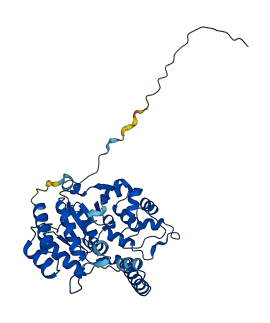
Descriptions
The autoinhibited protein was predicted that may have potential autoinhibitory elements via cis-regPred.
Autoinhibitory domains (AIDs)
Target domain |
|
Relief mechanism |
|
Assay |
cis-regPred |
Accessory elements
No accessory elements
Autoinhibited structure

Activated structure
1 structures for Q4R5U5
| Entry ID | Method | Resolution | Chain | Position | Source |
|---|---|---|---|---|---|
| AF-Q4R5U5-F1 | Predicted | AlphaFoldDB |
No variants for Q4R5U5
| Variant ID(s) | Position | Change | Description | Diseaes Association | Provenance |
|---|---|---|---|---|---|
| No variants for Q4R5U5 | |||||
No associated diseases with Q4R5U5
5 regional properties for Q4R5U5
| Type | Name | Position | InterPro Accession |
|---|---|---|---|
| domain | XPG, N-terminal | 1 - 107 | IPR006085 |
| domain | XPG-I domain | 146 - 233 | IPR006086 |
| conserved_site | Helix-hairpin-helix motif, class 2 | 220 - 253 | IPR008918 |
| conserved_site | XPG conserved site | 79 - 93 | IPR019974-1 |
| conserved_site | XPG conserved site | 149 - 163 | IPR019974-2 |
Functions
6 GO annotations of cellular component
| Name | Definition |
|---|---|
| chromosome, telomeric region | The end of a linear chromosome, required for the integrity and maintenance of the end. A chromosome telomere usually includes a region of telomerase-encoded repeats the length of which rarely exceeds 20 bp each and that permits the formation of a telomeric loop (T-loop). The telomeric repeat region is usually preceded by a sub-telomeric region that is gene-poor but rich in repetitive elements. Some telomeres only consist of the latter part (for eg. D. melanogaster telomeres). |
| mitochondrion | A semiautonomous, self replicating organelle that occurs in varying numbers, shapes, and sizes in the cytoplasm of virtually all eukaryotic cells. It is notably the site of tissue respiration. |
| nucleolus | A small, dense body one or more of which are present in the nucleus of eukaryotic cells. It is rich in RNA and protein, is not bounded by a limiting membrane, and is not seen during mitosis. Its prime function is the transcription of the nucleolar DNA into 45S ribosomal-precursor RNA, the processing of this RNA into 5.8S, 18S, and 28S components of ribosomal RNA, and the association of these components with 5S RNA and proteins synthesized outside the nucleolus. This association results in the formation of ribonucleoprotein precursors; these pass into the cytoplasm and mature into the 40S and 60S subunits of the ribosome. |
| nucleoplasm | That part of the nuclear content other than the chromosomes or the nucleolus. |
| nucleus | A membrane-bounded organelle of eukaryotic cells in which chromosomes are housed and replicated. In most cells, the nucleus contains all of the cell's chromosomes except the organellar chromosomes, and is the site of RNA synthesis and processing. In some species, or in specialized cell types, RNA metabolism or DNA replication may be absent. |
| protein-containing complex | A stable assembly of two or more macromolecules, i.e. proteins, nucleic acids, carbohydrates or lipids, in which at least one component is a protein and the constituent parts function together. |
5 GO annotations of molecular function
| Name | Definition |
|---|---|
| 5'-3' exonuclease activity | Catalysis of the hydrolysis of ester linkages within nucleic acids by removing nucleotide residues from the 5' end. |
| 5'-flap endonuclease activity | Catalysis of the cleavage of a 5' flap structure in DNA, but not other DNA structures; processes the 5' ends of Okazaki fragments in lagging strand DNA synthesis. |
| DNA binding | Any molecular function by which a gene product interacts selectively and non-covalently with DNA (deoxyribonucleic acid). |
| magnesium ion binding | Binding to a magnesium (Mg) ion. |
| RNA-DNA hybrid ribonuclease activity | Catalysis of the endonucleolytic cleavage of RNA in RNA-DNA hybrids to 5'-phosphomonoesters. |
3 GO annotations of biological process
| Name | Definition |
|---|---|
| base-excision repair | In base excision repair, an altered base is removed by a DNA glycosylase enzyme, followed by excision of the resulting sugar phosphate. The small gap left in the DNA helix is filled in by the sequential action of DNA polymerase and DNA ligase. |
| DNA replication, removal of RNA primer | Removal of the Okazaki RNA primer from the lagging strand of replicating DNA, by a combination of the actions of DNA polymerase, DNA helicase and an endonuclease. |
| positive regulation of sister chromatid cohesion | Any process that activates or increases the frequency, rate or extent of sister chromatid cohesion. |
No homologous proteins in AiPD
| UniProt AC | Gene Name | Protein Name | Species | Evidence Code |
|---|---|---|---|---|
| No homologous proteins | ||||
| 10 | 20 | 30 | 40 | 50 | 60 |
| MGIQGLAKLI | ADVAPSAIRE | NDIKSYFGRK | VAIDASMSIY | QFLIAVRQGG | DVLQNEEGET |
| 70 | 80 | 90 | 100 | 110 | 120 |
| TSHLMGMFYR | TIRMMENGIK | PVYVFDGKPP | QLKSGELAKR | SERRAEAEKQ | LQQAQAAGAE |
| 130 | 140 | 150 | 160 | 170 | 180 |
| QEVEKFTKRL | VKVTKQHNDE | CKHLLSLMGI | PYLDAPSEAE | ASCAALVKAG | KVYAAATEDM |
| 190 | 200 | 210 | 220 | 230 | 240 |
| DCLTFGSPVL | MRHLTASEAK | KLPIQEFHLS | RILQELGLNQ | EQFVDLCILL | GSDYCESIRG |
| 250 | 260 | 270 | 280 | 290 | 300 |
| IGPKRAVDLI | QKHKSIEEIV | RRLDPSKYPV | PENWLHKEAH | QLFLKPEVLD | PESVELKWSE |
| 310 | 320 | 330 | 340 | 350 | 360 |
| PNEEELVKFM | CGEKQFSEER | IRSGVKRLSK | SRQGSTQGRL | DDFFKVTGSL | SSAKRKEPEP |
| 370 | |||||
| KGSTKKKAKT | GAAGKFKRGK |