Descriptions
The autoinhibited protein was predicted that may have potential autoinhibitory elements via cis-regPred.
Autoinhibitory domains (AIDs)
Target domain |
|
Relief mechanism |
|
Assay |
cis-regPred |
Accessory elements
No accessory elements
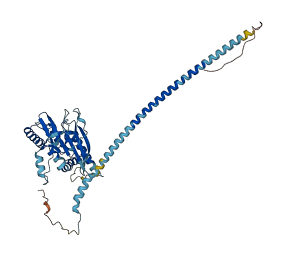
Autoinhibited structure

Activated structure
1 structures for Q4R555
| Entry ID | Method | Resolution | Chain | Position | Source |
|---|---|---|---|---|---|
| AF-Q4R555-F1 | Predicted | AlphaFoldDB |
No variants for Q4R555
| Variant ID(s) | Position | Change | Description | Diseaes Association | Provenance |
|---|---|---|---|---|---|
| No variants for Q4R555 | |||||
No associated diseases with Q4R555
1 regional properties for Q4R555
| Type | Name | Position | InterPro Accession |
|---|---|---|---|
| domain | Septin-type guanine nucleotide-binding (G) domain | 38 - 307 | IPR030379 |
4 GO annotations of cellular component
| Name | Definition |
|---|---|
| anchoring junction | A cell junction that mechanically attaches a cell (and its cytoskeleton) to neighboring cells or to the extracellular matrix. |
| axon | The long process of a neuron that conducts nerve impulses, usually away from the cell body to the terminals and varicosities, which are sites of storage and release of neurotransmitter. |
| dendritic spine | A small, membranous protrusion from a dendrite that forms a postsynaptic compartment, typically receiving input from a single presynapse. They function as partially isolated biochemical and an electrical compartments. Spine morphology is variable:they can be thin, stubby, mushroom, or branched, with a continuum of intermediate morphologies. They typically terminate in a bulb shape, linked to the dendritic shaft by a restriction. Spine remodeling is though to be involved in synaptic plasticity. |
| septin complex | A protein complex containing septins. Typically, these complexes contain multiple septins and are oligomeric. |
1 GO annotations of molecular function
| Name | Definition |
|---|---|
| GTP binding | Binding to GTP, guanosine triphosphate. |
2 GO annotations of biological process
| Name | Definition |
|---|---|
| cell cycle | The progression of biochemical and morphological phases and events that occur in a cell during successive cell replication or nuclear replication events. Canonically, the cell cycle comprises the replication and segregation of genetic material followed by the division of the cell, but in endocycles or syncytial cells nuclear replication or nuclear division may not be followed by cell division. |
| cell division | The process resulting in division and partitioning of components of a cell to form more cells; may or may not be accompanied by the physical separation of a cell into distinct, individually membrane-bounded daughter cells. |
No homologous proteins in AiPD
| UniProt AC | Gene Name | Protein Name | Species | Evidence Code |
|---|---|---|---|---|
| No homologous proteins | ||||
| 10 | 20 | 30 | 40 | 50 | 60 |
| MAVAVGRPSN | EELRNLSLSG | HVGFDSLPDQ | LVNKSTSQGF | CFNILCVGET | GIGKSTLMDT |
| 70 | 80 | 90 | 100 | 110 | 120 |
| LFNTKFESDP | ATHNEPGVRL | KARSYELQES | NVRLKLTIVD | TVGFGDQINK | DDSYKPIVEY |
| 130 | 140 | 150 | 160 | 170 | 180 |
| IDAQFEAYLQ | EELKIKRSLF | NYHDTRIHAC | LYFIAPTGHS | LKSLDLVTTK | KLDSKVNIIP |
| 190 | 200 | 210 | 220 | 230 | 240 |
| IIAKADTIAK | NELHKFKSKI | MSELVSNGVQ | IYQFPTDEET | VAEINATMSV | HLPFAVVGST |
| 250 | 260 | 270 | 280 | 290 | 300 |
| EEVKIGNKMA | KARQYPWGVV | QVENENHCDF | VKLREMLIRV | NMEDLREQTH | TRHYELYRRC |
| 310 | 320 | 330 | 340 | 350 | 360 |
| KLEEMGFKDT | DPDSKPFSLQ | ETYEAKRNEF | LGELQKKEEE | MRQMFVMRVK | EKEAELKEAE |
| 370 | 380 | 390 | 400 | 410 | 420 |
| KELHEKFDLL | KRTHQEEKKK | VEDKKKELEE | EVNNFQKKKA | AVQLLQSQAQ | QSGAQQTKKD |
| 430 | |||||
| KDKKNSPWLC | TE |