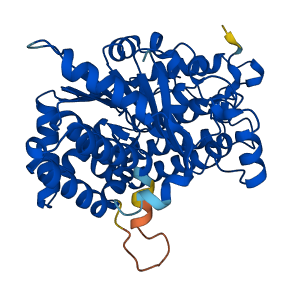
Descriptions
The autoinhibited protein was predicted that may have potential autoinhibitory elements via cis-regPred.
Autoinhibitory domains (AIDs)
Target domain |
|
Relief mechanism |
|
Assay |
cis-regPred |
Accessory elements
No accessory elements
Autoinhibited structure

Activated structure
1 structures for Q4R526
| Entry ID | Method | Resolution | Chain | Position | Source |
|---|---|---|---|---|---|
| AF-Q4R526-F1 | Predicted | AlphaFoldDB |
No variants for Q4R526
| Variant ID(s) | Position | Change | Description | Diseaes Association | Provenance |
|---|---|---|---|---|---|
| No variants for Q4R526 | |||||
No associated diseases with Q4R526
1 regional properties for Q4R526
| Type | Name | Position | InterPro Accession |
|---|---|---|---|
| domain | Damage-control phosphatase ARMT1-like, metal-binding domain | 20 - 419 | IPR002791 |
No GO annotations of cellular component
| Name | Definition |
|---|---|
| No GO annotations for cellular component |
6 GO annotations of molecular function
| Name | Definition |
|---|---|
| fructose 6-phosphate aldolase activity | Catalysis of the reaction: D-fructose-6-phosphate = dihydroxyacetone + D-glyceraldehyde-3-phosphate. |
| fructose-1-phosphatase activity | Catalysis of the reaction: beta-D-fructofuranose 1-phosphate + H2O <=> beta-D-fructofuranose + hydrogenphosphate. |
| metal ion binding | Binding to a metal ion. |
| protein carboxyl O-methyltransferase activity | Catalysis of the transfer of a methyl group to a carboxyl group on a protein. |
| protein-glutamate O-methyltransferase activity | Catalysis of the reaction: S-adenosyl-L-methionine + protein L-glutamate = S-adenosyl-L-homocysteine + protein L-glutamate 5-methyl ester; this reaction is the methylation of peptidyl-L-glutamate to form peptidyl-L-glutamate 5-methyl ester. |
| S-adenosylmethionine-dependent methyltransferase activity | Catalysis of the transfer of a methyl group from S-adenosyl-L-methionine to a substrate. |
3 GO annotations of biological process
| Name | Definition |
|---|---|
| cellular response to DNA damage stimulus | Any process that results in a change in state or activity of a cell (in terms of movement, secretion, enzyme production, gene expression, etc.) as a result of a stimulus indicating damage to its DNA from environmental insults or errors during metabolism. |
| methylation | The process in which a methyl group is covalently attached to a molecule. |
| regulation of response to DNA damage stimulus | Any process that modulates the frequency, rate or extent of response to DNA damage stimulus. |
No homologous proteins in AiPD
| UniProt AC | Gene Name | Protein Name | Species | Evidence Code |
|---|---|---|---|---|
| No homologous proteins | ||||
| 10 | 20 | 30 | 40 | 50 | 60 |
| MAVVPASLSG | QDVGSFAYLT | IKDRIPQILT | KVIDTLHRHK | SEFFENHGEE | GVEAEKKAIS |
| 70 | 80 | 90 | 100 | 110 | 120 |
| LLSKLRNELQ | TDKPIIPLVE | KFVDTDIWNQ | YLEYQQSLLN | ESDGKSRWFY | SPWLFVECYM |
| 130 | 140 | 150 | 160 | 170 | 180 |
| YRRIHEAIIQ | SPPIDYFDVF | KESKEQNFYE | SQESVIALCT | HLQQLIKTIE | DLDENQLKDE |
| 190 | 200 | 210 | 220 | 230 | 240 |
| FFKLLQISLW | GNKCDLSLSG | GESSSQKTDV | LNSLEDLKPF | ILLNDMEHLW | SLLSNCKKTR |
| 250 | 260 | 270 | 280 | 290 | 300 |
| EKASVTRVYI | VLDNSGFELV | TDLILANFLL | SSELATEVHF | YGKTIPWFVS | DTTIHDFNWL |
| 310 | 320 | 330 | 340 | 350 | 360 |
| IEQVKHGNHK | WMSKCGADWE | EYVKMGKWVY | HDHIFWTLPH | EYCAMPQVAP | DLYAELQKAH |
| 370 | 380 | 390 | 400 | 410 | 420 |
| LILFKGDLNY | RKLTGDRKWE | FSVPFHQALN | GFHPAPLCTI | RTLKAEIQVG | LKPGQGEQLM |
| 430 | 440 | ||||
| ASEPCWWTSG | KYGIFQYDGP | L |