Q4R4Y9
Gene name |
EIF4A2 (QnpA-20305) |
Protein name |
Eukaryotic initiation factor 4A-II |
Names |
eIF-4A-II, eIF4A-II, ATP-dependent RNA helicase eIF4A-2 |
Species |
Macaca fascicularis (Crab-eating macaque) (Cynomolgus monkey) |
KEGG Pathway |
|
EC number |
3.6.4.13: Acting on ATP; involved in cellular and subcellular movement |
Protein Class |
|
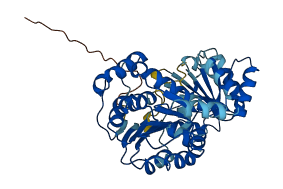
Descriptions
The autoinhibited protein was predicted that may have potential autoinhibitory elements via cis-regPred.
Autoinhibitory domains (AIDs)
Target domain |
|
Relief mechanism |
|
Assay |
cis-regPred |
Accessory elements
No accessory elements
Autoinhibited structure

Activated structure
1 structures for Q4R4Y9
| Entry ID | Method | Resolution | Chain | Position | Source |
|---|---|---|---|---|---|
| AF-Q4R4Y9-F1 | Predicted | AlphaFoldDB |
No variants for Q4R4Y9
| Variant ID(s) | Position | Change | Description | Diseaes Association | Provenance |
|---|---|---|---|---|---|
| No variants for Q4R4Y9 | |||||
No associated diseases with Q4R4Y9
5 regional properties for Q4R4Y9
| Type | Name | Position | InterPro Accession |
|---|---|---|---|
| domain | Helicase, C-terminal | 247 - 408 | IPR001650 |
| domain | DEAD/DEAH box helicase domain | 59 - 223 | IPR011545 |
| domain | Helicase superfamily 1/2, ATP-binding domain | 53 - 251 | IPR014001 |
| domain | RNA helicase, DEAD-box type, Q motif | 34 - 62 | IPR014014 |
| domain | ATP-dependent RNA helicase eIF4A, DEAD-box helicase domain | 36 - 237 | IPR044728 |
Functions
| Description | ||
|---|---|---|
| EC Number | 3.6.4.13 | Acting on ATP; involved in cellular and subcellular movement |
| Subcellular Localization |
|
|
| PANTHER Family | ||
| PANTHER Subfamily | ||
| PANTHER Protein Class | ||
| PANTHER Pathway Category | No pathway information available | |
No GO annotations of cellular component
| Name | Definition |
|---|---|
| No GO annotations for cellular component |
5 GO annotations of molecular function
| Name | Definition |
|---|---|
| ATP binding | Binding to ATP, adenosine 5'-triphosphate, a universally important coenzyme and enzyme regulator. |
| ATP hydrolysis activity | Catalysis of the reaction: ATP + H2O = ADP + H+ phosphate. ATP hydrolysis is used in some reactions as an energy source, for example to catalyze a reaction or drive transport against a concentration gradient. |
| RNA binding | Binding to an RNA molecule or a portion thereof. |
| RNA helicase activity | Unwinding of an RNA helix, driven by ATP hydrolysis. |
| translation initiation factor activity | Functions in the initiation of ribosome-mediated translation of mRNA into a polypeptide. |
No GO annotations of biological process
| Name | Definition |
|---|---|
| No GO annotations for biological process |
No homologous proteins in AiPD
| UniProt AC | Gene Name | Protein Name | Species | Evidence Code |
|---|---|---|---|---|
| No homologous proteins | ||||
| 10 | 20 | 30 | 40 | 50 | 60 |
| MSGGSADYNS | REHGGPEGMD | PDGVIESNWN | EIVDNFDDMN | LKESLLRGIY | AYGFEKPSAI |
| 70 | 80 | 90 | 100 | 110 | 120 |
| QQRAIIPCIK | GYDVIAQAQS | GTGKTATFAI | SILQQLEIEF | KETQALVLAP | TRELAQQIQK |
| 130 | 140 | 150 | 160 | 170 | 180 |
| VILALGDYMG | ATCHACIGGT | NVRNEMQKLQ | AEAPHIVVGT | PGRVFDMLNR | RYLSPKWIKM |
| 190 | 200 | 210 | 220 | 230 | 240 |
| FVLDEADGML | SRGFKDQIYE | IFQKLNTSIQ | VVLLSATMPT | DVLEVTKKFM | RDPIRILVKK |
| 250 | 260 | 270 | 280 | 290 | 300 |
| EELTLEGIKQ | FYINVEREEW | KLDTLCDLYE | TLTITQAVIF | LNTRRKVDWL | TEKMHARDFT |
| 310 | 320 | 330 | 340 | 350 | 360 |
| VSALHGDMDQ | KERDVIMREF | RSGSSRVLIT | TDLLARGIDV | QQVSLVINYD | LPTNRENYIH |
| 370 | 380 | 390 | 400 | ||
| RIGRGGRFGR | KGVAINFVTE | EDKRILRDIE | TFYNTTVEEM | PMNVADLI |