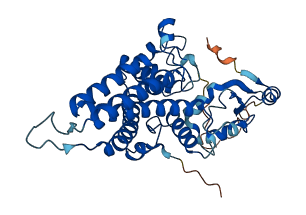
Descriptions
The autoinhibited protein was predicted that may have potential autoinhibitory elements via cis-regPred.
Autoinhibitory domains (AIDs)
Target domain |
|
Relief mechanism |
|
Assay |
cis-regPred |
Accessory elements
No accessory elements
Autoinhibited structure

Activated structure
1 structures for Q4R4P4
| Entry ID | Method | Resolution | Chain | Position | Source |
|---|---|---|---|---|---|
| AF-Q4R4P4-F1 | Predicted | AlphaFoldDB |
No variants for Q4R4P4
| Variant ID(s) | Position | Change | Description | Diseaes Association | Provenance |
|---|---|---|---|---|---|
| No variants for Q4R4P4 | |||||
No associated diseases with Q4R4P4
3 GO annotations of cellular component
| Name | Definition |
|---|---|
| endoplasmic reticulum membrane | The lipid bilayer surrounding the endoplasmic reticulum. |
| integral component of membrane | The component of a membrane consisting of the gene products and protein complexes having at least some part of their peptide sequence embedded in the hydrophobic region of the membrane. |
| membrane | A lipid bilayer along with all the proteins and protein complexes embedded in it an attached to it. |
3 GO annotations of molecular function
| Name | Definition |
|---|---|
| fatty acid alpha-hydroxylase activity | Catalysis of the conversion of a fatty acid to an alpha-hydroxylated fatty acid. A hydroxyl group is added to the second carbon, counted from the carboxyl end, of a fatty acid chain. |
| heme binding | Binding to a heme, a compound composed of iron complexed in a porphyrin (tetrapyrrole) ring. |
| iron ion binding | Binding to an iron (Fe) ion. |
6 GO annotations of biological process
| Name | Definition |
|---|---|
| ceramide biosynthetic process | The chemical reactions and pathways resulting in the formation of ceramides, any N-acylated sphingoid. |
| establishment of skin barrier | Establishment of the epithelial barrier, the functional barrier in the skin that limits its permeability. |
| fatty acid biosynthetic process | The chemical reactions and pathways resulting in the formation of a fatty acid, any of the aliphatic monocarboxylic acids that can be liberated by hydrolysis from naturally occurring fats and oils. Fatty acids are predominantly straight-chain acids of 4 to 24 carbon atoms, which may be saturated or unsaturated; branched fatty acids and hydroxy fatty acids also occur, and very long chain acids of over 30 carbons are found in waxes. |
| galactosylceramide biosynthetic process | The chemical reactions and pathways resulting in the formation of galactosylceramides, any compound formed by the replacement of the glycosidic hydroxyl group of a cyclic form of galactose by a ceramide group. |
| glucosylceramide biosynthetic process | The chemical reactions and pathways resulting in the formation of glucosylceramides, any compound formed by the replacement of the glycosidic hydroxyl group of a cyclic form of glucose by a ceramide group. |
| plasma membrane raft organization | A process that is carried out at the cellular level which results in the assembly, arrangement of constituent parts, or disassembly of plasma membrane rafts. |
No homologous proteins in AiPD
| UniProt AC | Gene Name | Protein Name | Species | Evidence Code |
|---|---|---|---|---|
| No homologous proteins | ||||
| 10 | 20 | 30 | 40 | 50 | 60 |
| MAPAPPPAAS | FSPSEVQRRL | AAGACWVRRG | ARLYDLSSFV | RHHPGGEQLL | RARAGQDISA |
| 70 | 80 | 90 | 100 | 110 | 120 |
| DLDGPPHRHS | ANARRWLEQY | YVGELRGEQQ | GSMENEAVAL | EETQKTDPAM | EPRFKVVDWD |
| 130 | 140 | 150 | 160 | 170 | 180 |
| KDLVDWQKPL | LWQVGHLGEK | YDEWVHQPVT | RPIRLFHSDL | IEGLSKTVWY | SVPIIWVPLV |
| 190 | 200 | 210 | 220 | 230 | 240 |
| LYLSWSYYRT | FAQGNVRLFT | SFTTEYALAV | PKSMFPGLFM | LGIFLWSLIE | YLIHRFLFHM |
| 250 | 260 | 270 | 280 | 290 | 300 |
| KPPSDSYYLI | MLHFVMHGQH | HKAPFDGSRL | VFPPVPASLV | IGVFYLCLQL | ILPEAVGGTV |
| 310 | 320 | 330 | 340 | 350 | 360 |
| FAGGLLGYVL | YDMTHYYLHF | GSPHRGSYLY | NLKAHHVKHH | FAHQKSGFGI | STKLWDYCFH |
| 370 | |||||
| TLIPEKPHLK | TQ |