Q4R4F5
Gene name |
TBP (QtsA-10091, QtsA-11515) |
Protein name |
TATA-box-binding protein |
Names |
TATA sequence-binding protein, TATA-binding factor, TATA-box factor, Transcription initiation factor TFIID TBP subunit |
Species |
Macaca fascicularis (Crab-eating macaque) (Cynomolgus monkey) |
KEGG Pathway |
mcf:101866697 |
EC number |
|
Protein Class |
|
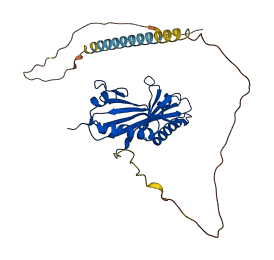
Descriptions
The autoinhibited protein was predicted that may have potential autoinhibitory elements via cis-regPred.
Autoinhibitory domains (AIDs)
Target domain |
|
Relief mechanism |
|
Assay |
cis-regPred |
Accessory elements
No accessory elements
Autoinhibited structure

Activated structure
1 structures for Q4R4F5
| Entry ID | Method | Resolution | Chain | Position | Source |
|---|---|---|---|---|---|
| AF-Q4R4F5-F1 | Predicted | AlphaFoldDB |
No variants for Q4R4F5
| Variant ID(s) | Position | Change | Description | Diseaes Association | Provenance |
|---|---|---|---|---|---|
| No variants for Q4R4F5 | |||||
No associated diseases with Q4R4F5
1 regional properties for Q4R4F5
| Type | Name | Position | InterPro Accession |
|---|---|---|---|
| conserved_site | TATA-box binding protein, conserved site | 270 - 319 | IPR030491 |
11 GO annotations of cellular component
| Name | Definition |
|---|---|
| cytoplasm | The contents of a cell excluding the plasma membrane and nucleus, but including other subcellular structures. |
| euchromatin | A dispersed and relatively uncompacted form of chromatin that is in a transcription-competent conformation. |
| female germ cell nucleus | The nucleus of the female germ cell, a reproductive cell in females. |
| female pronucleus | The pronucleus originating from the ovum that is being fertilized. |
| male germ cell nucleus | The nucleus of a male germ cell, a reproductive cell in males. |
| male pronucleus | The pronucleus originating from the spermatozoa that was involved in fertilization. |
| nucleus | A membrane-bounded organelle of eukaryotic cells in which chromosomes are housed and replicated. In most cells, the nucleus contains all of the cell's chromosomes except the organellar chromosomes, and is the site of RNA synthesis and processing. In some species, or in specialized cell types, RNA metabolism or DNA replication may be absent. |
| RNA polymerase transcription factor SL1 complex | A RNA polymerase I-specific transcription factor complex that contains the TATA-box-binding protein (TBP) and at least three TBP-associated factors including proteins known in mammals as TAFI110, TAFI63 and TAFI48. |
| transcription factor TFIIA complex | A component of the transcription machinery of RNA Polymerase II. In humans, TFIIA is a heterotrimer composed of an alpha (P35), beta (P19) and gamma subunits (P12). |
| transcription factor TFIID complex | A complex composed of TATA binding protein (TBP) and TBP associated factors (TAFs); the total mass is typically about 800 kDa. Most of the TAFs are conserved across species. In TATA-containing promoters for RNA polymerase II (Pol II), TFIID is believed to recognize at least two distinct elements, the TATA element and a downstream promoter element. TFIID is also involved in recognition of TATA-less Pol II promoters. Binding of TFIID to DNA is necessary but not sufficient for transcription initiation from most RNA polymerase II promoters. |
| transcription preinitiation complex | A protein-DNA complex composed of proteins binding promoter DNA to form the transcriptional preinitiation complex (PIC), the formation of which is a prerequisite for transcription. |
7 GO annotations of molecular function
| Name | Definition |
|---|---|
| aryl hydrocarbon receptor binding | Binding to an aryl hydrocarbon receptor. |
| enzyme binding | Binding to an enzyme, a protein with catalytic activity. |
| RNA polymerase II cis-regulatory region sequence-specific DNA binding | Binding to a specific upstream regulatory DNA sequence (transcription factor recognition sequence or binding site) located in cis relative to the transcription start site (i.e., on the same strand of DNA) of a gene transcribed by RNA polymerase II. |
| RNA polymerase II core promoter sequence-specific DNA binding | Binding to a DNA sequence that is part of the core promoter of a RNA polymerase II-transcribed gene. |
| RNA polymerase II general transcription initiation factor activity | A general transcription initiation factor activity that contributes to transcription start site selection and transcription initiation of genes transcribed by RNA polymerase II. The general transcription factors for RNA polymerase II include TFIIB, TFIID, TFIIE, TFIIF, TFIIH and TATA-binding protein (TBP). In most species, RNA polymerase II transcribes all messenger RNAs (mRNAs), most untranslated regulatory RNAs, the majority of the snoRNAs, four of the five snRNAs (U1, U2, U4, and U5), and other small noncoding RNAs. For some small RNAs there is variability between species as to whether it is transcribed by RNA polymerase II or RNA polymerase III. However there are also rare exceptions, such as Trypanosoma brucei, where RNA polymerase I transcribes certain mRNAs in addition to its normal role in rRNA transcription. |
| RNA polymerase III general transcription initiation factor activity | A general transcription initiation factor activity that contributes to transcription start site selection and transcription initiation of genes transcribed by RNA polymerase III. Factors required for RNA polymerase III transcription initiation include TFIIIA, TFIIIB and TFIIIC. RNA polymerase III transcribes genes encoding short RNAs, including tRNAs, 5S rRNA, U6 snRNA, the short ncRNA component of RNases P, the mitochondrial RNA processing (MRP) RNA, the signal recognition particle SRP RNA, and in higher eukaryotes a number of micro and other small RNAs, though there is some variability across species as to whether a given small noncoding RNA is transcribed by RNA polymerase II or RNA polymerase III. |
| TFIIB-class transcription factor binding | Binding to a general RNA polymerase II transcription factor of the TFIIB class, one of the factors involved in formation of the preinitiation complex (PIC) by RNA polymerase II. |
6 GO annotations of biological process
| Name | Definition |
|---|---|
| mRNA transcription by RNA polymerase II | The cellular synthesis of messenger RNA (mRNA) from a DNA template by RNA polymerase II, originating at an RNA polymerase II promoter. |
| positive regulation of transcription initiation by RNA polymerase II | Any process that increases the rate, frequency or extent of a process involved in starting transcription from an RNA polymerase II promoter. |
| protein phosphorylation | The process of introducing a phosphate group on to a protein. |
| RNA polymerase II preinitiation complex assembly | The aggregation, arrangement and bonding together of proteins on an RNA polymerase II promoter DNA to form the transcriptional preinitiation complex (PIC), the formation of which is a prerequisite for transcription by RNA polymerase. |
| transcription by RNA polymerase II | The synthesis of RNA from a DNA template by RNA polymerase II (RNAP II), originating at an RNA polymerase II promoter. Includes transcription of messenger RNA (mRNA) and certain small nuclear RNAs (snRNAs). |
| transcription by RNA polymerase III | The synthesis of RNA from a DNA template by RNA polymerase III, originating at an RNAP III promoter. |
No homologous proteins in AiPD
| UniProt AC | Gene Name | Protein Name | Species | Evidence Code |
|---|---|---|---|---|
| No homologous proteins | ||||
| 10 | 20 | 30 | 40 | 50 | 60 |
| MDQNNSLPPY | AQGLASPQGA | MTPGIPIFSP | MMPYGTGLTP | QPIQNTNSLS | ILEEQQRQQQ |
| 70 | 80 | 90 | 100 | 110 | 120 |
| QQQQQQQQQQ | QQQQQQQQQQ | QQAVAAAAVQ | QSTSQQTTQG | TSGQAPQLFH | SQTLTTAPLP |
| 130 | 140 | 150 | 160 | 170 | 180 |
| GTTPLYPSPV | TPMTPITPAT | PASESSGIVP | QLQNIVSTVN | LGCKLDLKTI | ALRARNAEYN |
| 190 | 200 | 210 | 220 | 230 | 240 |
| PKRFAAVIMR | IREPRTTALI | FSSGKMVCTG | AKSEEQSRLA | ARKYARVVQK | LGFPAKFLDF |
| 250 | 260 | 270 | 280 | 290 | 300 |
| KIQNMVGSCD | VKFPIRLEGL | VLTHQQFSSY | EPELFPGLIY | RMIKPRIVLL | IFVSGKVVLT |
| 310 | 320 | ||||
| GAKVRAEIYE | AFENIYPILK | GFRKTT |