Q4QML1
Gene name |
selA |
Protein name |
L-seryl-tRNA(Sec) selenium transferase |
Names |
Selenocysteine synthase, Sec synthase, Selenocysteinyl-tRNA(Sec) synthase |
Species |
Haemophilus influenzae (strain 86-028NP) |
KEGG Pathway |
hit:NTHI0835 |
EC number |
2.9.1.1: Selenotransferases |
Protein Class |
|
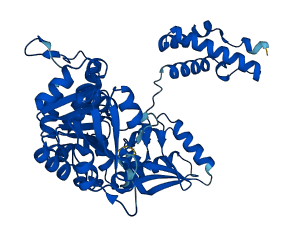
Descriptions
The autoinhibited protein was predicted that may have potential autoinhibitory elements via cis-regPred.
Autoinhibitory domains (AIDs)
Target domain |
|
Relief mechanism |
|
Assay |
cis-regPred |
Accessory elements
No accessory elements
Autoinhibited structure

Activated structure
1 structures for Q4QML1
| Entry ID | Method | Resolution | Chain | Position | Source |
|---|---|---|---|---|---|
| AF-Q4QML1-F1 | Predicted | AlphaFoldDB |
No variants for Q4QML1
| Variant ID(s) | Position | Change | Description | Diseaes Association | Provenance |
|---|---|---|---|---|---|
| No variants for Q4QML1 | |||||
No associated diseases with Q4QML1
1 regional properties for Q4QML1
| Type | Name | Position | InterPro Accession |
|---|---|---|---|
| domain | L-seryl-tRNA selenium transferase N-terminal domain | 5 - 44 | IPR025862 |
Functions
| Description | ||
|---|---|---|
| EC Number | 2.9.1.1 | Selenotransferases |
| Subcellular Localization |
|
|
| PANTHER Family | ||
| PANTHER Subfamily | ||
| PANTHER Protein Class | ||
| PANTHER Pathway Category | No pathway information available | |
1 GO annotations of cellular component
| Name | Definition |
|---|---|
| cytoplasm | The contents of a cell excluding the plasma membrane and nucleus, but including other subcellular structures. |
1 GO annotations of molecular function
| Name | Definition |
|---|---|
| L-seryl-tRNASec selenium transferase activity | Catalysis of the reaction: L-seryl-tRNA(Sec) + selenophosphate = L-selenocysteinyl-tRNA(Sec) + H2O + phosphate. |
2 GO annotations of biological process
| Name | Definition |
|---|---|
| selenocysteine incorporation | The incorporation of selenocysteine into a peptide; uses a special tRNA that recognizes the UGA codon as selenocysteine, rather than as a termination codon. Selenocysteine is synthesized from serine before its incorporation; it is not a posttranslational modification of peptidyl-cysteine. |
| selenocysteinyl-tRNA(Sec) biosynthetic process | The chemical reactions and pathways resulting in the formation of selenocysteinyl-tRNA(Sec). This process occurs through the following steps: a unique serine-tRNA with a UGA recognizing anticodon is first aminoacylated with serine; this is then phosphorylated by phosphoseryl-tRNA |
No homologous proteins in AiPD
| UniProt AC | Gene Name | Protein Name | Species | Evidence Code |
|---|---|---|---|---|
| No homologous proteins | ||||
| 10 | 20 | 30 | 40 | 50 | 60 |
| MTALFQQLPS | VDKILKTSQG | LQLITEFGHT | AVVATCRELL | TQARQFIKKN | NQLPEYFSNF |
| 70 | 80 | 90 | 100 | 110 | 120 |
| DRTFVEIHSR | LQKQNQVQIK | AVHNLTGTVL | HTNLGRALWS | EAAQQAALSV | MQKNVSLEYD |
| 130 | 140 | 150 | 160 | 170 | 180 |
| LDKGKRSHRD | NYISELLCKL | TGAEAACIVN | NNAAAVLLML | ATFAQGKEVI | ISRGELIEIG |
| 190 | 200 | 210 | 220 | 230 | 240 |
| GAFRIPDIME | QAGCYLVEVG | TTNRTHLKDY | RNAITENTAF | LMKVHSSNYQ | ICGFTSSVSE |
| 250 | 260 | 270 | 280 | 290 | 300 |
| EELAELGREM | NVPVVTDLGS | GALIDLSQYG | LPKESTVQEK | VAQGVGLVSF | SGDKLLGGVQ |
| 310 | 320 | 330 | 340 | 350 | 360 |
| AGIIVGKKEW | IEQLQAHPLK | RALRCDKVIL | AGLEATLRLY | LNPEKLTEKL | PTLYLLTQPL |
| 370 | 380 | 390 | 400 | 410 | 420 |
| KQLKINAMRL | KERLESRLNS | QFDIQIEASQ | AQIGSGSQPM | ERIPSVAVTI | AEKTNVKLSA |
| 430 | 440 | 450 | 460 | ||
| LSARFKQLSQ | PIIGRMENGK | IWLDLRSLAA | IETLLNTLDE | L |