Q4PB37
Gene name |
CLF1 (UMAG_02676) |
Protein name |
Pre-mRNA-splicing factor CLF1 |
Names |
|
Species |
Ustilago maydis (strain 521 / FGSC 9021) (Corn smut fungus) |
KEGG Pathway |
uma:UMAG_02676 |
EC number |
|
Protein Class |
|
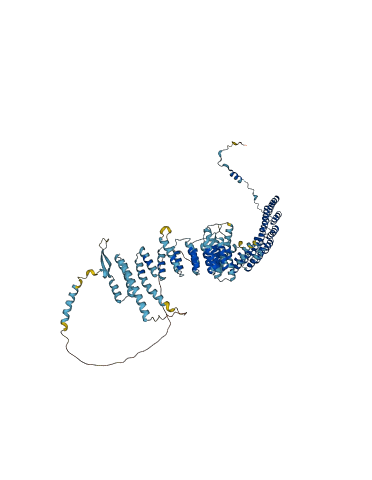
Descriptions
The autoinhibited protein was predicted that may have potential autoinhibitory elements via cis-regPred.
Autoinhibitory domains (AIDs)
Target domain |
|
Relief mechanism |
|
Assay |
cis-regPred |
Accessory elements
No accessory elements
Autoinhibited structure

Activated structure
1 structures for Q4PB37
| Entry ID | Method | Resolution | Chain | Position | Source |
|---|---|---|---|---|---|
| AF-Q4PB37-F1 | Predicted | AlphaFoldDB |
No variants for Q4PB37
| Variant ID(s) | Position | Change | Description | Diseaes Association | Provenance |
|---|---|---|---|---|---|
| No variants for Q4PB37 | |||||
No associated diseases with Q4PB37
14 regional properties for Q4PB37
| Type | Name | Position | InterPro Accession |
|---|---|---|---|
| repeat | HAT (Half-A-TPR) repeat | 50 - 82 | IPR003107-1 |
| repeat | HAT (Half-A-TPR) repeat | 84 - 116 | IPR003107-2 |
| repeat | HAT (Half-A-TPR) repeat | 118 - 150 | IPR003107-3 |
| repeat | HAT (Half-A-TPR) repeat | 152 - 183 | IPR003107-4 |
| repeat | HAT (Half-A-TPR) repeat | 185 - 216 | IPR003107-5 |
| repeat | HAT (Half-A-TPR) repeat | 218 - 257 | IPR003107-6 |
| repeat | HAT (Half-A-TPR) repeat | 259 - 293 | IPR003107-7 |
| repeat | HAT (Half-A-TPR) repeat | 357 - 391 | IPR003107-8 |
| repeat | HAT (Half-A-TPR) repeat | 401 - 437 | IPR003107-9 |
| repeat | HAT (Half-A-TPR) repeat | 439 - 470 | IPR003107-10 |
| repeat | HAT (Half-A-TPR) repeat | 472 - 504 | IPR003107-11 |
| repeat | HAT (Half-A-TPR) repeat | 506 - 547 | IPR003107-12 |
| repeat | HAT (Half-A-TPR) repeat | 549 - 580 | IPR003107-13 |
| repeat | Tetratricopeptide repeat | 458 - 491 | IPR019734 |
7 GO annotations of cellular component
| Name | Definition |
|---|---|
| chromatin | The ordered and organized complex of DNA, protein, and sometimes RNA, that forms the chromosome. |
| post-mRNA release spliceosomal complex | A spliceosomal complex that is formed following the release of the spliced product from the post-spliceosomal complex and contains the excised intron and three snRNPs, including U5. |
| Prp19 complex | A protein complex consisting of Prp19 and associated proteins that is involved in the transition from the precatalytic spliceosome to the activated form that catalyzes step 1 of splicing, and which remains associated with the spliceosome through the second catalytic step. It is widely conserved, found in both yeast and mammals, though the exact composition varies. In S. cerevisiae, it contains Prp19p, Ntc20p, Snt309p, Isy1p, Syf2p, Cwc2p, Prp46p, Clf1p, Cef1p, and Syf1p. |
| U2-type catalytic step 1 spliceosome | A spliceosomal complex that is formed by the displacement of the U1 and U4 snRNPs from the precatalytic spliceosome; the U2, U5 and U6 snRNPs remain associated with the mRNA. This complex, sometimes called the activated spliceosome, is the catalytically active form of the spliceosome, and includes many proteins in addition to those found in the U2, and U5 and U6 snRNPs. |
| U2-type catalytic step 2 spliceosome | A spliceosomal complex that contains the U2, U5 and U6 snRNPs bound to a splicing intermediate in which the first catalytic cleavage of the 5' splice site has occurred. The precise subunit composition differs significantly from that of the catalytic step 1, or activated, spliceosome, and includes many proteins in addition to those found in the U2, U5 and U6 snRNPs. |
| U2-type post-mRNA release spliceosomal complex | A spliceosomal complex that is formed following the release of the spliced product from the post-spliceosomal complex and contains the excised intron and the U2, U5 and U6 snRNPs. |
| U2-type prespliceosome | A spliceosomal complex that is formed by association of the 5' splice site with the U1 snRNP, while the branch point sequence is recognized by the U2 snRNP. The prespliceosome includes many proteins in addition to those found in the U1 and U2 snRNPs. Commitment to a given pair of 5' and 3' splice sites occurs at the time of prespliceosome formation. |
2 GO annotations of molecular function
| Name | Definition |
|---|---|
| chromatin binding | Binding to chromatin, the network of fibers of DNA, protein, and sometimes RNA, that make up the chromosomes of the eukaryotic nucleus during interphase. |
| DNA replication origin binding | Binding to a DNA replication origin, a unique DNA sequence of a replicon at which DNA replication is initiated and proceeds bidirectionally or unidirectionally. |
4 GO annotations of biological process
| Name | Definition |
|---|---|
| cis assembly of pre-catalytic spliceosome | Assembly of a spliceosomal complex containing the intact pre-mRNA and all of the spliceosomal snRNPs. This occurs when the tri-snRNP associates with the pre-mRNA and associated snRNPs in an ATP-dependent manner. |
| DNA replication initiation | The process in which DNA-dependent DNA replication is started; this begins with the ATP dependent loading of an initiator complex onto the DNA, this is followed by DNA melting and helicase activity. In bacteria, the gene products that enable the helicase activity are loaded after the initial melting and in archaea and eukaryotes, the gene products that enable the helicase activity are inactive when they are loaded and subsequently activate. |
| mRNA splicing, via spliceosome | The joining together of exons from one or more primary transcripts of messenger RNA (mRNA) and the excision of intron sequences, via a spliceosomal mechanism, so that mRNA consisting only of the joined exons is produced. |
| spliceosomal complex assembly | The aggregation, arrangement and bonding together of a spliceosomal complex, a ribonucleoprotein apparatus that catalyzes nuclear mRNA splicing via transesterification reactions. |
No homologous proteins in AiPD
| UniProt AC | Gene Name | Protein Name | Species | Evidence Code |
|---|---|---|---|---|
| No homologous proteins | ||||
| 10 | 20 | 30 | 40 | 50 | 60 |
| MSRSAPRIKN | RAPAPIQISA | EQLLREAQER | QEAPASAPVQ | KIEDYEELEE | YRGRRRSEFE |
| 70 | 80 | 90 | 100 | 110 | 120 |
| DRLRRNGLNM | STWIKYASWE | ASQGEMDRCR | SIYERALDVE | PHHLPLWLRY | TEQELKMRNV |
| 130 | 140 | 150 | 160 | 170 | 180 |
| QHARNLYDRA | VSILPRIDQL | WYKYVHLEEL | LGNIPGTRQV | FERWMKWEPE | EKAWHAYINL |
| 190 | 200 | 210 | 220 | 230 | 240 |
| EVRYDELDRA | SAIWERCVTC | HPVPKQWIRW | AKFEEDRGNL | EKARIVFQMA | LDYIGEDEDA |
| 250 | 260 | 270 | 280 | 290 | 300 |
| MEKAQSVFTA | FAKMETRLKE | YERARVIYKY | ALERLPRSKS | EGIYSSYTRF | EKQFGTMNSV |
| 310 | 320 | 330 | 340 | 350 | 360 |
| EDTVIGKRRI | QYEEELAAQE | AGGAPADYDT | WFDYSRLEED | AYRALLATGG | SQDQLQQAVK |
| 370 | 380 | 390 | 400 | 410 | 420 |
| RVREVYERAI | AQVPSSQEKR | DWRRYIFLWL | RYALFEEIDT | RDYDRTREIY | KAAIALVPHR |
| 430 | 440 | 450 | 460 | 470 | 480 |
| RFTFAKLWVQ | YARFEVRRLE | LTAARKILGA | AIGMAPKLKL | FSSYIELEVS | LKEFDRARKI |
| 490 | 500 | 510 | 520 | 530 | 540 |
| YEKALEWDPT | NSQTWVRFAE | LEKNLFDTDR | ARALFELGVG | QAEGGEASGG | LDMPEIVWKA |
| 550 | 560 | 570 | 580 | 590 | 600 |
| YIDFEFEERE | WEKVDALYER | LLAKSGHVKV | WISYALSKIN | RATAIEEDED | EEDDDHDHDD |
| 610 | 620 | 630 | 640 | 650 | 660 |
| DMAATPSREL | TEEEEALRQQ | RRSALASSAR | EIFQRAYDNL | KSRSLKDERV | ALLESWKSFE |
| 670 | 680 | 690 | 700 | 710 | 720 |
| QQHGSAETLS | RVEAKFPRVV | KKRRQVEDSA | DGAMEEYYDL | IFPDDQDEGK | GAFKLLQMAH |
| 730 | 740 | 750 | 760 | 770 | 780 |
| AWRAAQAAKE | QQQQQQQSSS | AETGASASAG | AGATGDDVRD | EESIGIAIDD | DQEQDASGEE |
| A |