Q4P9P9
Gene name |
PAC1 |
Protein name |
Nuclear distribution protein PAC1 |
Names |
Lissencephaly-1 homolog, LIS-1, nudF homolog |
Species |
Ustilago maydis (strain 521 / FGSC 9021) (Corn smut fungus) |
KEGG Pathway |
uma:UMAG_03164 |
EC number |
|
Protein Class |
|
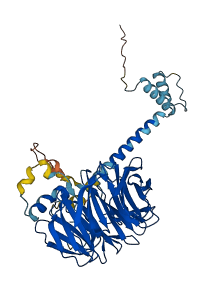
Descriptions
The autoinhibited protein was predicted that may have potential autoinhibitory elements via cis-regPred.
Autoinhibitory domains (AIDs)
Target domain |
|
Relief mechanism |
|
Assay |
cis-regPred |
Accessory elements
No accessory elements
Autoinhibited structure

Activated structure
1 structures for Q4P9P9
| Entry ID | Method | Resolution | Chain | Position | Source |
|---|---|---|---|---|---|
| AF-Q4P9P9-F1 | Predicted | AlphaFoldDB |
No variants for Q4P9P9
| Variant ID(s) | Position | Change | Description | Diseaes Association | Provenance |
|---|---|---|---|---|---|
| No variants for Q4P9P9 | |||||
No associated diseases with Q4P9P9
10 regional properties for Q4P9P9
| Type | Name | Position | InterPro Accession |
|---|---|---|---|
| repeat | WD40 repeat | 111 - 195 | IPR001680-1 |
| repeat | WD40 repeat | 196 - 452 | IPR001680-2 |
| domain | LIS1 homology motif | 19 - 51 | IPR006594 |
| conserved_site | WD40 repeat, conserved site | 179 - 193 | IPR019775-1 |
| conserved_site | WD40 repeat, conserved site | 222 - 236 | IPR019775-2 |
| conserved_site | WD40 repeat, conserved site | 264 - 278 | IPR019775-3 |
| conserved_site | WD40 repeat, conserved site | 373 - 387 | IPR019775-4 |
| repeat | G-protein beta WD-40 repeat | 222 - 236 | IPR020472-1 |
| repeat | G-protein beta WD-40 repeat | 331 - 345 | IPR020472-2 |
| repeat | G-protein beta WD-40 repeat | 373 - 387 | IPR020472-3 |
Functions
5 GO annotations of cellular component
| Name | Definition |
|---|---|
| cytoplasmic microtubule | Any microtubule in the cytoplasm of a cell. |
| kinetochore | A multisubunit complex that is located at the centromeric region of DNA and provides an attachment point for the spindle microtubules. |
| microtubule associated complex | Any multimeric complex connected to a microtubule. |
| nuclear envelope | The double lipid bilayer enclosing the nucleus and separating its contents from the rest of the cytoplasm; includes the intermembrane space, a gap of width 20-40 nm (also called the perinuclear space). |
| spindle pole | Either of the ends of a spindle, where spindle microtubules are organized; usually contains a microtubule organizing center and accessory molecules, spindle microtubules and astral microtubules. |
2 GO annotations of molecular function
| Name | Definition |
|---|---|
| dynein complex binding | Binding to a dynein complex, a protein complex that contains two or three dynein heavy chains and several light chains, and has microtubule motor activity. |
| microtubule plus-end binding | Binding to the plus end of a microtubule. |
6 GO annotations of biological process
| Name | Definition |
|---|---|
| cell division | The process resulting in division and partitioning of components of a cell to form more cells; may or may not be accompanied by the physical separation of a cell into distinct, individually membrane-bounded daughter cells. |
| establishment of mitotic spindle orientation | A cell cycle process that sets the alignment of mitotic spindle relative to other cellular structures. |
| microtubule organizing center organization | A process that is carried out at the cellular level which results in the assembly, arrangement of constituent parts, or disassembly of a microtubule organizing center, a structure from which microtubules grow. |
| microtubule sliding | The movement of one microtubule along another microtubule. |
| nuclear migration | The directed movement of the nucleus to a specific location within a cell. |
| vesicle transport along microtubule | The directed movement of a vesicle along a microtubule, mediated by motor proteins. This process begins with the attachment of a vesicle to a microtubule, and ends when the vesicle reaches its final destination. |
No homologous proteins in AiPD
| UniProt AC | Gene Name | Protein Name | Species | Evidence Code |
|---|---|---|---|---|
| No homologous proteins | ||||
| 10 | 20 | 30 | 40 | 50 | 60 |
| MSGFNGTSTS | SNSILSERQK | DELHKSILDY | FKTNNLHESF | ATLMREANQE | GFVPDPRAKY |
| 70 | 80 | 90 | 100 | 110 | 120 |
| AGLLEKKWTS | VIRLQKKIME | MESRISQLQE | ELSAAPSAKR | SASLNDWLPA | ASSARHTMQG |
| 130 | 140 | 150 | 160 | 170 | 180 |
| HRLPVTKVSF | HPVFSQIASA | SEDTTVKLWD | WETGDFERTL | KGHTKAVQDV | DFDSKGNYVL |
| 190 | 200 | 210 | 220 | 230 | 240 |
| SCSSDLSIKV | WDANNDYKNI | KTLQGHDHSV | SSVRFLPGDD | YIVSASRDKT | IKIWEFSTGF |
| 250 | 260 | 270 | 280 | 290 | 300 |
| CTKTLQGHAE | WVRSAIPSDD | AKWLVSCSTD | QTARVWDVSS | GETKVELRGH | EHVVEVAIFA |
| 310 | 320 | 330 | 340 | 350 | 360 |
| PVASYAAIRQ | LASLDPNASK | DASASMAGQF | VATGSRDKTI | RIWDSISGQC | LKTLTGHDNW |
| 370 | 380 | 390 | 400 | 410 | 420 |
| VRGLAFSPNG | KSLLSVSDDK | TMRLWDLQSG | RCTRTIEAHQ | HFATGIAWGK | AKIEAPIPPA |
| 430 | 440 | 450 | |||
| QDGEEAGRKQ | PEARTVNVVA | TSSVDLTIKI | WTP |