Q4KHH0
Gene name |
dxr |
Protein name |
1-deoxy-D-xylulose 5-phosphate reductoisomerase |
Names |
DXP reductoisomerase, 1-deoxyxylulose-5-phosphate reductoisomerase, 2-C-methyl-D-erythritol 4-phosphate synthase |
Species |
Pseudomonas fluorescens (strain ATCC BAA-477 / NRRL B-23932 / Pf-5) |
KEGG Pathway |
pfl:PFL_1182 |
EC number |
1.1.1.267: With NAD(+) or NADP(+) as acceptor |
Protein Class |
|
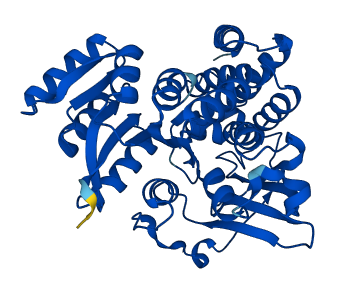
Descriptions
The autoinhibited protein was predicted that may have potential autoinhibitory elements via cis-regPred.
Autoinhibitory domains (AIDs)
Target domain |
|
Relief mechanism |
|
Assay |
cis-regPred |
Accessory elements
No accessory elements
Autoinhibited structure

Activated structure
1 structures for Q4KHH0
| Entry ID | Method | Resolution | Chain | Position | Source |
|---|---|---|---|---|---|
| AF-Q4KHH0-F1 | Predicted | AlphaFoldDB |
No variants for Q4KHH0
| Variant ID(s) | Position | Change | Description | Diseaes Association | Provenance |
|---|---|---|---|---|---|
| No variants for Q4KHH0 | |||||
No associated diseases with Q4KHH0
3 regional properties for Q4KHH0
Functions
| Description | ||
|---|---|---|
| EC Number | 1.1.1.267 | With NAD(+) or NADP(+) as acceptor |
| Subcellular Localization |
|
|
| PANTHER Family | ||
| PANTHER Subfamily | ||
| PANTHER Protein Class | ||
| PANTHER Pathway Category | No pathway information available | |
No GO annotations of cellular component
| Name | Definition |
|---|---|
| No GO annotations for cellular component |
3 GO annotations of molecular function
| Name | Definition |
|---|---|
| 1-deoxy-D-xylulose-5-phosphate reductoisomerase activity | Catalysis of the reaction: 2-C-methyl-D-erythritol 4-phosphate + NADP(+) = 1-deoxy-D-xylulose 5-phosphate + H(+) + NADPH. |
| metal ion binding | Binding to a metal ion. |
| NADPH binding | Binding to the reduced form, NADPH, of nicotinamide-adenine dinucleotide phosphate, a coenzyme involved in many redox and biosynthetic reactions. |
2 GO annotations of biological process
| Name | Definition |
|---|---|
| isopentenyl diphosphate biosynthetic process, methylerythritol 4-phosphate pathway | The chemical reactions and pathways resulting in the formation of isopentenyl diphosphate by the mevalonate-independent pathway. Isopentenyl diphosphate (IPP) is the fundamental unit in isoprenoid biosynthesis and is biosynthesized from pyruvate and glyceraldehyde 3-phosphate via intermediates, including 1-deoxy-D-xylulose 5-phosphate. |
| terpenoid biosynthetic process | The chemical reactions and pathways resulting in the formation of terpenoids, any member of a class of compounds characterized by an isoprenoid chemical structure. |
No homologous proteins in AiPD
| UniProt AC | Gene Name | Protein Name | Species | Evidence Code |
|---|---|---|---|---|
| No homologous proteins | ||||
| 10 | 20 | 30 | 40 | 50 | 60 |
| MTAVQQITVL | GATGSIGLST | LDVIARHPDR | YQVFALTGFT | RLAELLALCV | KHEPRFAVVP |
| 70 | 80 | 90 | 100 | 110 | 120 |
| EAAAASRLQQ | DLRGAGLATQ | VLVGEQGLCE | VASAPEVDAV | MAAIVGAAGL | RPTLAAVEAG |
| 130 | 140 | 150 | 160 | 170 | 180 |
| KKILLANKEA | LVMSGALFMQ | AVGKSGSVLL | PIDSEHNAIF | QCMPADFSRG | LSRVGVRRIL |
| 190 | 200 | 210 | 220 | 230 | 240 |
| LTASGGPFRQ | TPLEELEHVS | PEQACAHPNW | SMGRKISVDS | ASMMNKGLEL | IEACWLFDAR |
| 250 | 260 | 270 | 280 | 290 | 300 |
| PSQVEVVVHP | QSVIHSLVDY | VDGSVLAQLG | NPDMRTPIAN | ALAWPERIDS | GVAPLDLFAI |
| 310 | 320 | 330 | 340 | 350 | 360 |
| ARLDFQAPDE | QRFPCLRLAR | QAAEAGNSAP | AMLNAANEVA | VSAFLERRIR | YPEIASIIDE |
| 370 | 380 | 390 | |||
| VLTREPVVAV | NELDAVFAAD | ARARVLAQQW | LQRNGR |