Q4JHE3
Gene name |
|
Protein name |
L-amino-acid oxidase |
Names |
LAAO, LAO |
Species |
Oxyuranus scutellatus scutellatus (Australian taipan) (Coastal taipan) |
KEGG Pathway |
|
EC number |
1.4.3.2: With oxygen as acceptor |
Protein Class |
|
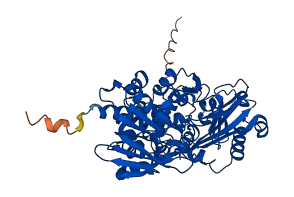
Descriptions
The autoinhibited protein was predicted that may have potential autoinhibitory elements via cis-regPred.
Autoinhibitory domains (AIDs)
Target domain |
|
Relief mechanism |
|
Assay |
cis-regPred |
Accessory elements
No accessory elements
Autoinhibited structure

Activated structure
1 structures for Q4JHE3
| Entry ID | Method | Resolution | Chain | Position | Source |
|---|---|---|---|---|---|
| AF-Q4JHE3-F1 | Predicted | AlphaFoldDB |
No variants for Q4JHE3
| Variant ID(s) | Position | Change | Description | Diseaes Association | Provenance |
|---|---|---|---|---|---|
| No variants for Q4JHE3 | |||||
No associated diseases with Q4JHE3
Functions
| Description | ||
|---|---|---|
| EC Number | 1.4.3.2 | With oxygen as acceptor |
| Subcellular Localization |
|
|
| PANTHER Family | ||
| PANTHER Subfamily | ||
| PANTHER Protein Class | ||
| PANTHER Pathway Category | No pathway information available | |
1 GO annotations of cellular component
| Name | Definition |
|---|---|
| extracellular region | The space external to the outermost structure of a cell. For cells without external protective or external encapsulating structures this refers to space outside of the plasma membrane. This term covers the host cell environment outside an intracellular parasite. |
2 GO annotations of molecular function
| Name | Definition |
|---|---|
| L-amino-acid oxidase activity | Catalysis of the reaction: a L-amino acid + H2O + O2 = a 2-oxo acid + NH3 + hydrogen peroxide. |
| toxin activity | Interacting selectively with one or more biological molecules in another (target) organism, initiating pathogenesis (leading to an abnormal, generally detrimental state) in the target organism. The activity should refer to an evolved function of the active gene product, i.e. one that was selected for. Examples include the activity of botulinum toxin, and snake venom. |
3 GO annotations of biological process
| Name | Definition |
|---|---|
| apoptotic process | A programmed cell death process which begins when a cell receives an internal (e.g. DNA damage) or external signal (e.g. an extracellular death ligand), and proceeds through a series of biochemical events (signaling pathway phase) which trigger an execution phase. The execution phase is the last step of an apoptotic process, and is typically characterized by rounding-up of the cell, retraction of pseudopodes, reduction of cellular volume (pyknosis), chromatin condensation, nuclear fragmentation (karyorrhexis), plasma membrane blebbing and fragmentation of the cell into apoptotic bodies. When the execution phase is completed, the cell has died. |
| defense response to bacterium | Reactions triggered in response to the presence of a bacterium that act to protect the cell or organism. |
| hemolysis in another organism | The cytolytic destruction of red blood cells, with the release of intracellular hemoglobin, in one organism by another. |
No homologous proteins in AiPD
| UniProt AC | Gene Name | Protein Name | Species | Evidence Code |
|---|---|---|---|---|
| No homologous proteins | ||||
| 10 | 20 | 30 | 40 | 50 | 60 |
| MNVFFMFSLL | FLAALESCAD | VRRNPLEECF | READYEEFLE | IARNGLKKTS | NPKHVVVVGA |
| 70 | 80 | 90 | 100 | 110 | 120 |
| GMAGLSAAYV | LAGAGHKVTL | LEASERVGGR | VHTYRNEKEG | WYVNLGPMRL | PERHRIIREY |
| 130 | 140 | 150 | 160 | 170 | 180 |
| IRKFGLKLNE | FFQENENAWY | FIRNIRKRVW | EVKKDPGVFK | YPVKPSEEGK | SASQLYRESL |
| 190 | 200 | 210 | 220 | 230 | 240 |
| KKVIEELKRT | NCSYILNKYD | TYSTKEYLIK | EGNLSRGAVD | MIGDLLNEDS | SYYLSFIESL |
| 250 | 260 | 270 | 280 | 290 | 300 |
| KSDDLFSYEK | RFDEIVGGFD | QLPISMYQAI | AEMVHLNAQV | IKIQHNAEKV | RVAYQTPAKT |
| 310 | 320 | 330 | 340 | 350 | 360 |
| LSYVTADYVI | VCSSSRAARR | IYFEPPLPPK | KAHALRSIHY | KSGTKIFLTC | SKKFWEADGI |
| 370 | 380 | 390 | 400 | 410 | 420 |
| HGGKSTTDLP | SRFIYYPNHN | FTSGVGVIVA | YTISDDADFF | QSLDIKTSAD | IVINDLSLIH |
| 430 | 440 | 450 | 460 | 470 | 480 |
| QLPKKEIQAL | CYPSMIKKWS | LDKYAMGSIT | SFAPYQFQDF | IERVAAPVGR | IYFAGEYTAR |
| 490 | 500 | 510 | |||
| VHGWLDSTIK | SGLTAARDVN | RASQKPSRRQ | LSNDNEL |