Q4IQM6
Gene name |
SLD5 (FGRRES_00482, FGSG_00482) |
Protein name |
DNA replication complex GINS protein SLD5 |
Names |
|
Species |
Gibberella zeae (strain ATCC MYA-4620 / CBS 123657 / FGSC 9075 / NRRL 31084 / PH-1) (Wheat head blight fungus) (Fusarium graminearum) |
KEGG Pathway |
fgr:FGSG_00482 |
EC number |
|
Protein Class |
|
Descriptions
The autoinhibited protein was predicted that may have potential autoinhibitory elements via cis-regPred.
Autoinhibitory domains (AIDs)
Target domain |
|
Relief mechanism |
|
Assay |
cis-regPred |
Accessory elements
No accessory elements
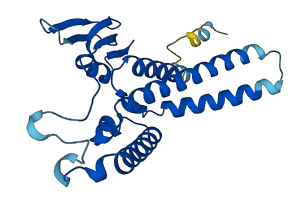
Autoinhibited structure

Activated structure
1 structures for Q4IQM6
| Entry ID | Method | Resolution | Chain | Position | Source |
|---|---|---|---|---|---|
| AF-Q4IQM6-F1 | Predicted | AlphaFoldDB |
No variants for Q4IQM6
| Variant ID(s) | Position | Change | Description | Diseaes Association | Provenance |
|---|---|---|---|---|---|
| No variants for Q4IQM6 | |||||
No associated diseases with Q4IQM6
1 GO annotations of cellular component
| Name | Definition |
|---|---|
| nucleus | A membrane-bounded organelle of eukaryotic cells in which chromosomes are housed and replicated. In most cells, the nucleus contains all of the cell's chromosomes except the organellar chromosomes, and is the site of RNA synthesis and processing. In some species, or in specialized cell types, RNA metabolism or DNA replication may be absent. |
No GO annotations of molecular function
| Name | Definition |
|---|---|
| No GO annotations for molecular function |
2 GO annotations of biological process
| Name | Definition |
|---|---|
| chromosome segregation | The process in which genetic material, in the form of chromosomes, is organized into specific structures and then physically separated and apportioned to two or more sets. In eukaryotes, chromosome segregation begins with the condensation of chromosomes, includes chromosome separation, and ends when chromosomes have completed movement to the spindle poles. |
| DNA-templated DNA replication | A DNA replication process that uses parental DNA as a template for the DNA-dependent DNA polymerases that synthesize the new strands. |
No homologous proteins in AiPD
| UniProt AC | Gene Name | Protein Name | Species | Evidence Code |
|---|---|---|---|---|
| No homologous proteins | ||||
| 10 | 20 | 30 | 40 | 50 | 60 |
| MDIDDILRQV | DPSSHGVPSE | ARDLQALTRL | WVAERSAPEL | LEWPTDGLFE | RVNARIKTQI |
| 70 | 80 | 90 | 100 | 110 | 120 |
| EKVEDMTGDM | DPKTNFALIV | IQTELERYKF | LMRSFLRARL | AKIDKHTLHY | LSSQELRDRL |
| 130 | 140 | 150 | 160 | 170 | 180 |
| SPTELSYATK | HQALLHNHYL | SSFLASFPQQ | LQNLNDTAGN | ISMIDSPDLD | TAVFIRMLRD |
| 190 | 200 | 210 | 220 | ||
| KDVYGKGTDA | DITLPATNGD | VLIIRWSSAK | HMVDVGDAEL | V |