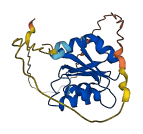
Descriptions
The autoinhibited protein was predicted that may have potential autoinhibitory elements via cis-regPred.
Autoinhibitory domains (AIDs)
Target domain |
|
Relief mechanism |
|
Assay |
cis-regPred |
Accessory elements
No accessory elements
Autoinhibited structure

Activated structure
1 structures for Q4GZK4
| Entry ID | Method | Resolution | Chain | Position | Source |
|---|---|---|---|---|---|
| AF-Q4GZK4-F1 | Predicted | AlphaFoldDB |
No variants for Q4GZK4
| Variant ID(s) | Position | Change | Description | Diseaes Association | Provenance |
|---|---|---|---|---|---|
| No variants for Q4GZK4 | |||||
No associated diseases with Q4GZK4
5 regional properties for Q4GZK4
| Type | Name | Position | InterPro Accession |
|---|---|---|---|
| domain | AAA+ ATPase domain | 168 - 307 | IPR003593 |
| domain | ATPase, AAA-type, core | 172 - 304 | IPR003959 |
| conserved_site | ATPase, AAA-type, conserved site | 275 - 293 | IPR003960 |
| domain | Proteasomal ATPase OB C-terminal domain | 59 - 114 | IPR032501 |
| domain | AAA ATPase, AAA+ lid domain | 328 - 370 | IPR041569 |
No GO annotations of cellular component
| Name | Definition |
|---|---|
| No GO annotations for cellular component |
No GO annotations of molecular function
| Name | Definition |
|---|---|
| No GO annotations for molecular function |
3 GO annotations of biological process
| Name | Definition |
|---|---|
| cytokinin-activated signaling pathway | The series of molecular signals generated by the binding of a cytokinin to a receptor, and ending with the regulation of a downstream cellular process, e.g. transcription. |
| phosphorelay signal transduction system | A conserved series of molecular signals found in prokaryotes and eukaryotes; involves autophosphorylation of a histidine kinase and the transfer of the phosphate group to an aspartate that then acts as a phospho-donor to response regulator proteins. |
| response to cytokinin | Any process that results in a change in state or activity of a cell or an organism (in terms of movement, secretion, enzyme production, gene expression, etc.) as a result of a cytokinin stimulus. |
No homologous proteins in AiPD
| UniProt AC | Gene Name | Protein Name | Species | Evidence Code |
|---|---|---|---|---|
| No homologous proteins | ||||
| 10 | 20 | 30 | 40 | 50 | 60 |
| MRVPAAVTGG | CGCGVDGGGG | CCRGGGKLAD | WEEGKDDEMK | SVVVKGWTRM | AQVVPLHDNA |
| 70 | 80 | 90 | 100 | 110 | 120 |
| SAEDDDDDEE | DDDEDDDDDD | DEDDEEEAAP | PYVMAVDDSS | VDRAVITALL | RRSKYRDSGK |
| 130 | 140 | 150 | 160 | 170 | 180 |
| RALEILGSEP | NVSMIITDYW | MPEMTGYDLL | KKIKESSELK | QIPVVIMSSE | NVPTRISRCL |
| 190 | 200 | ||||
| EEGAEDFLLK | PVRPADISRI | TSRMLQ |