Q4F883
Gene name |
SAG101 (At5g14930, F2G14.50) |
Protein name |
Senescence-associated carboxylesterase 101 |
Names |
|
Species |
Arabidopsis thaliana (Mouse-ear cress) |
KEGG Pathway |
ath:AT5G14930 |
EC number |
3.1.1.1: Carboxylic ester hydrolases |
Protein Class |
|
Descriptions
The autoinhibited protein was predicted that may have potential autoinhibitory elements via cis-regPred.
Autoinhibitory domains (AIDs)
Target domain |
|
Relief mechanism |
|
Assay |
cis-regPred |
Accessory elements
No accessory elements
Autoinhibited structure

Activated structure
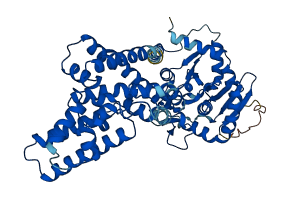
3 structures for Q4F883
| Entry ID | Method | Resolution | Chain | Position | Source |
|---|---|---|---|---|---|
| 4NFU | X-ray | 221 A | B | 2-537 | PDB |
| 7XJP | EM | 271 A | B | 1-537 | PDB |
| AF-Q4F883-F1 | Predicted | AlphaFoldDB |
52 variants for Q4F883
| Variant ID(s) | Position | Change | Description | Diseaes Association | Provenance |
|---|---|---|---|---|---|
| ENSVATH06968600 | 39 | N>Y | No | 1000Genomes | |
| ENSVATH00622476 | 40 | H>Q | No | 1000Genomes | |
| ENSVATH06968601 | 42 | P>L | No | 1000Genomes | |
| ENSVATH06968602 | 50 | K>R | No | 1000Genomes | |
| tmp_5_4829065_G_A | 54 | G>S | No | 1000Genomes | |
| tmp_5_4829066_G_T | 54 | G>V | No | 1000Genomes | |
| ENSVATH08411726 | 61 | R>P | No | 1000Genomes | |
| ENSVATH08411726 | 61 | R>Q | No | 1000Genomes | |
| tmp_5_4829142_T_A | 79 | S>R | No | 1000Genomes | |
| tmp_5_4829153_C_T | 83 | S>F | No | 1000Genomes | |
| ENSVATH14032240 | 98 | L>F | No | 1000Genomes | |
| ENSVATH06968605 | 113 | F>L | No | 1000Genomes | |
| ENSVATH00622477 | 126 | L>P | No | 1000Genomes | |
| ENSVATH00622480 | 132 | Q>H | No | 1000Genomes | |
| tmp_5_4829567_A_G | 138 | K>E | No | 1000Genomes | |
| tmp_5_4829570_C_T | 139 | P>S | No | 1000Genomes | |
| ENSVATH06968610 | 166 | T>M | No | 1000Genomes | |
| ENSVATH06968611 | 169 | R>C | No | 1000Genomes | |
| tmp_5_4829661_G_A | 169 | R>H | No | 1000Genomes | |
| tmp_5_4829692_G_T | 179 | L>F | No | 1000Genomes | |
| ENSVATH06968612 | 181 | G>A | No | 1000Genomes | |
| tmp_5_4829762_T_C | 203 | S>P | No | 1000Genomes | |
| ENSVATH06968613 | 208 | I>T | No | 1000Genomes | |
| tmp_5_4829810_T_A | 219 | F>I | No | 1000Genomes | |
| tmp_5_4829832_G_A | 226 | G>E | No | 1000Genomes | |
| ENSVATH06968614 | 243 | V>I | No | 1000Genomes | |
| tmp_5_4829952_C_T | 266 | A>V | No | 1000Genomes | |
| ENSVATH14032241 | 269 | R>T | No | 1000Genomes | |
| tmp_5_4829975_G_A | 274 | D>N | No | 1000Genomes | |
| ENSVATH14032242 | 278 | G>* | No | 1000Genomes | |
| ENSVATH06968615 | 279 | I>M | No | 1000Genomes | |
| tmp_5_4830003_C_T | 283 | A>V | No | 1000Genomes | |
| ENSVATH00622485 | 313 | K>T | No | 1000Genomes | |
| tmp_5_4830113_G_T | 320 | G>C | No | 1000Genomes | |
| tmp_5_4830144_C_T | 330 | A>V | No | 1000Genomes | |
| ENSVATH03057298 | 346 | S>A | No | 1000Genomes | |
| tmp_5_4830321_A_G | 389 | D>G | No | 1000Genomes | |
| ENSVATH03057299 | 397 | G>R | No | 1000Genomes | |
| ENSVATH03057300 | 404 | T>R | No | 1000Genomes | |
| ENSVATH14032243 | 405 | G>V | No | 1000Genomes | |
| ENSVATH00622487 | 407 | S>P | No | 1000Genomes | |
| ENSVATH00622488 | 411 | V>I | No | 1000Genomes | |
| ENSVATH06968621 | 426 | K>T | No | 1000Genomes | |
| tmp_5_4830443_A_G | 430 | K>E | No | 1000Genomes | |
| tmp_5_4830473_T_A | 440 | F>I | No | 1000Genomes | |
| ENSVATH06968622 | 455 | I>M | No | 1000Genomes | |
| ENSVATH03057301 | 483 | V>M | No | 1000Genomes | |
| tmp_5_4830695_A_G | 514 | K>E | No | 1000Genomes | |
| tmp_5_4830702_T_A | 516 | F>Y | No | 1000Genomes | |
| ENSVATH03057302 | 519 | S>L | No | 1000Genomes | |
| tmp_5_4830735_C_A | 527 | T>N | No | 1000Genomes | |
| ENSVATH06968624 | 533 | Y>N | No | 1000Genomes |
No associated diseases with Q4F883
Functions
| Description | ||
|---|---|---|
| EC Number | 3.1.1.1 | Carboxylic ester hydrolases |
| Subcellular Localization |
|
|
| PANTHER Family | ||
| PANTHER Subfamily | ||
| PANTHER Protein Class | ||
| PANTHER Pathway Category | No pathway information available | |
4 GO annotations of cellular component
| Name | Definition |
|---|---|
| cytoplasm | The contents of a cell excluding the plasma membrane and nucleus, but including other subcellular structures. |
| EDS1 disease-resistance complex | A plant complex involved in basal disease resistance and resistance (R) gene-mediated effector triggered immunity (ETI). Regulates accumulation of the hormone salicylic acid (SA) which is a necessary component of systemic immunity. Involved in responds to bacteria, viruses and oomycetes. |
| integral component of membrane | The component of a membrane consisting of the gene products and protein complexes having at least some part of their peptide sequence embedded in the hydrophobic region of the membrane. |
| nucleus | A membrane-bounded organelle of eukaryotic cells in which chromosomes are housed and replicated. In most cells, the nucleus contains all of the cell's chromosomes except the organellar chromosomes, and is the site of RNA synthesis and processing. In some species, or in specialized cell types, RNA metabolism or DNA replication may be absent. |
2 GO annotations of molecular function
| Name | Definition |
|---|---|
| carboxylic ester hydrolase activity | Catalysis of the hydrolysis of a carboxylic ester bond. |
| methyl indole-3-acetate esterase activity | Catalysis of the reaction: methyl indole-3-acetate + H2O = indole-3-acetate + methanol + H+. |
10 GO annotations of biological process
| Name | Definition |
|---|---|
| aging | A developmental process that is a deterioration and loss of function over time. Aging includes loss of functions such as resistance to disease, homeostasis, and fertility, as well as wear and tear. Aging includes cellular senescence, but is more inclusive. May precede death and may succeed developmental maturation (GO:0021700). |
| defense response to Gram-negative bacterium | Reactions triggered in response to the presence of a Gram-negative bacterium that act to protect the cell or organism. |
| leaf abscission | The controlled shedding of a leaf. |
| lipid catabolic process | The chemical reactions and pathways resulting in the breakdown of lipids, compounds soluble in an organic solvent but not, or sparingly, in an aqueous solvent. |
| plant-type hypersensitive response | The rapid, localized death of plant cells in response to invasion by a pathogen. |
| positive regulation of defense response to bacterium | Any process that activates or increases the frequency, rate or extent of defense response to bacterium. |
| positive regulation of defense response to oomycetes | Any process that activates or increases the frequency, rate or extent of defense response to oomycetes. |
| positive regulation of defense response to virus by host | Any host process that results in the promotion of antiviral immune response mechanisms, thereby limiting viral replication. |
| positive regulation of leaf senescence | Any process that activates or increases the frequency, rate or extent of leaf senescence. |
| systemic acquired resistance, salicylic acid mediated signaling pathway | The series of molecular signals mediated by salicylic acid involved in systemic acquired resistance. |
No homologous proteins in AiPD
| UniProt AC | Gene Name | Protein Name | Species | Evidence Code |
|---|---|---|---|---|
| No homologous proteins | ||||
| 10 | 20 | 30 | 40 | 50 | 60 |
| MESSSSLKGS | ALGKLVVTSG | LLHSSWSKIL | EIHNPPYSNH | DPGLQVSKKK | KDSGLEFQIH |
| 70 | 80 | 90 | 100 | 110 | 120 |
| REEKFTLVVF | SAPPICRSSS | SDSTLLHVKD | KENPFPFLCS | ENNPSFSLHT | PAFNLFTSAS |
| 130 | 140 | 150 | 160 | 170 | 180 |
| TSLTYLKSEL | LQTLKSEKPV | IITGAALGGS | VASLYTLWLL | ETIEPTLKRP | LCITFGSPLI |
| 190 | 200 | 210 | 220 | 230 | 240 |
| GDASLQQILE | NSVRNSCFLH | VVSAQTRIKM | DFFKPFGTFL | ICFDSGCVCI | EDHVAVTELL |
| 250 | 260 | 270 | 280 | 290 | 300 |
| NGVHDSGLVD | YSQVLNRLDQ | SMLSLADSRL | IPEDVIKGIE | KRAEMKNLRF | DMMFKKLNDM |
| 310 | 320 | 330 | 340 | 350 | 360 |
| KISMAYIEWY | KKKCKEVKIG | YYDRFKTQLA | FPSKEFDINI | KNHHKSELNR | FWKSVVEEVE |
| 370 | 380 | 390 | 400 | 410 | 420 |
| RRPQSDASIL | KRRFLFSGNN | YRRMIEPLDI | AEYYLEGRKE | YRTTGRSHHY | VMLEKWFGME |
| 430 | 440 | 450 | 460 | 470 | 480 |
| SILIEKERCK | KRDLSDLLTF | DSCFWAEVED | SLIVINQLNT | TVGMRDDVRE | VLTRKLVEFE |
| 490 | 500 | 510 | 520 | 530 | |
| GYVWEIITKR | EVSPEIFLEE | SSFMKWWKEY | KKIKGFNSSY | LTEFMNTRKY | ESYGKSQ |