Q4A172
Gene name |
serS |
Protein name |
Serine--tRNA ligase |
Names |
Seryl-tRNA synthetase, SerRS, Seryl-tRNA(Ser/Sec) synthetase |
Species |
Staphylococcus saprophyticus subsp. saprophyticus (strain ATCC 15305 / DSM 20229 / NCIMB 8711 / NCTC 7292 / S-41) |
KEGG Pathway |
ssp:SSP0009 |
EC number |
6.1.1.11: Ligases forming aminoacyl-tRNA and related compounds |
Protein Class |
|
Descriptions
The autoinhibited protein was predicted that may have potential autoinhibitory elements via cis-regPred.
Autoinhibitory domains (AIDs)
Target domain |
|
Relief mechanism |
|
Assay |
cis-regPred |
Accessory elements
No accessory elements
Autoinhibited structure

Activated structure
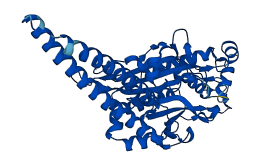
1 structures for Q4A172
| Entry ID | Method | Resolution | Chain | Position | Source |
|---|---|---|---|---|---|
| AF-Q4A172-F1 | Predicted | AlphaFoldDB |
No variants for Q4A172
| Variant ID(s) | Position | Change | Description | Diseaes Association | Provenance |
|---|---|---|---|---|---|
| No variants for Q4A172 | |||||
2 associated diseases with Q4A172
[MIM: 612938]: Growth retardation, developmental delay, and facial dysmorphism (GDFD)
A severe polymalformation syndrome characterized by postnatal growth retardation, microcephaly, severe psychomotor delay, functional brain deficits and characteristic facial dysmorphism. In some patients, structural brain malformations, cardiac defects, genital anomalies, and cleft palate are observed. Early death occurs by the age of 3 years. {ECO:0000269|PubMed:19559399, ECO:0000269|PubMed:22002720, ECO:0000269|PubMed:26378117, ECO:0000269|PubMed:26697951}. Note=The disease is caused by variants affecting the gene represented in this entry.
[MIM: 601665]: Obesity (OBESITY)
A condition characterized by an increase of body weight beyond the limitation of skeletal and physical requirements, as the result of excessive accumulation of body fat. {ECO:0000269|PubMed:24646999, ECO:0000269|PubMed:26287746}. Note=Disease susceptibility is associated with variants affecting the gene represented in this entry. It is unclear whether variations associated with obesity directly affect FTO function or alter the expression of adjacent genes such as IRX3, rather than FTO itself (PubMed:24646999, PubMed:26287746). A pathogenic intronic FTO variation (rs1421085) disrupts an evolutionarily conserved motif for ARID5B binding (PubMed:26287746). Loss of ARID5B binding results in overexpression of two genes distal to FTO, IRX3 and IRX5. IRX3 and IRX5 overexpression shifts pre-adipocytes differentiation from brown to white fat cells, resulting in increased lipid storage and loss of mitochondrial thermogenesis (PubMed:26287746). {ECO:0000269|PubMed:24646999, ECO:0000269|PubMed:26287746}.
Without disease ID
- A severe polymalformation syndrome characterized by postnatal growth retardation, microcephaly, severe psychomotor delay, functional brain deficits and characteristic facial dysmorphism. In some patients, structural brain malformations, cardiac defects, genital anomalies, and cleft palate are observed. Early death occurs by the age of 3 years. {ECO:0000269|PubMed:19559399, ECO:0000269|PubMed:22002720, ECO:0000269|PubMed:26378117, ECO:0000269|PubMed:26697951}. Note=The disease is caused by variants affecting the gene represented in this entry.
- A condition characterized by an increase of body weight beyond the limitation of skeletal and physical requirements, as the result of excessive accumulation of body fat. {ECO:0000269|PubMed:24646999, ECO:0000269|PubMed:26287746}. Note=Disease susceptibility is associated with variants affecting the gene represented in this entry. It is unclear whether variations associated with obesity directly affect FTO function or alter the expression of adjacent genes such as IRX3, rather than FTO itself (PubMed:24646999, PubMed:26287746). A pathogenic intronic FTO variation (rs1421085) disrupts an evolutionarily conserved motif for ARID5B binding (PubMed:26287746). Loss of ARID5B binding results in overexpression of two genes distal to FTO, IRX3 and IRX5. IRX3 and IRX5 overexpression shifts pre-adipocytes differentiation from brown to white fat cells, resulting in increased lipid storage and loss of mitochondrial thermogenesis (PubMed:26287746). {ECO:0000269|PubMed:24646999, ECO:0000269|PubMed:26287746}.
Functions
| Description | ||
|---|---|---|
| EC Number | 6.1.1.11 | Ligases forming aminoacyl-tRNA and related compounds |
| Subcellular Localization |
|
|
| PANTHER Family | ||
| PANTHER Subfamily | ||
| PANTHER Protein Class | ||
| PANTHER Pathway Category | No pathway information available | |
1 GO annotations of cellular component
| Name | Definition |
|---|---|
| cytoplasm | The contents of a cell excluding the plasma membrane and nucleus, but including other subcellular structures. |
2 GO annotations of molecular function
| Name | Definition |
|---|---|
| ATP binding | Binding to ATP, adenosine 5'-triphosphate, a universally important coenzyme and enzyme regulator. |
| serine-tRNA ligase activity | Catalysis of the reaction: ATP + L-serine + tRNA(Ser) = AMP + diphosphate + L-seryl-tRNA(Ser). |
3 GO annotations of biological process
| Name | Definition |
|---|---|
| selenocysteine biosynthetic process | The chemical reactions and pathways resulting in the formation of selenocysteine, an essential component of glutathione peroxidase and some other proteins. |
| selenocysteinyl-tRNA(Sec) biosynthetic process | The chemical reactions and pathways resulting in the formation of selenocysteinyl-tRNA(Sec). This process occurs through the following steps: a unique serine-tRNA with a UGA recognizing anticodon is first aminoacylated with serine; this is then phosphorylated by phosphoseryl-tRNA |
| seryl-tRNA aminoacylation | The process of coupling serine to seryl-tRNA, catalyzed by seryl-tRNA synthetase. The seryl-tRNA synthetase is a class-II synthetase. The activated amino acid is transferred to the 3'-OH group of a serine-accetping tRNA. |
No homologous proteins in AiPD
| UniProt AC | Gene Name | Protein Name | Species | Evidence Code |
|---|---|---|---|---|
| No homologous proteins | ||||
| 10 | 20 | 30 | 40 | 50 | 60 |
| MLDIKLFRND | PEFLKEKVAK | RGMDSKVVDE | VLELDEQRRQ | LISQAEEMKA | ERNKVSGEIA |
| 70 | 80 | 90 | 100 | 110 | 120 |
| QKKRNKEDAD | DAIAAMRNLG | DEIKVLDDTL | NQVDVDLNDK | LSRIPNIIHD | DVPEGATDED |
| 130 | 140 | 150 | 160 | 170 | 180 |
| NIEVKRWGTP | RTFEFEDKAH | WDLVEELEMV | DFERAAKVSG | ARFVFLTGDG | AQLERALMNY |
| 190 | 200 | 210 | 220 | 230 | 240 |
| MITKHTTQHG | YTEMMVPQLV | NADSMYGTGQ | LPKFEEDLFK | VEKEGLYTIP | TAEVPLTNYY |
| 250 | 260 | 270 | 280 | 290 | 300 |
| RNEIIAPDVL | PAKFTAQSAC | YRSEAGSAGR | DTRGLIRLHQ | FDKVEMVRIE | KPEDSWQALE |
| 310 | 320 | 330 | 340 | 350 | 360 |
| DMTHHAEAIL | EELGLPYRRV | ILCTGDIGFG | SSKTYDLEVW | LPSYNDYKEI | SSCSNITDFQ |
| 370 | 380 | 390 | 400 | 410 | 420 |
| ARRSNIRFKR | DKNAKPELAH | TLNGSGLAVG | RTFAAIVENY | QNEDGSVTIP | EVLVPFMGGK |
| TVIRPTK |