Q49Z29
Gene name |
cshA |
Protein name |
DEAD-box ATP-dependent RNA helicase CshA |
Names |
|
Species |
Staphylococcus saprophyticus subsp. saprophyticus (strain ATCC 15305 / DSM 20229 / NCIMB 8711 / NCTC 7292 / S-41) |
KEGG Pathway |
ssp:SSP0802 |
EC number |
3.6.4.13: Acting on ATP; involved in cellular and subcellular movement |
Protein Class |
|
Descriptions
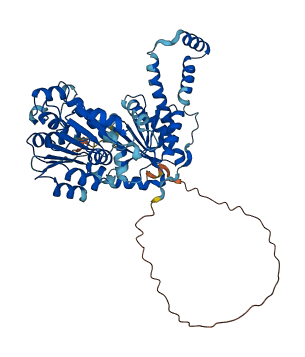
The autoinhibited protein was predicted that may have potential autoinhibitory elements via cis-regPred.
Autoinhibitory domains (AIDs)
Target domain |
|
Relief mechanism |
|
Assay |
cis-regPred |
Accessory elements
No accessory elements
Autoinhibited structure

Activated structure
1 structures for Q49Z29
| Entry ID | Method | Resolution | Chain | Position | Source |
|---|---|---|---|---|---|
| AF-Q49Z29-F1 | Predicted | AlphaFoldDB |
No variants for Q49Z29
| Variant ID(s) | Position | Change | Description | Diseaes Association | Provenance |
|---|---|---|---|---|---|
| No variants for Q49Z29 | |||||
No associated diseases with Q49Z29
Functions
| Description | ||
|---|---|---|
| EC Number | 3.6.4.13 | Acting on ATP; involved in cellular and subcellular movement |
| Subcellular Localization |
|
|
| PANTHER Family | ||
| PANTHER Subfamily | ||
| PANTHER Protein Class | ||
| PANTHER Pathway Category | No pathway information available | |
1 GO annotations of cellular component
| Name | Definition |
|---|---|
| cytoplasm | The contents of a cell excluding the plasma membrane and nucleus, but including other subcellular structures. |
4 GO annotations of molecular function
| Name | Definition |
|---|---|
| ATP binding | Binding to ATP, adenosine 5'-triphosphate, a universally important coenzyme and enzyme regulator. |
| ATP hydrolysis activity | Catalysis of the reaction: ATP + H2O = ADP + H+ phosphate. ATP hydrolysis is used in some reactions as an energy source, for example to catalyze a reaction or drive transport against a concentration gradient. |
| RNA binding | Binding to an RNA molecule or a portion thereof. |
| RNA helicase activity | Unwinding of an RNA helix, driven by ATP hydrolysis. |
2 GO annotations of biological process
| Name | Definition |
|---|---|
| RNA catabolic process | The chemical reactions and pathways resulting in the breakdown of RNA, ribonucleic acid, one of the two main type of nucleic acid, consisting of a long, unbranched macromolecule formed from ribonucleotides joined in 3',5'-phosphodiester linkage. |
| RNA secondary structure unwinding | The process in which a secondary structure of RNA are broken or 'melted'. |
No homologous proteins in AiPD
| UniProt AC | Gene Name | Protein Name | Species | Evidence Code |
|---|---|---|---|---|
| No homologous proteins | ||||
| 10 | 20 | 30 | 40 | 50 | 60 |
| MQNFKELGIS | DKMAETLQSM | GFNEATPIQK | ESIPLALEGK | DVLGQAQTGT | GKTGAFGIPL |
| 70 | 80 | 90 | 100 | 110 | 120 |
| IEKVADQEGV | QSLILAPTRE | LAMQVAESLK | AFAKGQNIQV | VTVFGGMPID | RQIKALKKGP |
| 130 | 140 | 150 | 160 | 170 | 180 |
| QIVVGTPGRV | IDHLNRRTLK | TNDIHTLILD | EADEMMNMGF | IDDMKFIMDK | IPAEQRQTML |
| 190 | 200 | 210 | 220 | 230 | 240 |
| FSATMPKAIQ | TLVQQFMKSP | VIVKTMNNEM | SDPQIEEYYT | IVKELEKFDT | FTSFLDVHQP |
| 250 | 260 | 270 | 280 | 290 | 300 |
| ELAIVFGRTK | RRVDELTSAL | ISKGYKAEGL | HGDITQAKRL | EVLKKFKNDQ | LDILVATDVA |
| 310 | 320 | 330 | 340 | 350 | 360 |
| ARGLDISGVS | HVYNFDIPQD | TESYTHRIGR | TGRAGKKGVA | ITFVNPIEMD | YIRQIEQANK |
| 370 | 380 | 390 | 400 | 410 | 420 |
| RQMTALRPPH | RKEVLKAREN | DIKGKVQNWM | SRDNEPRLQR | IATELLGEYN | DVDLIASLLQ |
| 430 | 440 | 450 | 460 | 470 | 480 |
| ELVESNDEVD | VQLTFEKPLS | RGKGRQGKGG | PKRGGNHKRG | GGKFDNKNRR | SGKGGFNNKK |
| 490 | 500 | ||||
| KNDRPSSDRN | NNKKSMKGRT | FADHKK |